


How Much Does It Cost to Develop a Flutter App in 2026?




Flutter app development costs can vary significantly depending on the application’s functionality, technical requirements, design expectations, and long-term product plans. Most businesses evaluating Flutter are less concerned with a fixed number and more focused on understanding how predictable the investment will be over time.
Clear planning around features, integrations, infrastructure, and ongoing support usually provides a more accurate cost picture. Establishing these factors early helps reduce unexpected expenses and supports better budgeting decisions before development begins.
Why Flutter Is Dominating Modern App Development
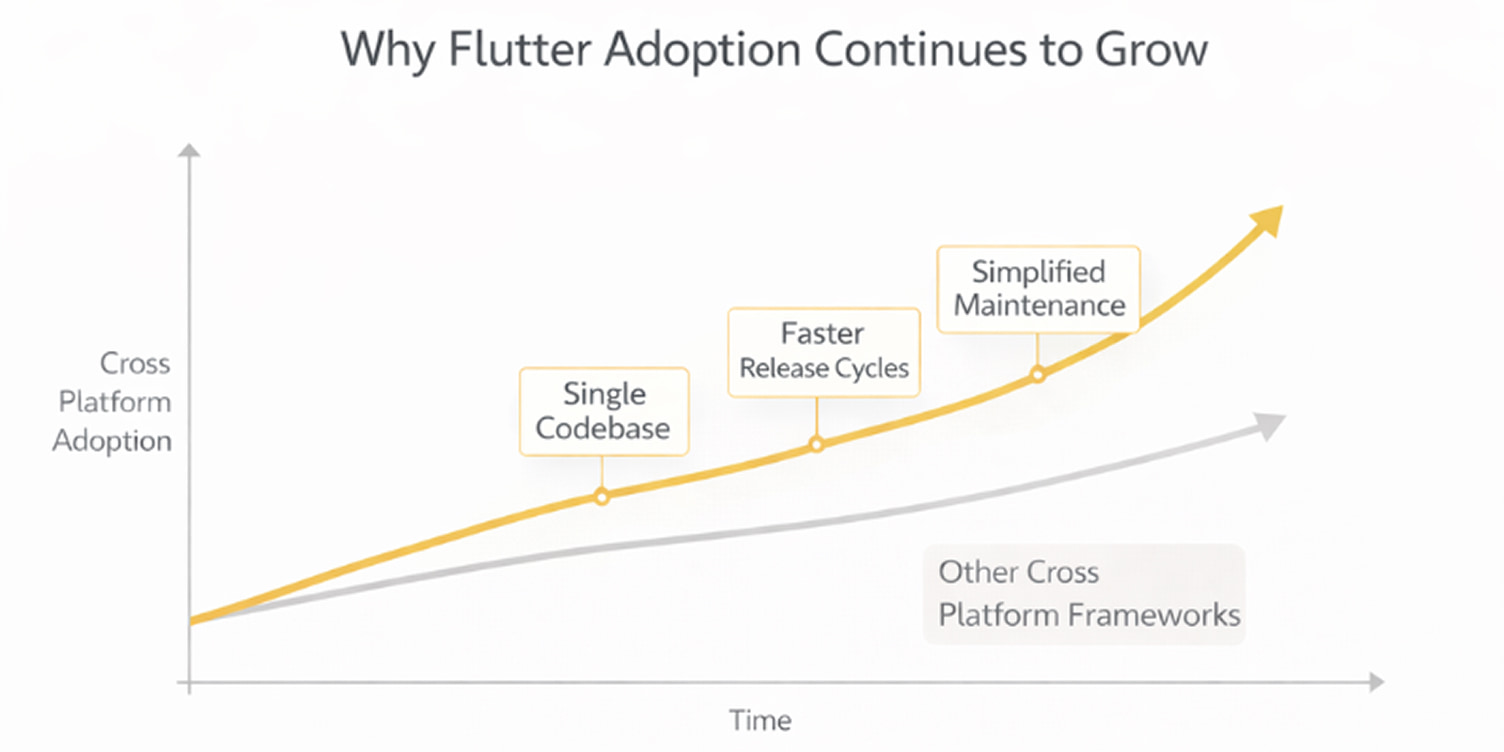
Flutter entered the cross-platform ecosystem later than some established frameworks. Despite that, adoption has increased steadily over the past few years. A report by Statista shows Flutter consistently ranking among the most widely used cross-platform mobile frameworks worldwide, signaling growing industry confidence in its tooling and long-term viability.
This growth is largely tied to practical development efficiencies. A single codebase reduces the need to maintain parallel iOS and Android builds, while consistent performance across platforms simplifies release management.
From a budgeting standpoint, that structure often translates into less duplicated engineering effort and more controlled update cycles. Teams spend fewer resources coordinating separate deployments, which helps maintain financial predictability.
Flutter does not remove development costs. What it frequently improves is how those costs are distributed and managed over time, particularly when applications continue evolving after launch.
Flutter App Development Cost Overview
The average cost of developing a Flutter app globally is between $20,000 and $200,000+. Broader mobile application pricing trends often influence these estimates, particularly when comparing cross-platform and native approaches.
For example, enterprise applications that have many integrated features will generally be at the higher end of the price scale, while apps that have a limited number of features will generally be at the lower end of the price scale.
Costs can be roughly categorized by project complexity to help clarify these expectations.
Estimated Flutter app development cost by complexity level
These figures are broad global benchmarks intended for early planning, not fixed project quotes. Actual budgets depend on clearly defined requirements, design expectations, infrastructure needs, and long-term product goals.
Flutter App Development Cost by Application Type
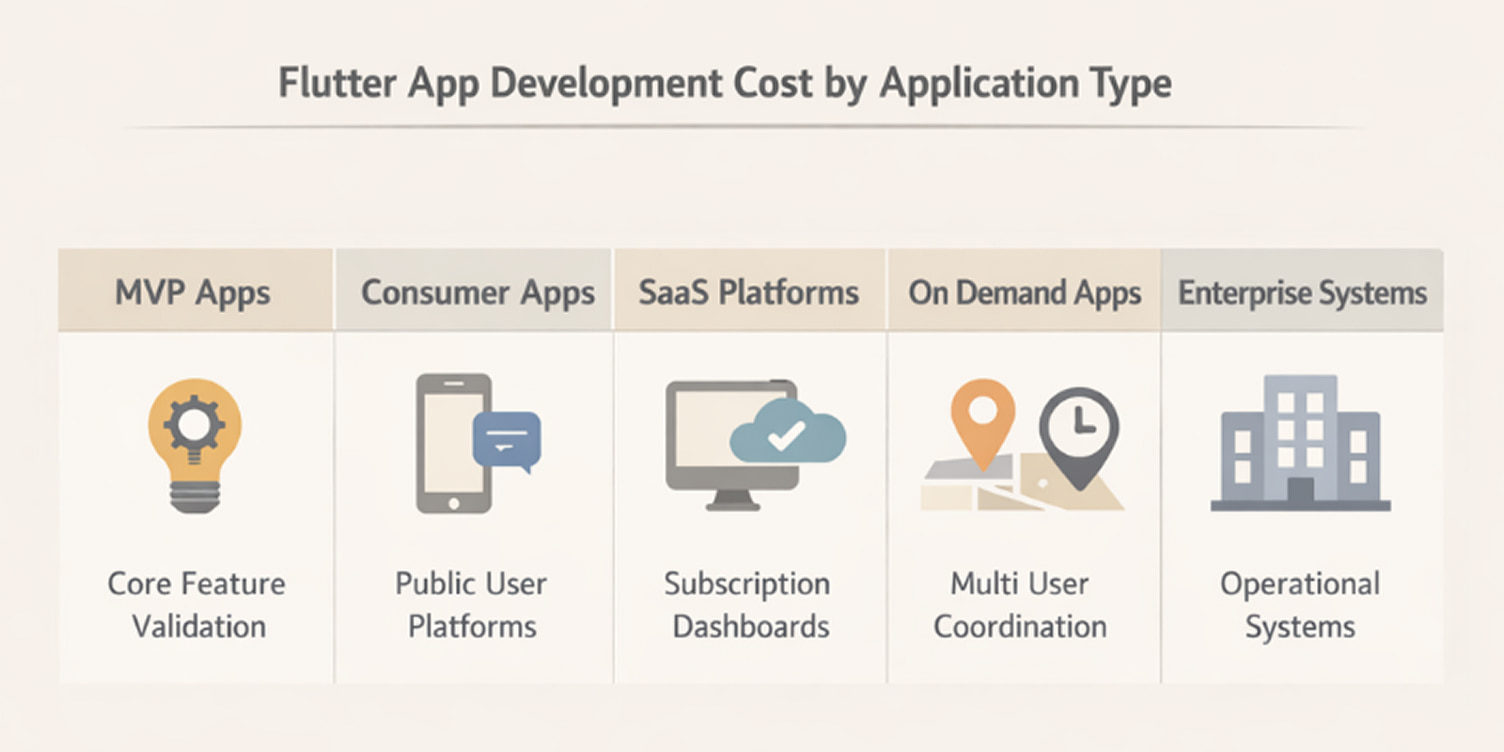
While complexity is one area of consideration for estimating costs, the functional type of application that you are developing may also provide a more practical guideline for budgeting purposes.
Each specific application category is subject to its own individual baseline functioning, expected infrastructure, and scope requirements.
By evaluating the associated costs from this perspective, it allows for the alignment of the product vision with the reality of the financial plan by the decision-makers.
Estimated Cost by App Category
These figures serve as general planning benchmarks. The actual investment depends on feature depth, architectural decisions, and long-term scalability objectives.
MVP Applications
Flutter is often used for MVP builds because a single codebase allows faster initial releases across platforms. These apps typically focus on core workflows, basic authentication, and limited integrations to validate product ideas quickly.
Costs vary depending on whether the MVP is purely experimental or built with future expansion in mind. Backend readiness, data structure planning, and early integration decisions usually influence investment more than interface design at this stage.
Consumer (B2C) Applications
Consumer-facing Flutter apps emphasize usability, performance consistency, and engagement features such as payments, notifications, and analytics. The framework helps maintain a uniform experience across devices while reducing duplicated development effort.
Budget impact generally comes from UI refinement, infrastructure readiness for user growth, and ongoing performance optimization. As adoption increases, backend capacity, security measures, and monitoring requirements often drive additional costs.
SaaS Platforms
Flutter works well for SaaS products that require dashboards, subscription workflows, and multi-role access. These platforms rely heavily on backend architecture, data handling, and integration with third-party services.
Investment levels typically depend on reporting complexity, data security expectations, and integration depth. Early architectural planning tends to influence long-term operational cost more than the initial interface build.
On-Demand Platforms
On-demand Flutter apps usually connect multiple user groups and coordinate services, transactions, or logistics. Features often include tracking systems, booking flows, and operational dashboards.
A food delivery platform is a common example of this pattern, where the customer, vendor, and delivery partner interfaces all need to stay in sync in real time.
Costs rise mainly due to infrastructure coordination, backend stability requirements, and integration complexity rather than the mobile interface itself. Reliable system performance becomes a major budget consideration.
Enterprise Applications
Enterprise Flutter applications often support internal operations, workflow automation, or system integration across departments. These projects usually involve compliance considerations, custom workflows, and deeper infrastructure planning.
Higher investment typically reflects security requirements, integration complexity, and long-term maintenance planning. The scale of organizational use often determines both initial development cost and ongoing operational expense.
Key Factors That Influence Flutter App Development Cost
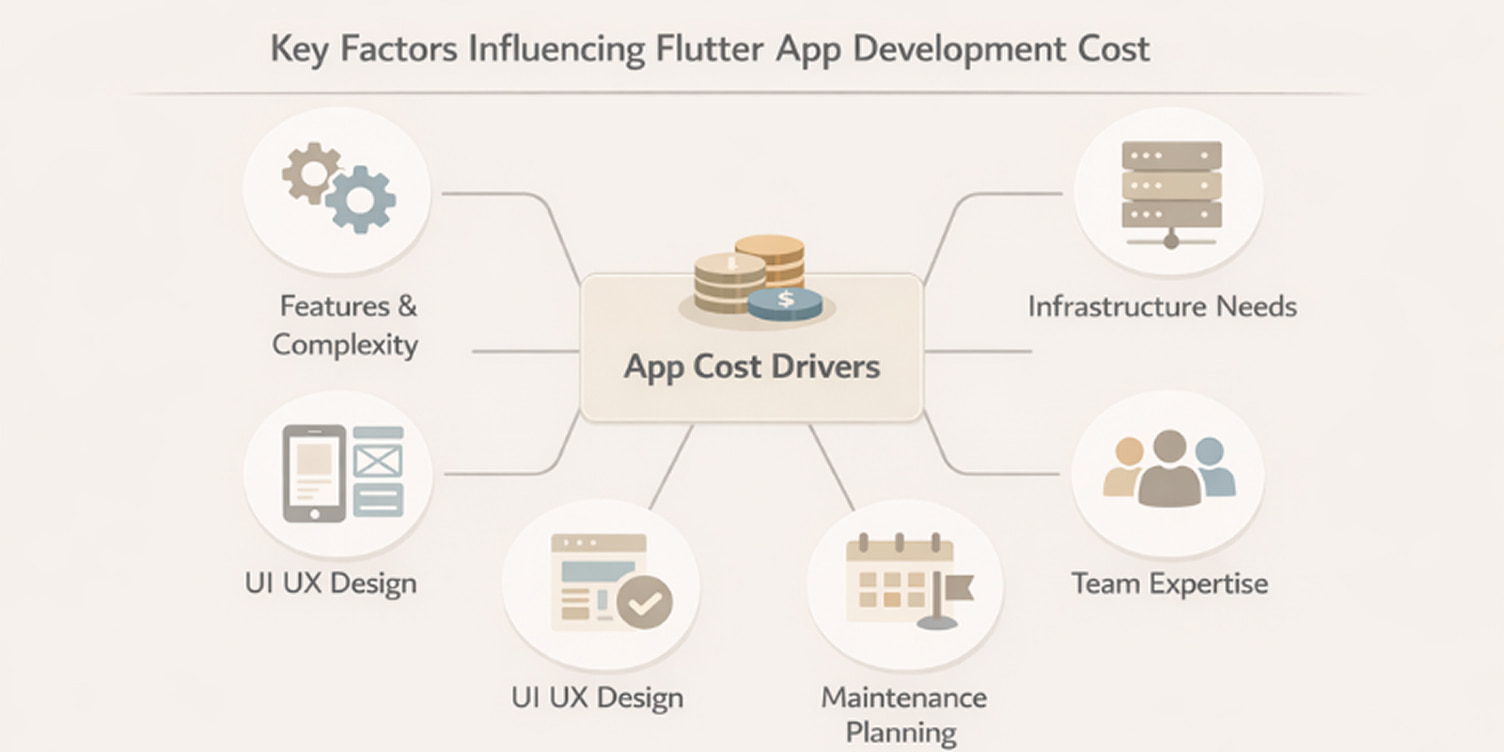
General price ranges can help set initial expectations, but actual Flutter app development costs depend heavily on technical scope, infrastructure needs, design complexity, and team expertise. Looking at these factors early gives a clearer budgeting picture and helps avoid relying on oversimplified cost assumptions.
App Features and Complexity
Feature depth has the strongest impact on development cost. Basic apps with limited functionality require simpler architecture, while applications involving payments, real-time communication, analytics, or multi-role workflows demand more engineering effort and testing.
Payments in particular tend to add more engineering weight than expected, since secure payment gateway integration brings its own compliance and testing requirements beyond the core app logic.
How Feature Complexity Affects Cost
The more integrations and advanced functionality involved, the more backend architecture and quality assurance effort is required.
UI/UX Design Requirements
Design complexity affects both development effort and user perception. Simple layouts are faster to implement, while custom branding, motion design, and interactive elements require additional design iteration and front-end engineering.
Design Scope and Cost Variation
Design investment is often tied to market competitiveness rather than purely technical necessity.
Backend Infrastructure and Integrations
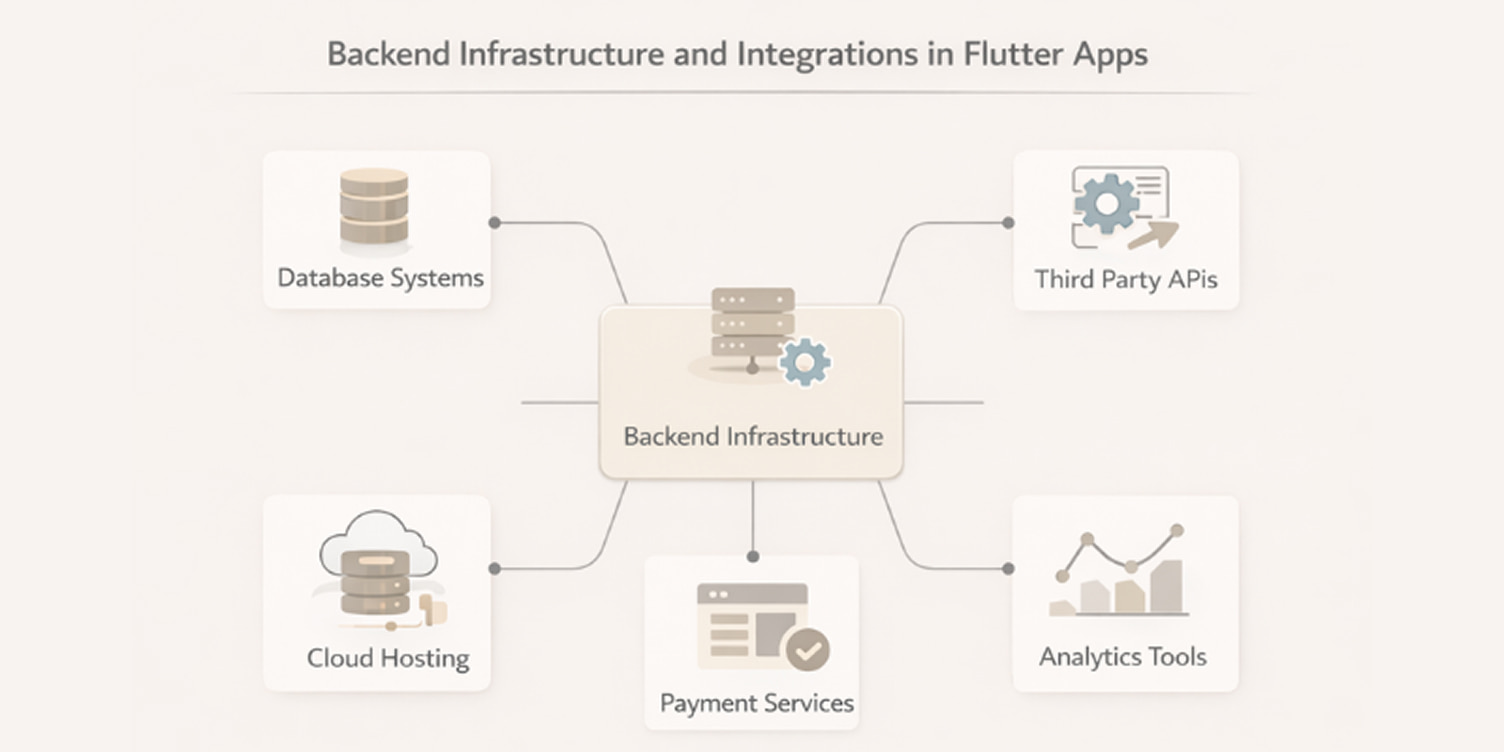
Backend architecture directly influences performance, scalability, and operational stability. Apps requiring secure databases, cloud infrastructure, or external integrations need additional engineering effort.
Backend Requirements and Cost Impact
Infrastructure decisions also influence long-term operational expenses.
Development Team and Expertise
Who builds the app affects both upfront investment and long-term stability. Experienced teams often deliver more efficient architecture and fewer maintenance issues, even if initial rates are higher, which is why evaluating offshore development partners carefully has become part of cost planning for many projects.
Team Structure and Budget Influence
Expertise often reduces rework, which can offset higher hourly rates, especially when experienced mobile app development teams are involved in architectural planning from the outset.
Tools, Licensing, and Platform Costs
Flutter itself is free, but development still involves supporting tools such as design software, testing platforms, analytics services, and CI/CD infrastructure. These tools improve efficiency and product quality, yet they contribute incrementally to overall development costs.
Licensing costs may arise from third-party APIs, premium SDKs, enterprise integrations, or specialized development utilities. While not always mandatory, these additions often support advanced features, security requirements, or scalability goals that influence the final budget.
Platform-related expenses continue after development through app store fees, cloud hosting, monitoring services, and payment gateway infrastructure. Accounting for these operational costs early helps create a more accurate estimate of long-term Flutter app ownership.
Maintenance and Ongoing Support
An app’s lifecycle begins after it has been released. Regularly updating your app, monitoring performance, applying security patches, and modifying it to accommodate new operating systems are all necessary to keep your product running optimally.
An app is typically expected to incur annual maintenance costs of 15%-25% of its original development cost per year. The amount of maintenance will vary depending on the type of application, the expected number of users that will access the application, and the infrastructure needed to support the application.
By planning for these future expenses as part of your early-project budget, you’ll be better able to manage your long-term operations smoothly, without incurring any excessive/unexpected costs.
Flutter vs Native App Development Cost Comparison
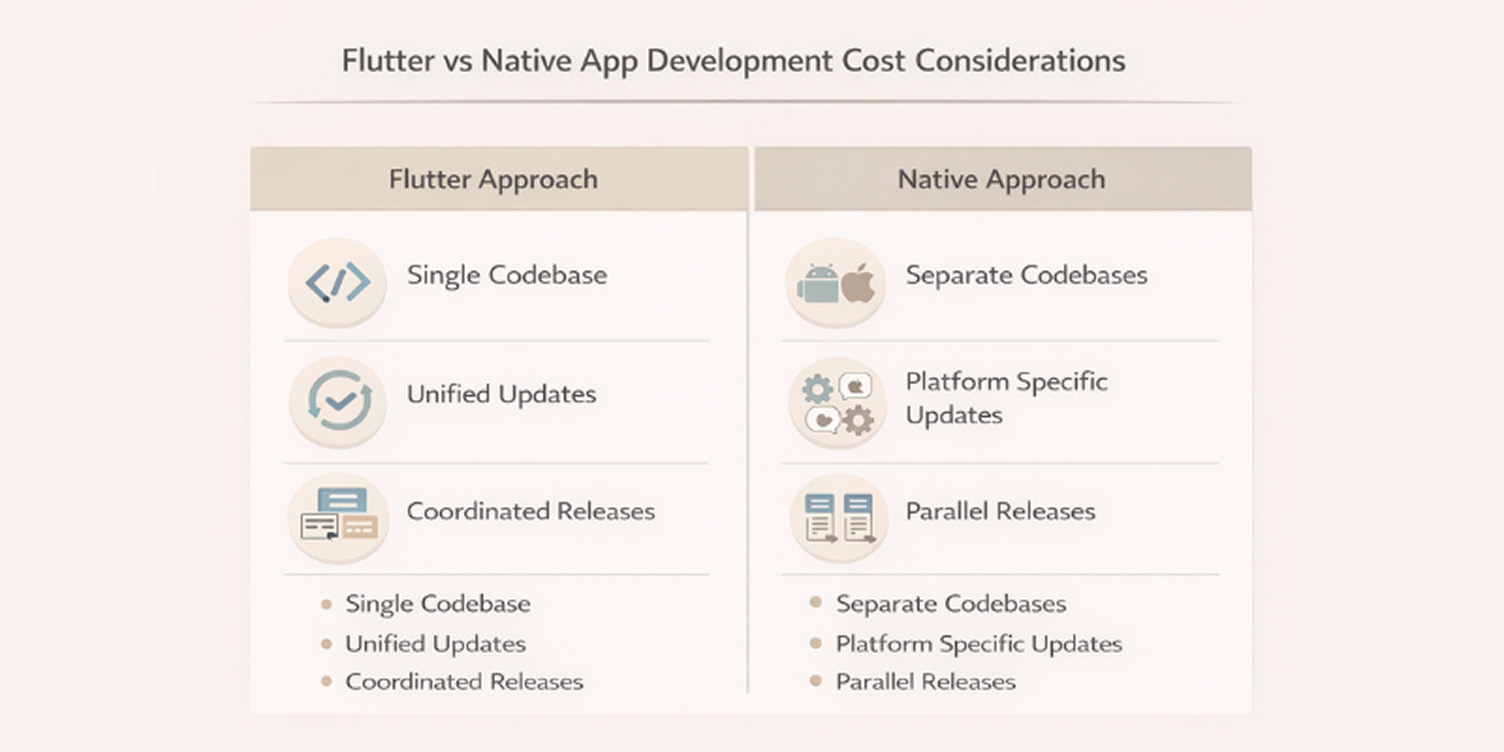
In general terms cost is only some part of the evaluation process when considering Flutter, with many decision makers comparing directly with native development to consider what effect either approach would have in terms of long-term financial implications
Being aware of the differences between the respective models with respect to resources required, building maintenance, etc., and the development process will assist in identifying which of those models most closely aligns with the organization's business priorities. Many organizations evaluate multiple cross-platform frameworks before making this decision.
Single Codebase Advantage
Using Flutter, developers can create an app from one codebase and support several different platforms. The app logic, components, and core features developed in one codebase can run on different platforms like Apple iOS and Google Android.
Conversely, when you develop natively, you develop a different codebase for every platform. Across all platforms, using individual codebases increases the effort needed to develop, test, and manage multiple apps.
In addition, the single-codebase approach can reduce the initial cost of developing the app and make it easier to add new features or make ongoing changes after the app is built.
Duplicate Development Costs in Native
With native apps, teams usually need platform-specific developers, separate testing processes, and parallel release cycles. Even when functionality appears identical across platforms, implementation differs technically.
This duplication increases development hours and can raise overall project budgets by requiring additional engineering resources. It also extends coordination complexity, particularly for feature parity across platforms.
Maintenance and Update Efficiency
The cost of maintaining an app can vary significantly over time; this is often where the most substantial difference in cost comes from. With Flutter, there’s one way to update a feature, like adding a new feature that can be rolled out and implemented on both platforms at once.
Native applications usually require updating the code on each platform individually and therefore, over the long term, will incur additional expenses for each new version of the app. Over the long term, these expenses accumulate quickly, especially on applications that release new features or where the app continues to evolve.
Long-Term Cost Efficiency
For businesses planning cross-platform deployment from the beginning, Flutter app development often provides stronger long-term cost efficiency due to shared development resources and streamlined maintenance.
However, cost efficiency depends on project goals. If the application targets a single platform exclusively, native development may not carry the same duplication overhead. In such cases, the financial difference may narrow.
When Native Development Still Makes Sense
Although Flutter is effective for developing most cross-platform apps, there are certain technical requirements and/or performance standards that would make creating a native app worthwhile.
Considering overutilizing a fair amount of time and resources developing an app using Flutter. As such, some use cases may require more additional platform-level control than is available through cross-platform solutions such as Flutter.
Common scenarios where native development may be preferable include:
Applications requiring deep hardware integration
Performance-intensive gaming or graphics-heavy apps
Platform-specific features needing tight OS-level control
In these situations, the additional flexibility and optimization offered by native development can justify the higher cost. The decision usually comes down to technical requirements and long-term product goals rather than upfront development expenses alone.
Hidden Costs in Flutter App Development
You will need to invest more than just your original funding for a mobile app. After your application goes live, you will continue to incur operating and technical costs. By planning for these types of expenses ahead of time, you’ll establish a more realistic long-term financial projections.
Estimated Ongoing Cost Overview
These estimates offer initial budgeting guidance. Final costs depend on feature scope, expected users, and technical requirements.
Maintenance and Updates
After launch, all apps require ongoing maintenance, which consists of bug fixes, OS compatibility updates, minor fine-tuning, and performance monitoring.
Most companies typically budget up to 20% of original development costs each year for ongoing maintenance of an app so the app remains stable and current with both new and ongoing changes in the platform on which it runs.
Cloud Hosting and Infrastructure
Backend systems have to grow as the number of people using them grows. This might mean adding servers, upgrading databases, and increasing the number of APIs being called by other applications.
Infrastructure costs tend to grow more slowly than user adoption; therefore, it is important to plan for capacity before it is needed.
Security and Compliance
Security needs are constantly changing over time. To keep your platform safe and your users trusting in it, you should perform vulnerability assessments regularly, update your encryption, and update any relevant policies.
For heavily regulated industries, complying with new laws could result in added operational run-time costs.
Performance Optimization
As increasingly complex apps expand, they require performance tuning, such as back-end improvements, database optimization, or front-end efficiency.
Ongoing optimization allows you to keep your products responsive while avoiding major disruptions due to technical issues down the road.
Feature Enhancements
Applications that are successful continue growing from being a static application. User feedback, market shifts, and expansion of a business all create a need for enhancement of new features and/or adjustments to current workflows.
The enhancements are a result of planned growth investment, provided they are included in a subsequent budget long-term.
Real-World Flutter App Cost Examples
General price ranges are helpful, but most businesses need clearer context before committing to a budget. Looking at common application categories makes cost expectations easier to interpret because each type carries different technical and operational demands.
Estimated Cost by App Category
These cost ranges show how the type of product shapes the overall investment. The framework may remain the same, but the complexity behind it does not. Backend systems, integrations, and multi-user workflows are often what move a project from moderate to high-budget territory.
In practice, infrastructure decisions usually influence cost more than visual design alone. Clarifying workflows, integrations, and operational requirements early helps prevent budget drift once development is underway.
How to Optimize Flutter App Development Costs
Managing app development costs involves more than just picking the right framework. It also depends on how the project is planned and carried out. Careful choices made in the early stages can help avoid extra costs later. This approach also keeps product quality and scalability intact.
Cost optimization usually focuses on improving efficiency rather than cutting essential features. A structured approach helps keep budgets predictable without affecting long-term product stability.
Define Requirements Clearly from the Start
Projects often exceed budgets when requirements keep changing mid-development. Having a clear understanding of workflows, integrations, and expected functionality before development begins reduces rework and unexpected adjustments.
Detailed planning upfront makes development smoother and helps avoid costly revisions later.
Manage Feature Expansion Carefully
New feature ideas often emerge during development, but constant additions can quickly increase costs. Each change requires design updates, development time, and additional testing.
Maintaining a structured process for evaluating new features helps control scope while keeping the project financially stable.
Use Modular Development Approaches
When building applications as modular pieces, each element of a system can change independently over time, which limits the amount of large-scale rework required for large updates or improvements.
When utilizing specific modular architectures, it becomes much more cost-effective to continue with the maintenance of an application and also to grow it into a service with potential longer-term scalability, without incurring exponentially increasing costs.
Plan Development in Financial Milestones
Tracking spending and progress by segmenting work into specific phases of a project enables a better record of what is being spent and how much progress has been made. It also gives the opportunity to make changes early on if company priorities or needs change.
By planning based on milestones, you will enhance financial visibility and diminish the chance for excessive budget overruns.
Focus on Overall Efficiency, Not Just Hourly Rates
At first glance, lower hourly rates seem appealing, but in reality they may lead to higher costs due to inefficiencies, communication issues, and having to redo work that was not done properly. An experienced team will usually get the job done faster than an inexperienced team and will offer better long-term stability.
Determining overall efficiency is much more valuable than just comparing hourly rates because it produces a more accurate financial picture of your project.
Keep a Contingency Buffer
In software development, it's commonplace to have sudden changes. You might need extra resources because of integration changes, performance improvements, or other technical upgrades.
If you set aside 10% to 20% of your original budget, then you can use those funds for flexibility without impacting the overall financial plan.
Conclusion
Flutter app development costs can vary widely depending on features, infrastructure, design depth, and long-term product goals. Treating budgeting as a planning exercise rather than a rough guess helps avoid surprises and keeps projects financially stable.
Clear requirements, realistic expectations, and early cost evaluation usually lead to better outcomes. Taking time to assess scope properly and explore a detailed estimate can make the entire development process smoother and more predictable.
Frequently Asked Questions (FAQs)

 WhatsApp
 Call Us
 Mail Us