
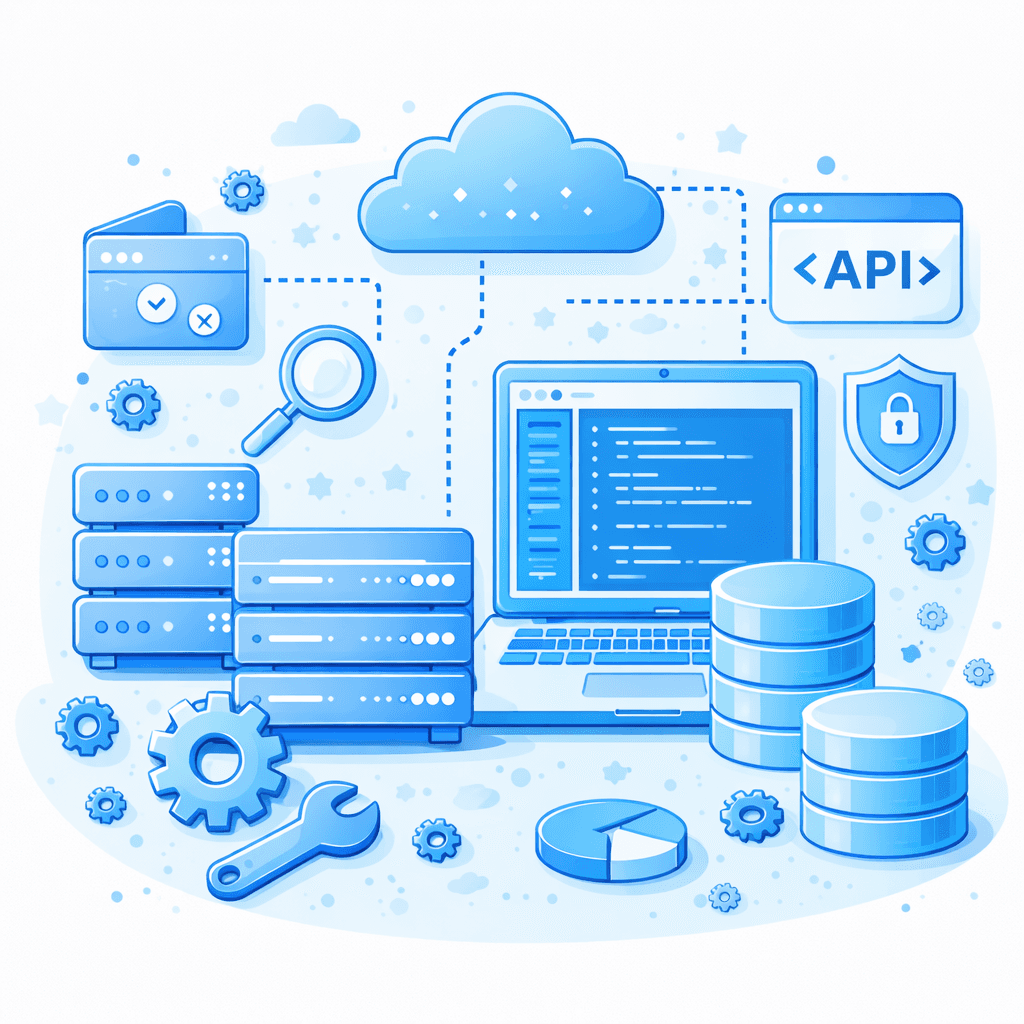
Backend Development Services
We build backend systems that support clear business outcomes, steady performance, predictable delivery, and room for product growth. With long-term experience in startup and SME environments, we architect backend structures that strengthen your operational flow.
Core Strengths:
- Expert Build
- Reliable Execution
- Startup Fit
Trusted by Global Industry Leaders


70+
Projects Launched
50+
Satisfied Customers
7+
Years Experience
97%
Client Retention
Proven Software Development Results
As a trusted global software development partner, we bring dedicated expertise and proven delivery experience to support enterprise-grade software solutions worldwide.

Committed to Excellence
Our achievements reflect our dedication to quality and expertise across various fields. With certifications in industry standards and partnerships with leading platforms, we uphold the highest benchmarks in software development and service delivery. Trust in our commitment to excellence for your projects.


Build with Custom Backend Services

We build backend systems aligned with your product vision, giving you stable workflows, dependable execution, and the technical depth needed to support evolving business needs.

Our engineers build backend engines and APIs that enable reliable data exchange, smooth integrations, and steady communication across your internal and external systems.

We design mobile-ready backends that manage data sync, secure access, notifications, and consistent app behavior, ensuring a dependable experience across devices.

Backend database engineers build organized, fast-responding, and secure data structures that support accurate decision-making and keep daily operations running without friction.

We build modular backend structures that break complex systems into smaller services, enabling easier updates, independent deployments, and steady application behavior.

Cloud solutions that support backend environments on leading platforms, giving your systems steady performance, controlled operations, and an easier way to manage infrastructure.

Security specialists implement authentication, access rules, encryption & ongoing checks that protect your backend from threats while keeping user interactions safe.

DevOps engineers set up automated pipelines for builds, testing, and deployments, allowing your team to ship updates faster, cut manual effort, and maintain consistent delivery cycles.

We guide you on backend choices, architecture options, and performance improvements, giving you clear direction and practical steps to strengthen your technology foundation.
















Backend Use Cases We Enable
How We Build Your Backend
Smart Process.
Strong Result

Requirement Mapping
We identify core product needs, data flow demands, and integration points to set a precise direction for backend development.
Architecture Blueprint
We design the backend layout, define services, and plan API behavior to build a structure that supports long-term product growth.
Backend Execution
We develop backend logic, modules, and APIs in stages while ensuring clean communication across all systems and touchpoints.
Quality & Release
We validate performance, security, and response behavior, then support deployment to ensure a stable and smooth backend launch.
Innovate. Accelerate Succeed
They have strong expertise in the latest technologies and provide excellent guidance in using them effectively.
CODE B launches the products quickly, and their solutions have excellent architecture and are scalable.
CODE B is proactive in coming up with solutions.
Aside from getting the job done, they’re able to provide their expertise and share their opinion.
They’re a very bright team that requires minimal levels of communication or time investment to be very effective.
Their constant communication was a key aspect of the success.
They completed the project within the timeline we gave them, and they did it within budget.
Had a great experience working with the team and in times of crisis, CODE B team was always there to support us.
The way that they have supported us by giving us one of their developers to work directly with our development team.
Our overall experience has been very positive.
They are friendly and reliable.
The ability to deliver on time impressed us the most.
They’re excellent at what they do and come up with solutions for various problems.
CODE B will work overtime to resolve issues, which is a difficult trait to find.
Code B’s communicative.
I’ve had a great experience working with CODE B
The main positive point of working with CODE B team is their analyzing skills.
They are receptive and try to adjust to meet our requirements.
Why Businesses Trust Code B
Strong Engineering Craft
Our backend engineers understand system behavior under active load and operational demands. From Node.js and Go to Python and cloud-native patterns, we build foundations that hold up as your product grows and your operations expand.
Aligned Delivery Models
Whether offshore, hybrid, or on-site, whichever model you choose, our team integrates seamlessly into your workflow. You get predictable timelines, clear communication, and engineers who work with the same discipline and cadence as your internal team.
Technical Expertise
Our team works across modern backend stacks, including Nest.js and Django, as well as serverless setups, API-driven ecosystems, and data-heavy environments. You work with engineers who understand how backend choices influence performance, cost, and long-term maintainability.
Long-Term System Support
Every backend choice service boundaries, interface design, and data flow is planned with upcoming releases in mind. You avoid avoidable rebuilds, gain room to extend features, and maintain a backend that remains steady as your product evolves.
Engagement Models
Frequently asked questions (FAQs)

Vector Intelligence in Product Backends

Vector databases are becoming a practical component of backend systems that need to manage content, user behaviour, or search-driven workloads. Instead of matching fixed keywords, they store information as numerical vectors, enabling the system to compare items based on meaning or context. For teams building features such as semantic search, personalised results, or pattern-based discovery, vector databases bring these capabilities closer to the backend, reducing the need for separate pipelines and enabling advanced retrieval within the core system design, especially in products already using microservices design patterns. Below are key functions where vector databases strengthen backend systems and enable more advanced product features:
Pattern Search
Allows applications to find information based on meaning, intent, or context instead of exact matching. This helps products surface more relevant results for users, even when queries are vague or phrased differently.
Embedding Storage
Stores vectors generated from text, images, documents, or user actions, allowing systems to work with deeper semantic signals. This enables features like personalized suggestions, smarter classification, and contextual retrieval.
Contextual Retrieval
Helps rank or retrieve items by how closely related they are in vector space, for example, surfacing similar products, related documents, or comparable user actions.
Hybrid Data Models
Supports traditional structured records alongside vector search, enabling product teams to use one backend system for both operational queries and semantic matching.
 WhatsApp
 Call Us
 Mail Us