


What Are the Different Types of Machine Learning Techniques?
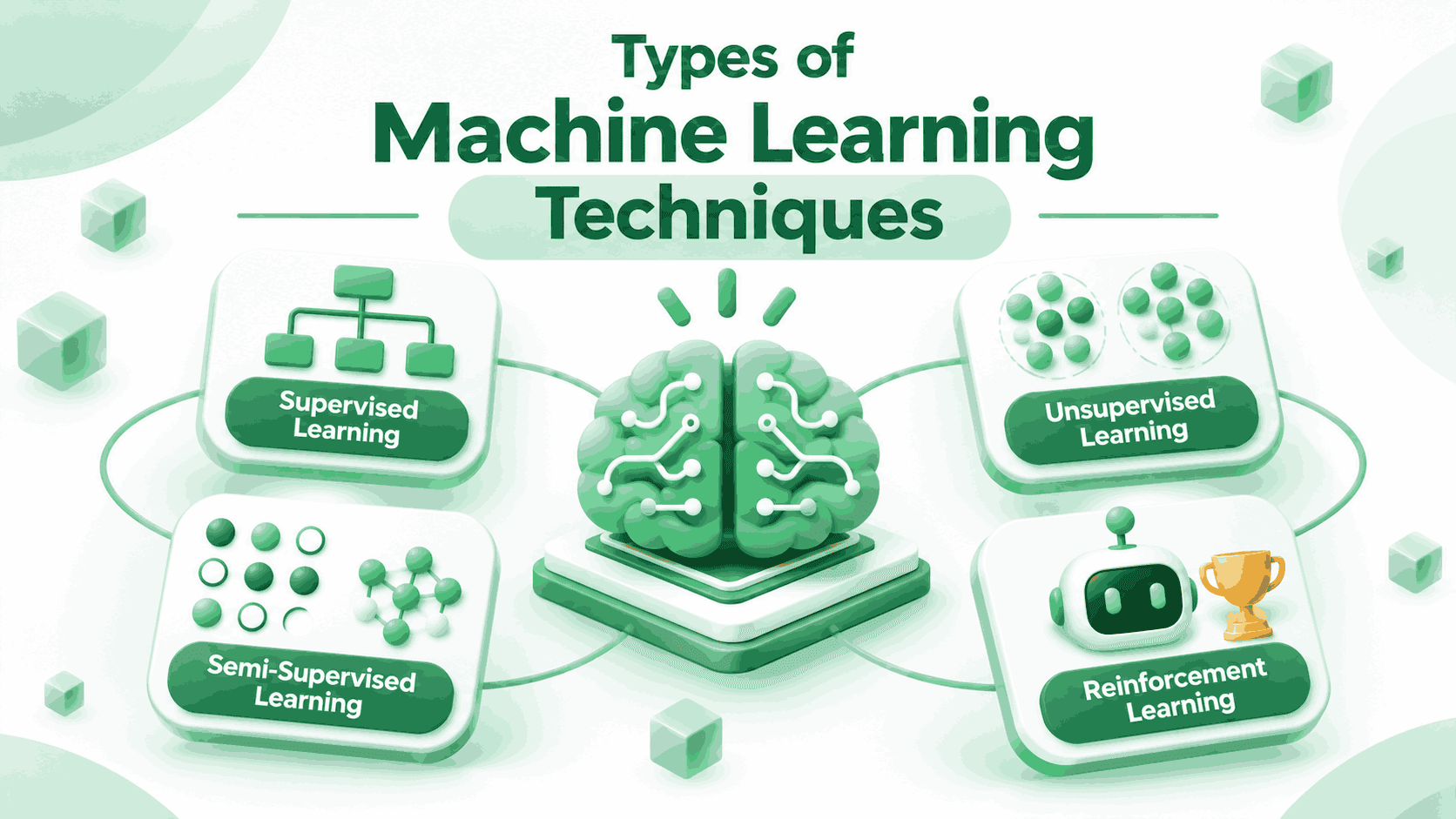



Machine learning is a branch of artificial intelligence (AI) that enables computers to learn from data, identify patterns, and make predictions or decisions without being explicitly programmed for every task. From fraud detection and personalized recommendations to autonomous vehicles and predictive analytics, machine learning techniques power a wide range of modern applications.
Understanding the different types of machine learning techniques helps businesses and developers select the right approach for solving specific problems, improving operational efficiency, and building intelligent applications.
There are five major types of machine learning: supervised learning, unsupervised learning, semi-supervised learning, self-supervised learning, and reinforcement learning. Each technique follows a different learning approach depending on the available data and desired outcomes.
In this guide, we will explore these machine learning techniques, their algorithms, real-world applications, advantages, limitations, and how to choose the right approach for your business requirements.
What Is Machine Learning?
Machine learning is a subset of artificial intelligence that enables computer systems to learn from data and improve their performance through experience.
Unlike traditional programming, where developers manually define rules for every operation, machine learning algorithms analyze training data to identify patterns and generate predictions or decisions.
For example, an email spam detection system can learn from previously classified emails to identify whether incoming messages are spam or legitimate.
Businesses use machine learning to automate processes, analyze large datasets, improve customer experiences, and support data-driven decision-making.
Organizations looking to implement intelligent applications can explore machine learning app development services to build customized solutions based on their operational and technical requirements.
How Does Machine Learning Work?
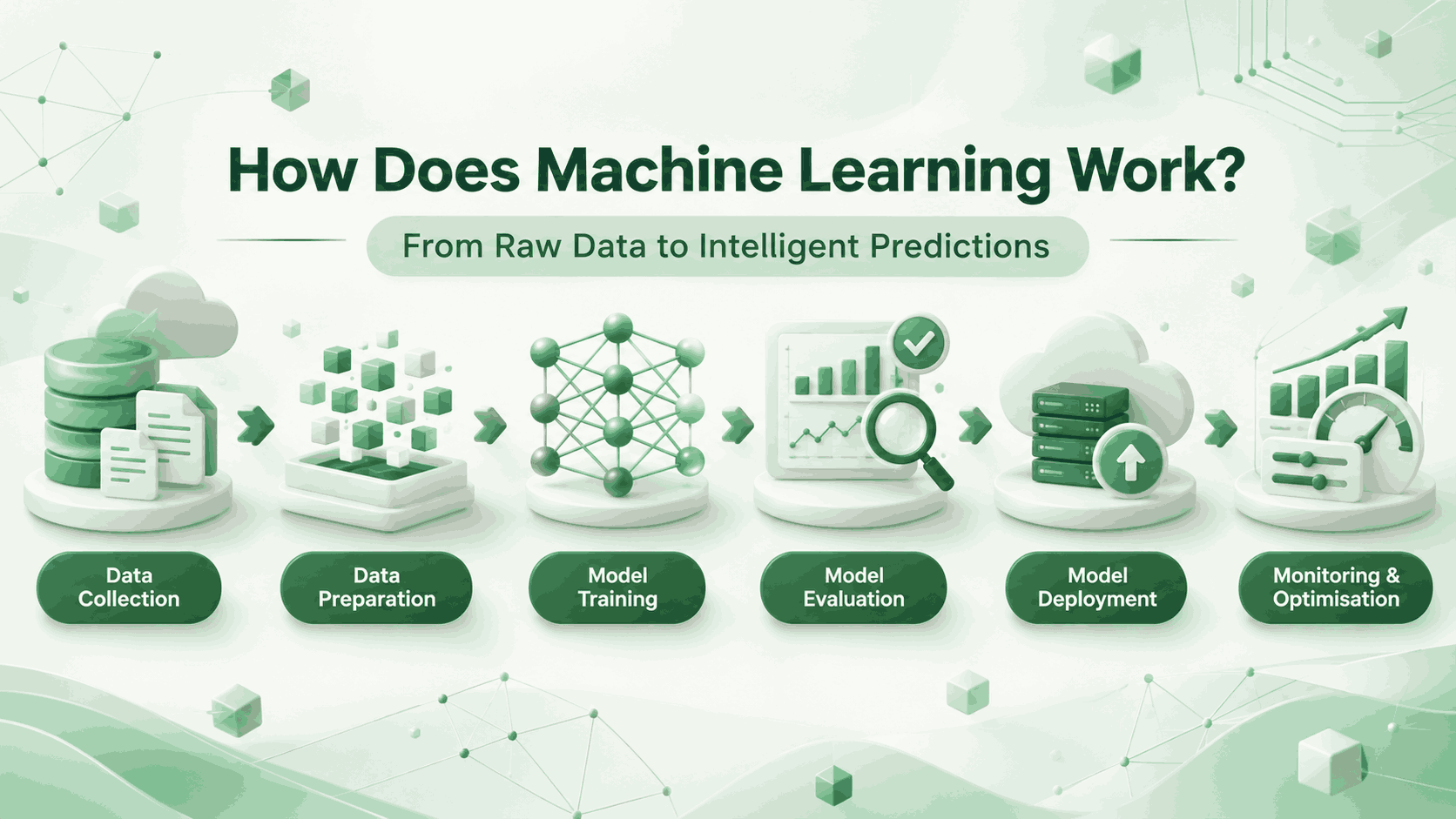
A typical machine learning workflow involves the following steps:
- Data Collection: Gather relevant structured and unstructured data from databases, applications, sensors, and other sources.
- Data Preparation: Clean, organize, and transform collected data to make it suitable for model training.
- Model Training: Apply appropriate machine learning algorithms to identify patterns and relationships in the data.
- Model Evaluation: Test the trained model using suitable performance metrics to measure its effectiveness.
- Model Deployment: Integrate the trained model into an application, platform, or business workflow.
- Monitoring and Optimization: Monitor model performance and update it when new data or changing requirements demand improvements.
The choice of machine learning technique depends on data availability, business objectives, model complexity, and expected outcomes.
What Are the Different Types of Machine Learning?
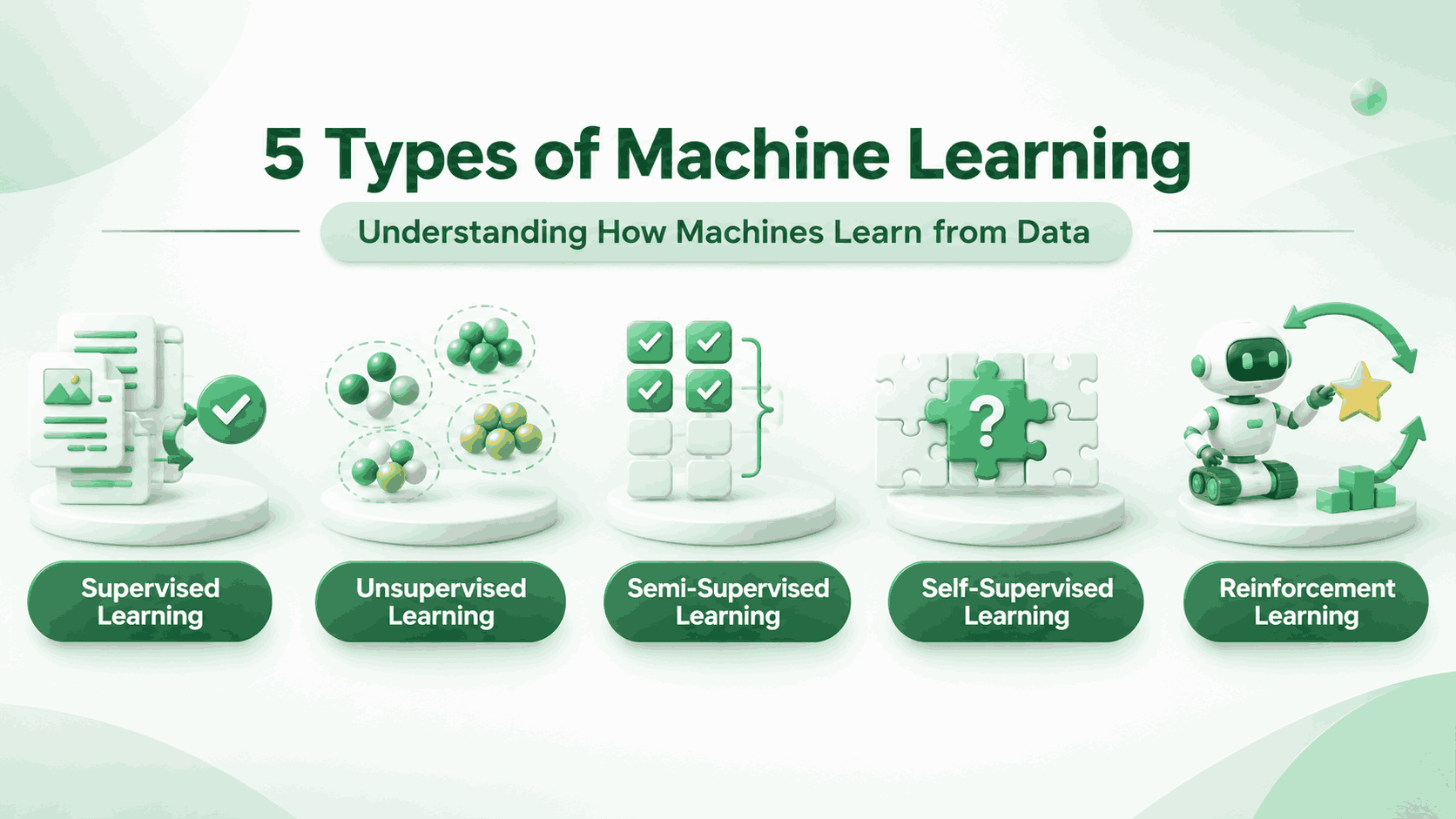
Machine learning techniques are generally classified into five major categories based on how models learn from data.
Supervised Learning: Trains models using labeled datasets to predict known outcomes.
Unsupervised Learning: Identifies hidden patterns and relationships in unlabeled data.
Semi-Supervised Learning: Combines a small amount of labeled data with a larger amount of unlabeled data.
Self-Supervised Learning: Generates learning signals directly from the input data.
Reinforcement Learning: Learns through interactions with an environment and feedback in the form of rewards or penalties.
Each technique serves different purposes and is suitable for specific applications.
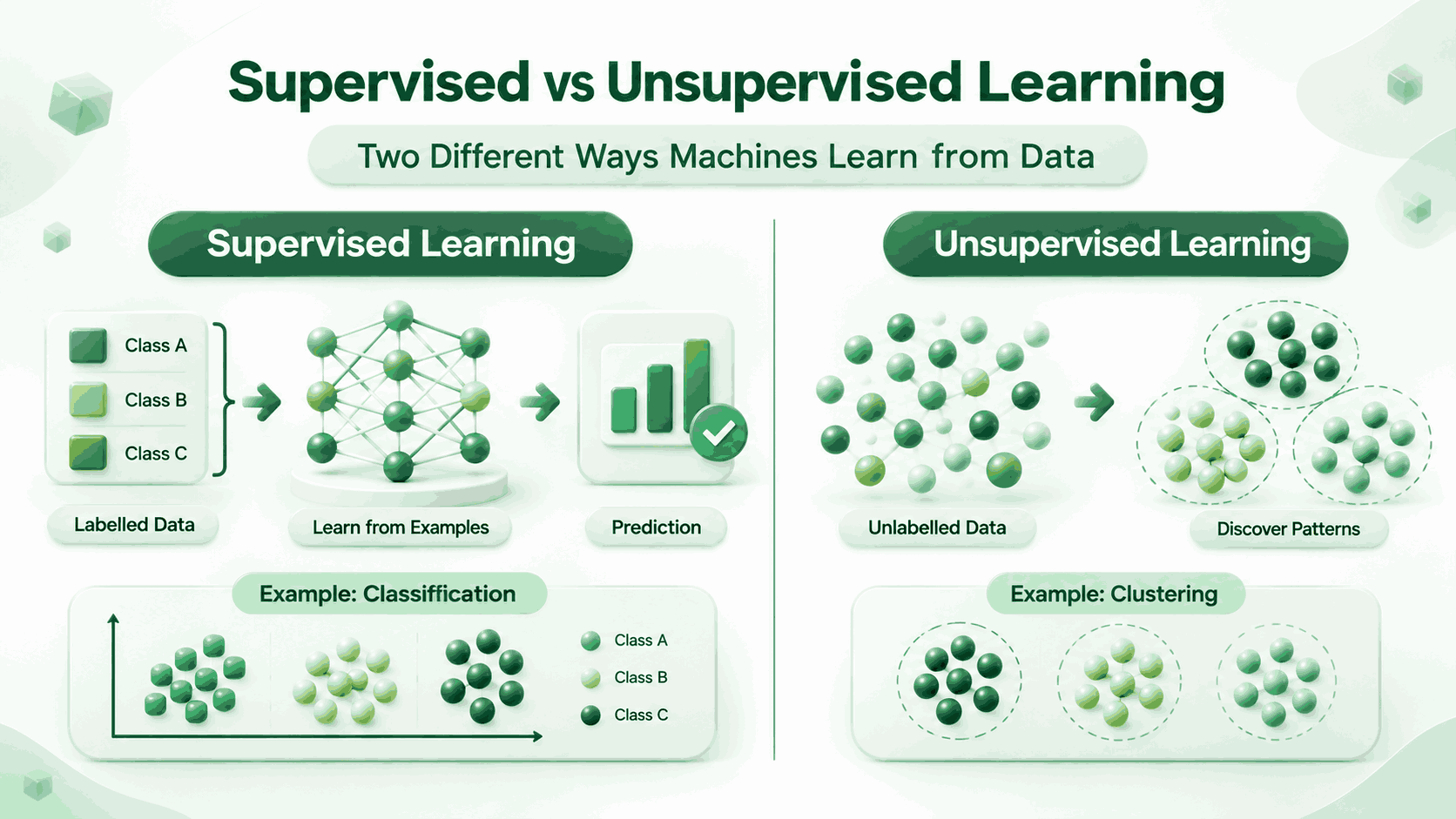
1. Supervised Learning: Learning from Labeled Data
Supervised learning is a machine learning technique in which models are trained using labeled datasets. Each training example contains input data and its corresponding expected output.
The algorithm analyzes these examples to learn the relationship between inputs and outputs. Once trained, the model can use this knowledge to make predictions on new, unseen data.
For example, a bank can train a supervised learning model using historical transactions labeled as fraudulent or legitimate. The model learns patterns associated with fraudulent activities and uses them to identify potentially suspicious transactions.
Types of Supervised Learning
1. Classification
Classification algorithms predict discrete categories or class labels. They are commonly used when the expected output belongs to a predefined group.
Examples include:
Email spam detection.
Customer churn prediction.
Medical disease classification.
Fraudulent transaction identification.
Popular classification algorithms include logistic regression, decision trees, support vector machines (SVM), and Naive Bayes.
Regression
Regression algorithms predict continuous numerical values by identifying relationships between input variables and target outcomes.
Examples include:
- House price prediction.
- Sales forecasting.
- Temperature prediction.
- Revenue estimation.
Popular regression algorithms include linear regression, polynomial regression, decision tree regression, and random forest regression.
Common Supervised Learning Algorithms
Linear Regression
Logistic Regression
Decision Trees
Random Forest
Support Vector Machines (SVM)
K-Nearest Neighbors (KNN)
Naive Bayes
Advantages of Supervised Learning
Produces measurable predictions using labeled training data.
Supports classification and numerical forecasting.
Model performance can be evaluated using established metrics.
Suitable for applications with clearly defined target outcomes.
Limitations of Supervised Learning
Requires sufficient high-quality labeled data.
Data labeling can be expensive and time-consuming.
Models may perform poorly when new data differs significantly from training data.
2. Unsupervised Learning: Discovering Hidden Patterns
Unsupervised learning is a machine learning approach that identifies patterns, relationships, and structures in datasets without predefined labels.
Unlike supervised learning, the model does not receive the correct output for each training example. Instead, it analyzes available data to discover meaningful groups and associations.
For example, an e-commerce company can use unsupervised learning to group customers according to purchasing behavior, browsing patterns, and product preferences. These customer segments can help businesses develop more relevant marketing strategies.
Types of Unsupervised Learning
Clustering
Clustering algorithms organize similar data points into groups based on their characteristics.
Common applications include:
Customer segmentation.
Document grouping.
Image segmentation.
Market research.
Popular clustering algorithms include K-Means, DBSCAN, and hierarchical clustering.
Association Rule Learning
Association rule learning identifies relationships between different items or events in large datasets.
For example, retailers can analyze purchase histories to discover products that customers frequently buy together.
Popular algorithms include Apriori and Eclat.
Dimensionality Reduction
Dimensionality reduction reduces the number of features in a dataset while retaining important information.
It helps simplify complex datasets, improve visualization, and support efficient model development.
Popular techniques include Principal Component Analysis (PCA), t-SNE, and UMAP.
Common Unsupervised Learning Algorithms
K-Means Clustering
Hierarchical Clustering
DBSCAN
Apriori
Gaussian Mixture Models (GMM)
Principal Component Analysis (PCA)
Advantages of Unsupervised Learning
Works with unlabeled datasets.
Helps discover previously unknown patterns.
Supports customer segmentation and exploratory data analysis.
Can identify relationships that may not be immediately apparent.
Limitations of Unsupervised Learning
Results can be difficult to interpret.
Evaluating model performance can be challenging without predefined labels.
Discovered patterns may not always have practical business value.
3. Semi-Supervised Learning: Combining Labeled and Unlabeled Data
Semi-supervised learning combines a relatively small amount of labeled data with a larger amount of unlabeled data.
This approach is useful when obtaining labeled training data is expensive, but large quantities of raw data are available.
For example, a healthcare organization may have thousands of medical images but only a limited number reviewed and labeled by medical professionals. A semi-supervised learning model can use both labeled and unlabeled images to learn useful patterns.
How Does Semi-Supervised Learning Work?
Collect a dataset containing labeled and unlabeled examples.
Train an initial model using the labeled data.
Use the model to generate predictions or pseudo-labels for selected unlabeled examples.
Apply suitable validation and filtering techniques.
Retrain or refine the model using the expanded training data.
Common Semi-Supervised Learning Techniques
Self-Training.
Co-Training.
Label Propagation.
Consistency Regularization.
Real-World Applications
Medical image classification.
Speech recognition.
Image classification.
Document categorization.
Fraud detection.
Advantages of Semi-Supervised Learning
Reduces dependence on manually labeled datasets.
Makes use of available unlabeled data.
Can improve learning when labeled examples are limited.
Limitations of Semi-Supervised Learning
Incorrect pseudo-labels can introduce errors.
Model performance depends on data quality.
Training and validation processes can become more complex.
4. Self-Supervised Learning: Learning from Data Itself
Self-supervised learning is a machine learning approach in which a model creates its own training signals from input data rather than depending on manually assigned labels.
The model learns by solving tasks generated from the data itself. These tasks help it understand patterns, relationships, and representations that can later be applied to other tasks.
For example, a language model can be trained to predict missing or next words in a sentence. By performing this task across large text datasets, it learns language patterns, context, and relationships between words.
Self-supervised learning is particularly important in modern artificial intelligence because it supports the pretraining of large language models and other foundation models.
Businesses exploring advanced AI capabilities can also learn about generative AI development services for building intelligent applications powered by modern AI technologies.
How Does Self-Supervised Learning Work?
Collect a large dataset without manually assigned labels.
Create a pretext task using the available data.
Train the model to solve the generated task.
Learn useful representations from the training process.
Fine-tune the model for a specific downstream task when required.
Common Self-Supervised Learning Approaches
Masked Language Modeling.
Contrastive Learning.
Next-Token Prediction.
Image Representation Learning.
Real-World Applications
Large language model pretraining.
Natural language processing.
Computer vision.
Speech recognition.
Image understanding.
Advantages of Self-Supervised Learning
Uses large amounts of unlabeled data.
Reduces dependence on manual annotations.
Supports pretraining and transfer to downstream tasks.
Helps models learn useful representations from raw data.
Limitations of Self-Supervised Learning
Can require substantial computational resources.
Pretraining may require large datasets.
Performance depends on training objectives and data quality.
5. Reinforcement Learning: Learning Through Rewards and Penalties
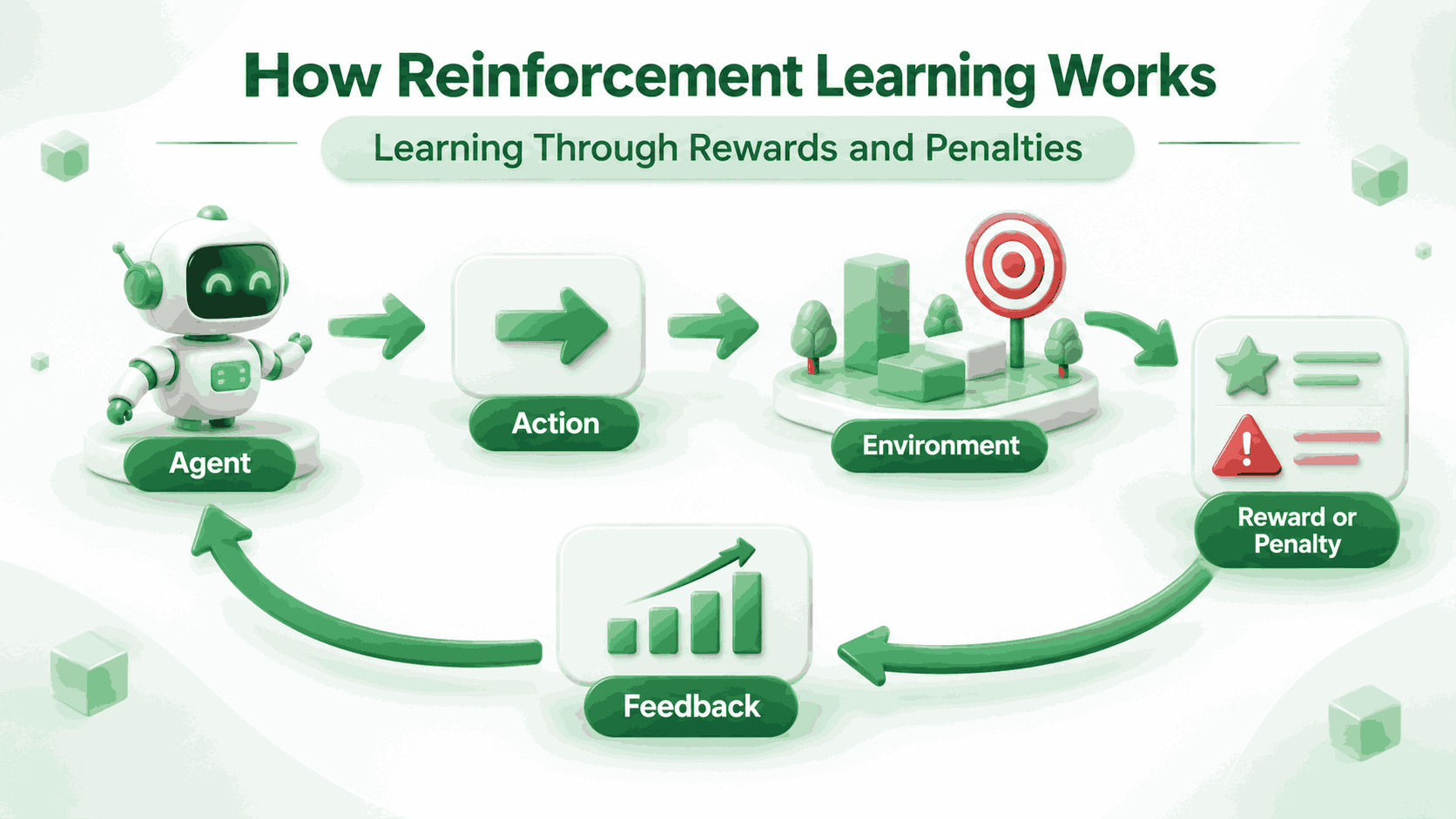
Reinforcement learning is a machine learning technique in which an agent learns by interacting with an environment and receiving feedback through rewards or penalties.
Instead of learning from a fixed collection of labeled examples, the agent takes actions, observes their consequences, and adjusts its strategy to maximize cumulative rewards over time.
For example, a robotics system can use reinforcement learning to learn how to navigate an unfamiliar environment. It receives positive rewards for reaching a target and negative rewards for collisions or unsuccessful actions.
Key Components of Reinforcement Learning
Agent: The system that makes decisions.
Environment: The surroundings in which the agent operates.
State: The current situation of the environment.
Action: A decision made by the agent.
Reward: Feedback received after taking an action.
Policy: The strategy used to select actions.
Common Reinforcement Learning Algorithms
Q-Learning.
Deep Q-Networks (DQN).
SARSA.
Proximal Policy Optimization (PPO).
Actor-Critic Methods.
Real-World Applications
Robotics and autonomous systems.
Game-playing systems.
Resource allocation.
Traffic signal optimization.
Industrial process optimization.
Advantages of Reinforcement Learning
Supports sequential decision-making.
Learns from environmental feedback.
Can adapt strategies through repeated interactions.
Helps optimize complex decision-making processes.
Limitations of Reinforcement Learning
Training can require many interactions.
Reward design can be challenging.
Exploration and training may be computationally expensive.
Types of Machine Learning Algorithms
Machine learning algorithms are mathematical methods that help models identify patterns, make predictions, and learn from data.
Different algorithms are suited to different learning approaches and problem types.
The choice of algorithm depends on factors such as dataset size, data quality, available labels, computational requirements, and the problem being solved.
Other Important Machine Learning Approaches
Apart from the five major learning categories, machine learning systems can also be classified according to how they process data, update models, and make predictions.
These approaches are not separate replacements for the five learning categories. They describe different dimensions of machine learning systems.
Batch Learning
Batch learning trains a model using the entire available training dataset. Once training is complete, the model is deployed and generally requires retraining to incorporate new information.
It is suitable for applications where data changes less frequently and periodic model updates are sufficient.
Online Learning
Online learning updates a model incrementally as new data becomes available.
It is useful for applications that process continuous data streams, such as real-time fraud detection and dynamic recommendation systems.
Instance-Based Learning
Instance-based learning makes predictions by comparing new data points with previously observed examples.
K-Nearest Neighbors (KNN) is a common example of this approach.
Model-Based Learning
Model-based learning creates a generalized model from training data and uses that model to make predictions on new examples.
Linear regression and decision tree models are common examples.
Ensemble Learning
Ensemble learning combines predictions from multiple models to improve predictive performance, stability, or robustness.
Common methods include Random Forest, Bagging, Boosting, and Stacking.
Transfer Learning
Transfer learning reuses knowledge learned from a previously trained model for a related task.
It is commonly used in computer vision and natural language processing, where pretrained models can be adapted to specific applications.
Federated Learning
Federated learning trains models across multiple devices or organizations without requiring all raw training data to be centralized.
It can help organizations collaborate on machine learning while keeping data within their respective environments, subject to the privacy and security design of the system.
Deep Learning vs. Machine Learning
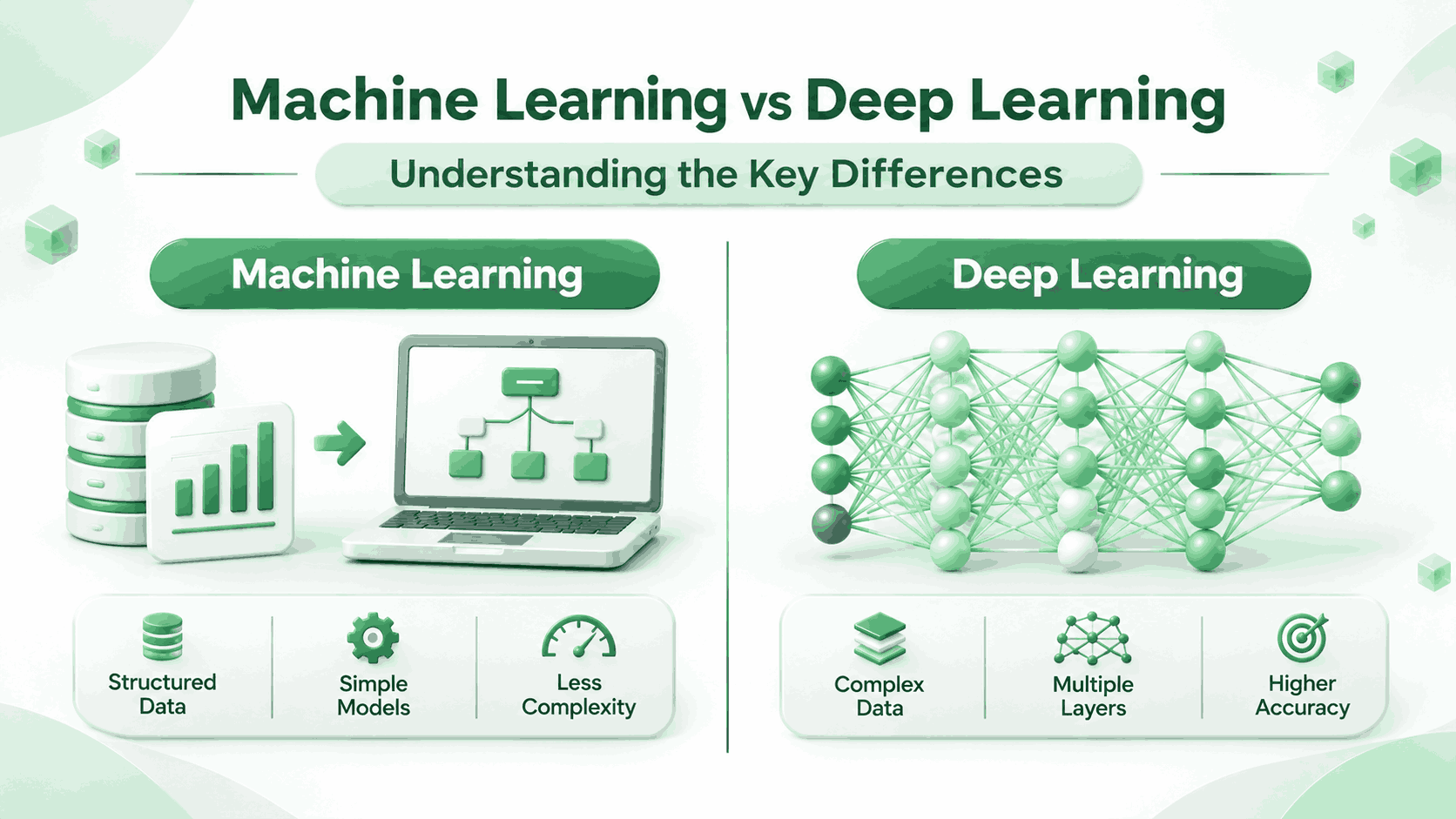
Deep learning is a specialized subset of machine learning that uses multi-layered artificial neural networks to learn complex patterns from data.
While traditional machine learning can work effectively with structured datasets and engineered features, deep learning is particularly useful for complex unstructured data such as images, audio, and text.
Deep learning is not a sixth learning category alongside supervised and unsupervised learning. Deep neural networks can be trained using supervised, unsupervised, self-supervised, and reinforcement learning approaches.
Real-World Applications of Machine Learning Techniques
Machine learning techniques support business operations and decision-making across multiple industries.
Healthcare
Disease prediction and risk assessment.
Medical image analysis.
Patient outcome forecasting.
Drug discovery research.
Finance and Banking
Fraud detection.
Credit risk assessment.
Transaction monitoring.
Financial forecasting.
Retail and E-commerce
Personalized product recommendations.
Customer segmentation.
Demand forecasting.
Inventory optimization.
Manufacturing
Predictive maintenance.
Quality inspection.
Production optimization.
Equipment failure prediction.
Transportation
Traffic prediction.
Route optimization.
Autonomous driving research.
Fleet management.
Businesses that want to implement these capabilities can consider AI development services to identify suitable technologies and develop solutions aligned with their business objectives.
How to Choose the Right Machine Learning Technique?
Selecting the appropriate machine learning technique is an important step in building an effective solution.
Consider the following factors before choosing an approach:
Understand the Business Problem: Determine whether the goal is prediction, classification, clustering, or sequential decision-making.
Evaluate Data Availability: Identify whether your dataset contains labeled data, unlabeled data, or a combination of both.
Consider Model Complexity: Choose an approach that matches the complexity of the problem.
Assess Computational Resources: Evaluate processing power, storage, training time, and infrastructure requirements.
Define Performance Metrics: Select evaluation metrics that align with your business objectives.
Consider Scalability: Ensure the model can handle changing data volumes and future requirements.
Monitor Model Performance: Continuously evaluate predictions and update the model when necessary.
For example, supervised learning may be suitable for credit scoring, unsupervised learning for customer segmentation, and reinforcement learning for sequential decision-making problems.
The right choice should be based on experimentation, validation, and measurable business outcomes rather than algorithm popularity alone.
Build Custom Machine Learning Solutions
Develop and deploy tailored machine learning models that solve business challenges and turn your data into actionable insights.
Hire Machine Learning Developers
Scale your AI initiatives with experienced ML developers who can help you build, train, and optimize intelligent applications.
Conclusion
Understanding the different types of machine learning techniques is essential for selecting the right approach to solve data-driven problems.
Supervised, unsupervised, semi-supervised, self-supervised, and reinforcement learning each offer different ways to train models and extract value from data. Additional approaches such as ensemble learning, transfer learning, online learning, and federated learning extend how machine learning systems can be developed and deployed.
For businesses planning to implement intelligent applications, choosing the appropriate machine learning approach can improve prediction accuracy, operational efficiency, and decision-making.
Working with experienced AI and machine learning developers can help organizations identify suitable algorithms, build reliable models, and integrate machine learning capabilities into their business applications.

Frequently Asked Questions
What are the five main types of machine learning?

What is the difference between supervised and unsupervised learning?
What are the most common machine learning algorithms?
Is deep learning a type of machine learning?
What is the difference between machine learning and artificial intelligence?
Which machine learning technique is best for prediction?
What is the difference between semi-supervised and self-supervised learning?
Where are machine learning techniques used?
 WhatsApp
 Call Us
 Mail Us