


What Is Agentic RAG and How Does It Work?




AI systems are becoming better at finding and retrieving information. Hard tasks often require more than a quick search. A complicated request might need information from multiple places, comparisons of different data, or more research. In these situations, the AI has to know what information is missing and where to get it. If it needs to search again.
That is where Agentic RAG (Retrieval-Augmented Generation) comes in. It brings together RAG with AI agents that can think, plan, choose, and use tools. The agent can pick what information to get, check what it finds, and adjust its method when more details are needed.
Rather than seeing retrieval as one search and then an answer, Agentic RAG makes it a multi-step process. Retrieval, thinking, choices, and creating information all work together to finish the task.
What Is Agentic RAG?
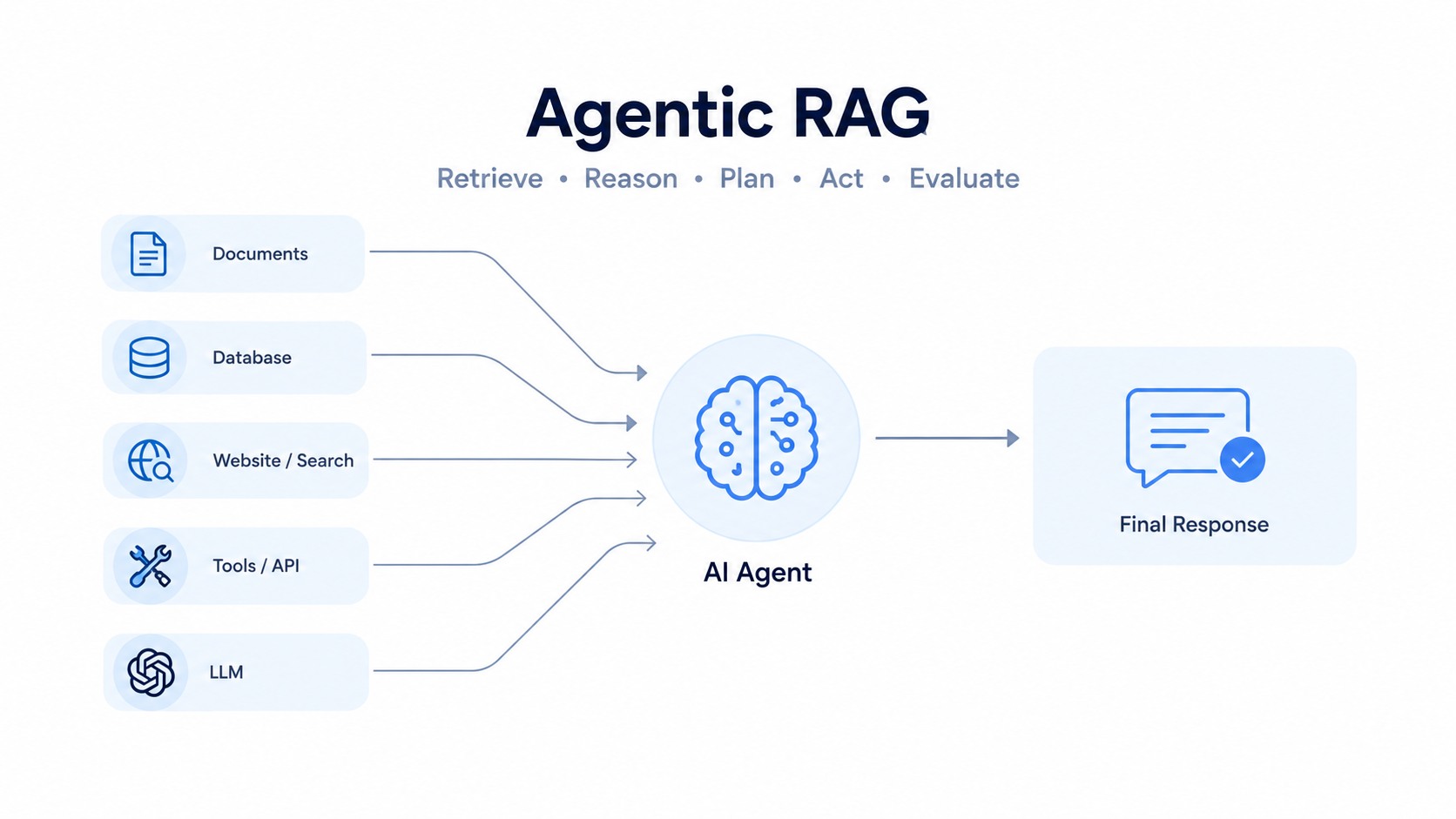
Agentic RAG combines information retrieval with AI agents that can reason, plan, and take actions. Unlike RAG, which usually retrieves information once and uses it to generate an answer, Agentic RAG allows the system to decide what information it needs, where to find it, and whether more information is required. This makes the retrieval process more flexible and useful for complex tasks.
The growing interest in Agentic RAG is also reflected in market projections. The global Agentic RAG market is expected to grow from USD 3.8 billion in 2024 to USD 165 billion by 2034, with a projected CAGR of 45.8%.
At the core of Agentic RAG is an AI agent that manages the process from start to finish. An AI agent can break a user’s request into tasks, retrieve relevant information, examine the results, and decide what to do next. If retrieved information is incomplete or does not answer the question properly, the agent can perform another search, use a different source, and then continue. This creates a cycle of retrieval, reasoning, and decision-making.
How Does Agentic RAG Work at a Conceptual Level?
Agentic RAG works as a decision‑making process. Agentic RAG decides what information is needed, where to look for it, which tools to use, and whether the gathered information is enough to finish the user’s request. Then, following a set order, Agentic RAG can make choices at each step and change its plan when new results appear.
Step 1: Retrieve the Required Information
Retrieval lets Agentic RAG reach out to sources when the knowledge needed for a task is missing from the model’s current context. Agentic RAG can search documents, knowledge bases, databases, websites, vector databases, APIs, and internal business systems.
Vector databases play a particularly important role here, since they store information as embeddings and allow the agent to retrieve results based on semantic similarity rather than exact keyword matches. First, Agentic RAG decides what information matters for the task; then it pulls the data. If the data found is incomplete or not useful, Agentic RAG can change its search style. Fetch more information.
Step 2: Reason About the Task
Reasoning helps Agentic RAG understand the user’s request and figure out what must be done to get the desired outcome. Agentic RAG looks at the question, pinpoints the needed information, and decides which actions might be required. For a request, Agentic RAG may need to see how different pieces of information connect before choosing what to retrieve or what tools to use. This lets Agentic RAG handle jobs that need decisions instead of just answering one question.
Step 3: Plan the Next Steps
Planning lets Agentic RAG split a job into smaller steps and map out how each step should happen. When a request needs data from multiple places or several actions, Agentic RAG builds a plan to finish the job. The plan can shift while the work goes on. If Agentic RAG finds that a step does not give the expected information, Agentic RAG can change the plan. Pick another route. This makes the workflow more flexible and fits tasks whose exact steps are unknown ahead of time.
Step 4: Use the Right Tools
Tool use allows Agentic RAG to talk to systems and programmes when extra information or actions are needed. Depending on the task, Agentic RAG may use search engines, databases, APIs, calculators, code runners, document libraries, or other linked software. Agentic RAG chooses the tool based on the task’s needs and uses the tool’s output to decide what comes next.
Step 5: Evaluate the Results
Evaluation lets Agentic RAG check the information and results it has gathered before giving the answer. Agentic RAG can decide whether the retrieved data is relevant, complete, and enough to answer the user’s request. If the data is missing or does not support the task well, Agentic RAG can go back to a stage and try another search, use a different tool, or change its approach. This creates a feedback loop in which Agentic RAG keeps retrieving and checking until it has context to move on.
Step 6: Generate the Final Response
Generation is where the language model uses the information collected during Agentic RAG’s workflow to craft the reply. Once Agentic RAG has gathered the needed data and confirmed it is sufficient, the model processes the context and writes an answer that meets the user’s request. The reply therefore comes from the model’s knowledge plus the data and results gathered by Agentic RAG.
Together, retrieval, reasoning, planning, tool use, evaluation, and generation let Agentic RAG treat a task as a process instead of a single fetch‑and‑answer operation. Agentic RAG can understand the goal, decide what information it needs to gather, use tools, evaluate the results, tweak its plan when necessary, and finally produce a response based on everything it has collected.
Who Is Agentic RAG For?
Agentic RAG is useful for companies and AI applications that need to work with large amounts of information, multiple data sources, and tasks that involve several steps. Agentic RAG is especially helpful when the route to an answer cannot be known before the task begins. Instead of following one fixed retrieval process, Agentic RAG allows the AI agent to decide what information is needed, where it should look, which tools may help, and whether the results are sufficient to move forward.
Agentic RAG makes it easier to gather, compare, check, or act on information before a final response can be produced. The agent can use the results from one step to influence the next step, making the workflow suitable when requirements can change as more information becomes available.
1. Companies With Multiple Data Sources
Companies usually store information across many different systems. Important data may be found in databases, documents, internal websites, cloud storage, customer management systems, business applications, and knowledge bases. A request from an employee may require information from more than one of these sources, making a simple retrieval system less useful when it can only search a predefined location.
Agentic RAG can help by deciding which sources are relevant to the request and retrieving information from them as required. Agentic RAG can use the results from one source to determine what information should be retrieved next,, combine information from locations, and identify gaps in the available data. This is useful for organisations where knowledge is distributed across systems, and agentic RAG needs to connect that information to complete a task.
2. Companies Building AI Assistants
AI assistants are increasingly expected to handle tasks rather than simply answer individual questions. A business assistant, for example, may need to look up company policies, check documents, retrieve customer information, use a business tool, and then provide an answer based on everything it has found. These tasks require the system to understand the user’s goal and determine which actions are needed.
Agentic RAG allows the assistant to manage these steps intelligently. The agent can break a request into tasks, retrieve the information required for each part, and use the results to decide what should happen next. If one source does not contain information, Agentic RAG can look elsewhere or use another tool before completing the request. This makes Agentic RAG useful for assistants that need to perform multi‑step tasks and work with changing information.
3. Applications That Require Research
Research applications often need to gather information from sources before producing a useful result. A question may require RAG to examine documents, search websites, compare different sources, and look for additional information when an important detail is missing. The exact information needed may become clear after the first set of results has been examined.
Agentic RAG can support this process by allowing the AI agent to adjust its research based on what it discovers. Agentic RAG can retrieve a set of information, evaluate the results, identify unanswered parts of the task, and perform additional searches when necessary. Instead of stopping after the first retrieval, Agentic RAG can continue working until it has enough relevant context to complete the research task.
4. Customer Support Systems
Customer support applications often need to bring information from different sources to understand and resolve an issue. Depending on the request, the required information could include product documentation, troubleshooting guides, FAQs, customer records, order details, or internal support information. The relevant source can be different for every customer query.
Agentic RAG can help the support system determine which information is needed for a problem and retrieve it from the appropriate sources. For example, if a customer reports a product issue, Agentic RAG may first retrieve troubleshooting information. Then look for product‑specific details or account information. Agentic RAG can evaluate the information it receives and search again if something important is missing before generating a response. This helps Agentic RAG provide answers based on the relevant available information.
5. Data and Business Analysis
Business analysis often requires information to be collected from systems before a useful conclusion can be reached. A company may need to compare sales figures, financial results, customer information, previous performance, and market data to understand a business situation. Simply retrieving one dataset may not provide context for the analysis.
Agentic RAG can manage this type of workflow by determining what information is required and retrieving it from the sources. Agentic RAG can compare pieces of data, identify patterns or gaps, and decide whether additional information is needed. For example, if a change in sales is identified, Agentic RAG may retrieve data or related business information to understand what caused the change before presenting its findings.
6. Knowledge Management
Companies often have amounts of internal knowledge stored across different locations. Employee guidelines, policies, technical documents, reports, meeting records, FAQs, and other resources may all exist in systems. Employees may know that the information exists but still spend time finding the correct document or source.
Agentic RAG can make this information easier to access by allowing an AI system to search across knowledge sources based on the user’s request. Agentic RAG can determine where useful information is likely to be found, retrieve content, compare results from different sources, and bring the information together in one response. This can be particularly useful when a question requires information from parts of an organisation rather than one specific document.
7. Developers Building AI Applications
Developers can use RAG when an AI application needs to work with external information, tools, or systems through multiple steps. Some applications may need to search a database for one part of a task, call an API for another, perform a calculation, and then use the combined results to generate a response. A fixed retrieval workflow may not be suitable when different requests require different actions.
Agentic RAG gives the application a way to make these decisions during the workflow. The AI agent can determine which source or tool is appropriate to use, use its output to guide the step, and change its approach if the results do not meet the task requirements. This is useful for developers building AI systems where the workflow needs to respond to the information it discovers by following the exact same sequence every time.
When Should You Use RAG?
Agentic RAG is most useful when an AI system needs to decide how to reach an answer rather than simply retrieve information from a known source. If a question can be answered by retrieving a few documents from one database, traditional RAG may be sufficient. Agentic RAG becomes more useful when the task involves sources, tools, decisions, or retrieval steps, and Agentic RAG needs to determine the next action based on what it finds.
You should consider RAG when your AI application needs to:
- Handle complex or multi‑step requests
- Gather information from different sources
- Decide which sources or tools are relevant
- Perform additional retrieval when the first results are incomplete
- Compare and evaluate information before responding.
- Change its workflow based on new findings
- Combine retrieved information with actions or tool outputs
- Continue working until it has context to complete the task
The main idea is that Agentic RAG is a better fit when the route to the answer cannot always be defined in advance. Agentic RAG can decide what to search for, what tools to use, how to respond to the information it finds, and whether another step is needed. This makes Agentic RAG useful for AI applications where completing the task requires more reasoning and decision‑making than a standard retrieval‑and‑generation workflow.
Types of Agentic RAG
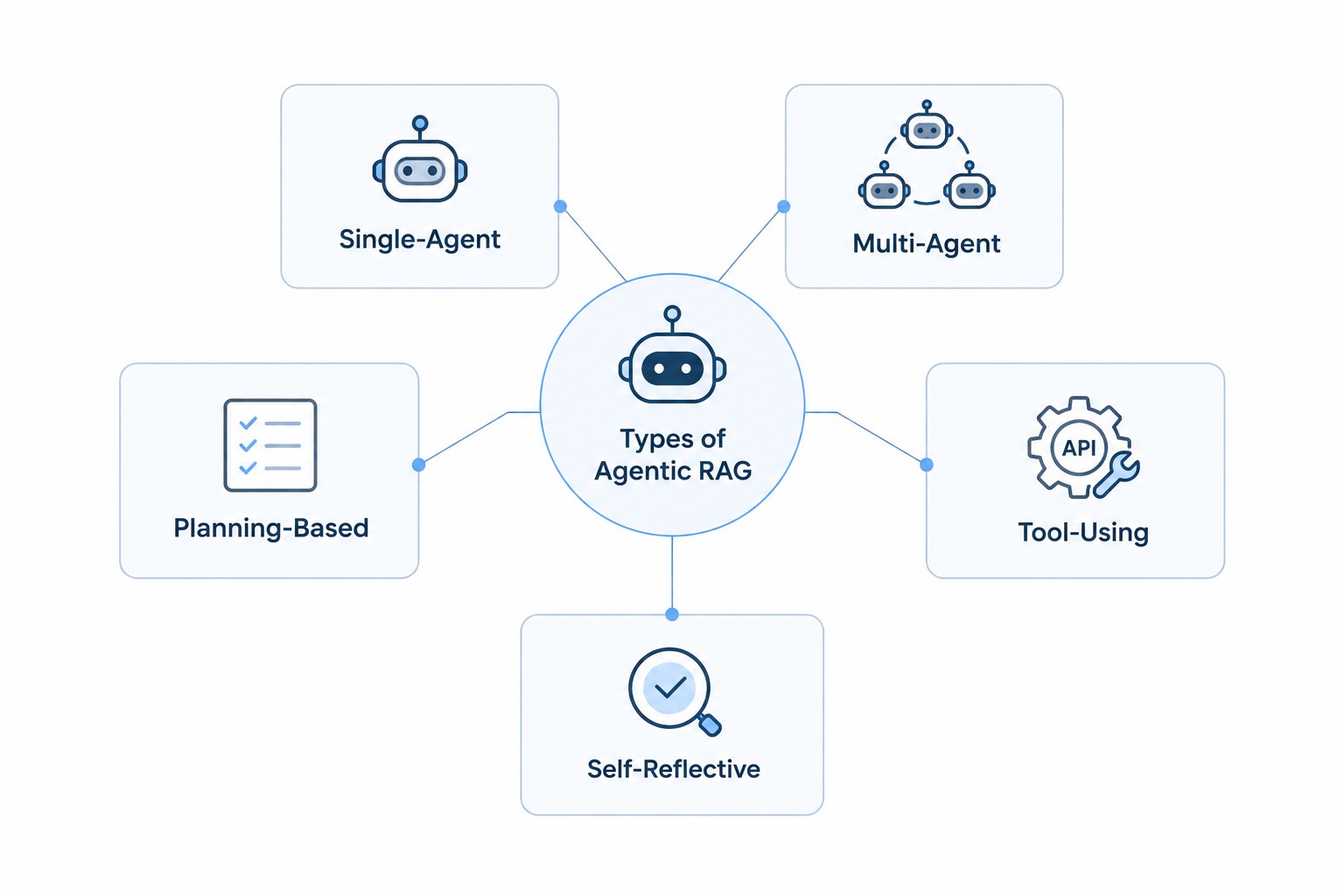
RAG can be built in different ways depending on how complex the task is, how many sources are involved, and how much freedom the AI agent is given to make decisions. Some systems use one agent to handle everything. Others split the work between agents or let the agent use outside tools. The main types of RAG include:
1. Single-Agent RAG
Single-Agent RAG uses one AI agent to manage the process from start to finish. The same agent handles understanding the user’s question, figuring out what information is needed, picking the sources, getting the data, checking the results, and finally creating the answer.
This agent works through each step without needing help from another agent to manage a part of the task. For example, if a user asks about a product, the agent can identify what details are needed, search the knowledge base, look at what was found and use that to build a response. This method works well when the task is not too complex and can still be handled effectively by an agent.
2. Multi-Agent RAG
Multi-Agent RAG uses AI agents that work together. Each agent focuses on a part of the task. Instead of one agent doing everything, the job is split up based on different roles. One agent might handle retrieving data. Another might analyse the information. A third might check the results. Help prepare the final answer.
These agents can share information. Use the output from each other to move the process forward. For example, in a research task, one agent could collect information from sources; another could compare the findings. A third could check whether the information is complete. This setup is helpful for more complex tasks where dividing up the work makes things easier to manage.
3. Planning-Based RAG
Planning-based agentic RAG lets the agent create a plan before or during the retrieval process. Instead of jumping straight into searching for information, the agent first looks at the overall goal and breaks it into smaller steps. It then decides what needs to be done and what information is needed at each stage.
The plan does not have to stay the same. As the agent finds information, it might realise that a step needs data or that a different approach would work better. It can then change the plan. Keep going. This makes planning- Based RAG suitable for tasks that need several steps in a certain order but where the exact path may shift as new information is discovered.
4. Tool-Using RAG
Tool-Using Agentic RAG lets the AI agent use outside tools when just retrieving information is not enough to finish a task. Depending on the request, the agent might use APIs, databases, search engines, calculators, data analysis tools, code execution systems, or business software.
The key is that the agent chooses which tool to use and when to use it based on the task. For example, it might get information from a database, use a calculator to process numbers, and then call an API to get details. The results from each tool can then guide the agent’s move. This approach is useful for tasks that need both information retrieval and real-world actions.
5. Self-Reflective Agentic RAG
Self-reflective agentic RAG adds a step where the AI system checks its work. Instead of assuming the first results are right or enough, the agent looks at the information it has found and the response it has made. It evaluates whether the information is relevant, complete, and useful.
If the results don’t give context, the agent can see what is missing and go back to the retrieval stage. It might change the search query, use a source, or collect more data before trying again. The workflow can look like this:
Retrieve → Evaluate → Improve → Retrieve Again → Generate
This approach works well for tasks where the quality and completeness of the information matter a lot. By reviewing its output before giving the final answer, the system gets a chance to fix mistakes and make the response better.
Which Type Should You Choose?
Choosing the Agentic RAG type depends on what the AI system must achieve, how complex the workflow is, how many data sources it must use, and how much freedom the Agentic RAG needs to make choices. A simple task can be handled well by a single-agent Agentic RAG, where one Agentic RAG controls retrieval, reasoning, and response creation. A complex task may gain from several agentic RAGs, each agentic RAG handling research, analysis, verification, or other workflow stages.
The choice also depends on how the Agentic RAG must interact with information and external tools. If a task needs a step‑by‑step order, a planning‑based Agentic RAG might be better. For applications that must use databases, APIs, calculators, or other external systems, a tool‑using Agentic RAG can help. If the Agentic RAG must verify accuracy and answer quality before delivering the reply, a self‑reflective Agentic RAG can add an extra review stage.
There is no Agentic RAG approach that fits every application. The best choice is the RAG that matches the task’s needs without adding needless complexity. By understanding the workflow, information sources, tools, and the amount of autonomy the agentic RAG needs, you can decide which type of RAG is most suitable.
Applications of Agentic RAG
RAG can be used in applications where AI must collect data, think about what it finds, and carry out several steps before giving an answer or performing an action. Unlike a search system that might look for relevant data and instantly produce a reply, Agentic RAG can decide what data is needed, pick among different sources or tools, judge the results, and keep the workflow going when more data is required.
This makes it useful in business and technical settings where data is spread across systems or where a task cannot be finished with a single search step. From research and customer help to software building and money analysis, Agentic RAG can help AI handle changing data and tasks that need choices.
1. AI Research Assistants
Agentic RAG can assist research assistants who must collect and examine data from various sources. A research question may split into small questions, and the information needed to answer one part may dictate what to search next. The agent can split the request into smaller jobs and pull data from relevant documents, websites, databases, or knowledge bases.
After collecting the data, the agent can compare the results, spot gaps, and run more searches when needed. It can also organise the gathered data before writing the answer. This makes Agentic RAG handy for research tasks where the system must explore a topic rather than pulling a fixed set of documents.
2. Customer Support
Customer help systems must give answers based on product facts, customer details, fix guides, FAQs, and internal help files. Different customer questions may need sources, so relying on a single knowledge base may not always give enough background.
Agentic RAG can tell which facts are relevant to the customer’s problem and fetch them from the places. If a fix guide does not fully solve the issue, the agent can look for product facts or customer‑specific data. It can then mix the gathered context. Write a reply that fits the customer’s exact situation.
3. Enterprise Knowledge Management
Businesses often keep data in documents, internal wikis, databases, cloud storage, reports, and company apps. Workers may need info from several of these places to finish a job. Checking each system by hand can slow things down and make tasks hard.
Agentic RAG can act as a layer over these knowledge sources. When a worker asks a question, the agent can see what data is needed, decide where that data might live, and pull content from different systems. It can then combine the findings. Give a single answer instead of making the worker hunt through many platforms alone.
4. Business Intelligence and Data Analysis
Business analysis often needs data from multiple sets before a useful conclusion can be made. For example, to understand a sales change, you might need sales numbers, past results, customer info, and data about a particular market or product.
Agentic RAG can gather the needed data. Use it to steer the next phase of analysis. The agent may compare periods, spot odd changes, fetch extra data to explain those changes, and use external tools when calculations are required. Once the data has been checked and studied, the system can present the results in a clear way.
5. Healthcare Information Systems
Healthcare systems hold lots of data across rules, research papers, patient files, hospital policies, and other medical sources. Apps working with this data may need to look at sources before giving useful info.
Agentic RAG can help such apps pull data from approved sources and link info from different parts of the workflow. The agent can check if the data is relevant and if any important context is missing before writing a reply. In high‑risk healthcare settings, Agentic RAG should support professionals instead of replacing medical judgement, and systems need proper privacy, checks, and safety controls.
6. Financial Analysis
Financial analysis often deals with information from statements, company filings, market data, reports, databases, and internal business systems. A good analysis may require the AI to compare numbers, look at trends over time, and do calculations before concluding.
Agentic RAG can handle these steps by fetching the financial data and deciding what more data is needed. The agent can compare figures from periods, spot key changes, run calculations with proper tools, and pull extra context when the numbers alone do not explain the situation. It can then use the collected data to build an analysis.
7. E‑commerce Applications
Agentic RAG can be used to build shopping helpers that need to understand what a customer wants and work with changing product data. A customer might give preferences, such as price range, product features, availability, size, or intended use, requiring the system to gather info from more than one source.
The agent can pull product specs, check stock via an API, compare items, and use the customer’s needs to narrow the available choices. If a preferred item is out of stock, the agent can look for alternatives that match the needs. This lets the helper treat product discovery as a multi‑step task rather than just returning search results.
8. Software Development
Developers often need data from code repos, docs, issue trackers, tech guides, databases, and past solutions when investigating a problem. A coding issue may also require the developer to understand both the code and the surrounding tech context before deciding how to fix it.
Agentic RAG can pull code, docs, bug reports, and tech info based on the problem being looked at. The agent can compare what it finds to spot useful parts of the codebase and search for more context when the first results are not enough. It can then use the gathered info to explain the problem or suggest a fix.
9. Legal and Compliance Applications
Legal and compliance work often needs data checked across rules, contracts, company policies, legal papers, and internal records. One question may involve rules or documents, and the needed info may lie in different places.
Agentic RAG can search across these sources. Decide which documents matter to the request. It can compare the data and spot gaps or conflicting points. Pull extra material when required. Before writing an answer, the system can evaluate whether the gathered data actually addresses the question. Because legal decisions can have effects, such systems should be used with proper professional review.
10. Personalised AI Assistants
Personalised AI helpers can use RAG when they must work with many sources, tools, and kinds of data to finish a user’s request. Instead of giving a quick reply based only on the chat, the helper can decide what data or actions are needed for that task.
For example, a helper may need to pull data from a knowledge source, use a calendar or another app, do a calculation, and then mix the results. Agentic RAG lets the system decide which steps are needed and whether another step is required before finishing the request. This makes it fit for helpers that manage tasks of just chatting.
Overall Applications of Agentic RAG
Agentic RAG is most useful in situations where AI needs to do more than pull data and generate a reply. Its ability to combine pulling, thinking, planning, tool use, and checking lets it handle workflows where the needed data may come from places and where the next step depends on what the system learns.
The main advantage is the flexibility to treat a request as a workflow instead of a single search operation. Whether the job involves researching data, analysing business numbers, fixing a customer problem, finding info, or working with company knowledge, Agentic RAG can help the AI decide what to pull, what to do with it, and when it has enough data to give a useful result.
Traditional RAG vs. Agentic RAG
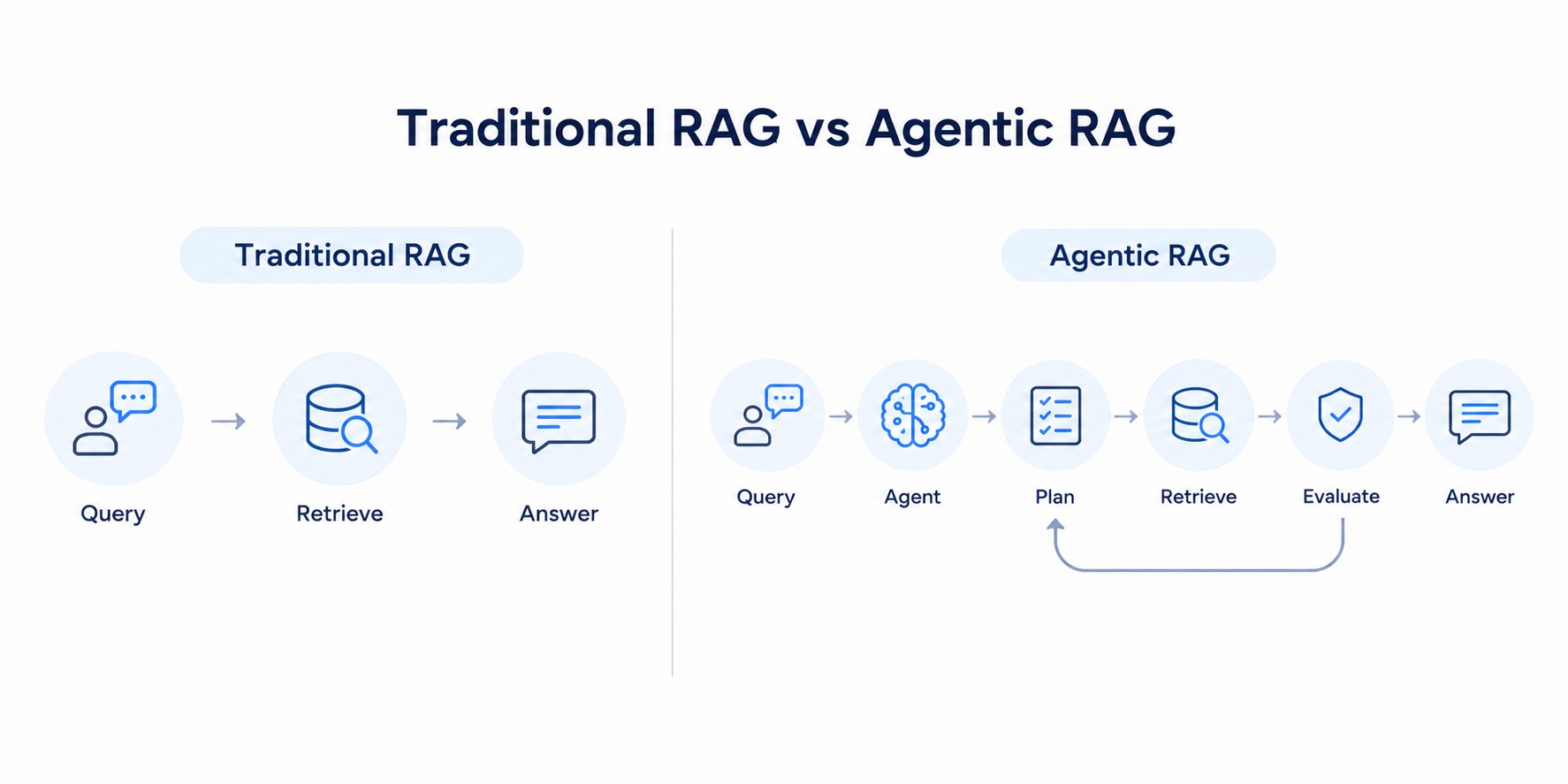
Traditional RAG and agentic RAG both rely on information to make AI responses better. They take different paths when it comes to retrieval. Traditional RAG sticks to a fixed step-by-step process for retrieving data. It does not change its approach based on what it finds or what the task requires.
On the other hand, Agentic RAG uses an AI agent that can think through the task plan, how to get the right information, use tools when needed, check results, and adjust its steps as it goes. This makes Agentic RAG more flexible and responsive. The main differences between them are listed below.
Why Traditional RAG Is Best for Simple Tasks?
Traditional RAG works well when the answer can be found by a search. The system takes the user’s question, looks in a knowledge base or document collection, pulls the most useful pieces, and gives that context to the language model to produce a reply. Because the workflow is usually predictable, the system does not need to make decisions about what to do next.
This makes Traditional RAG a practical choice for applications such as FAQ assistants, internal document search, product knowledge bases, and basic question‑answering systems. Traditional RAG is generally easier to build, maintain, test, and control because the workflow has moving parts. When the needed information sits in a known source and one retrieval step is enough, adding agent‑based decision‑making may give little extra value.
Why Is Agentic RAG Best for Complex Tasks?
Agentic RAG is better suited to tasks where finding the answer requires retrieval steps from different sources, external tools, or decisions along the way. Instead of following one fixed retrieval process, the AI agent can decide what information it needs, which source or tool to use, and whether the data gathered is enough to continue. The result from one step can influence what the agent does next.
For example, a complex business analysis may need the agent to pull data, compare it with previous results, perform calculations, and search for extra information to explain an unusual change. If the first retrieval does not give context, the agent can adjust its search and keep going. This ability to respond to information makes Agentic RAG useful for research, business analysis, complex customer support, technical troubleshooting, and other tasks where the path to the final answer is not fixed in advance.
Research and industry reports also point to potential improvements in response quality. Google reports that Gemini Enterprise can improve factual accuracy by up to 34% compared with standard RAG. Corrective RAG (CRAG) research has also reported a precision score of 0.69, a 10.5% hallucination rate, and 240 ms latency. These findings highlight how different retrieval approaches can affect the quality and reliability of AI-generated responses.
The main difference is therefore how much decision‑making the task requires. Traditional RAG is suitable when the system mainly needs to retrieve information and generate an answer. Agentic RAG is more suitable when the system must decide what to retrieve, what actions to take, how to evaluate the results, and whether another step is needed before completing the task.
Architecture of Agentic RAG
The architecture of RAG combines an AI agent, retrieval systems, knowledge sources, external tools, and a large language model to manage complex tasks that involve information. The AI agent serves as the core of the system. It controls the process. It decides what information is needed, where to get it, which tools to use, and whether the retrieved results are enough to answer the user’s question.
1. User Query Layer
The process starts when a user sends a question or a task to the RAG system. The query can be simple, like asking for a fact, or complex, requiring steps. Instead of jumping straight into searching the system, it sends the query to the AI agent first. This allows the agent to understand what the user really wants and figure out the steps needed to respond.
For example, a request such as "Analyse our sales performance this year, compare it with last year, and explain the major changes” means the system must work with different information sets and possibly do calculations before giving a complete answer.
2. AI Agent
The AI agent is the central decision-making component of Agentic RAG. It interprets the user's goal. Decides how to handle the task. Based on the query, it chooses which information sources to use, whether to break the task into parts, which tools or APIs to call, and whether more retrieval is needed.
The agent also keeps track of the task’s progress. If the information it gets in one step is not enough or if new needs come up, it can decide what to do. This lets the system change its path of following a fixed sequence.
3. Planning and Reasoning Layer
The planning and reasoning layer helps the agent break down tasks into steps. When a query involves dependent actions, the agent figures out what to do first and what information is needed for the next part.
For example, when analysing business performance, the agent may first get sales data. Then it retrieves the year's data. After that, it compares the two sets. It investigates why significant changes occurred. Finally, it prepares the analysis. If the results show missing pieces, the agent can adjust the plan. Retrieve more data.
4. Retrieval Layer
The retrieval layer connects the agent to the information. It searches knowledge sources based on the agent’s instructions and gets the data needed for the current task.
Agentic RAG can retrieve information more than once if needed. If the first results are not enough, the agent can refine the search. Ask for more data. This makes retrieval a part of the process, not just a single step before generating the final answer.
5. Knowledge Sources
Knowledge sources hold the data the Agentic RAG system uses. These sources can include company documents, PDFs, internal knowledge bases, websites, cloud storage, product manuals, databases, customer records, and other enterprise data.
The agent decides which source is best for each request. This is especially useful in organisations where information is scattered across systems and not stored in one place.
6. Tools and APIs
Agentic RAG can also use tools and APIs when just retrieving data is not enough. The agent decides when a tool is needed and includes it in the workflow.
For example, an e-commerce assistant may get product specs from a knowledge base. Then use an inventory API to check if the product is in stock. Similarly, a business analysis tool may get data and then use a data analysis tool to calculate trends.
7. Large Language Model
The large language model acts as the language and reasoning engine. It processes the information gathered during the workflow. It gets the user’s query, relevant retrieved content, output from tools, and instructions from the agent.
The LLM uses all this context to understand the data link pieces of knowledge and create a clear and meaningful response. While the agent manages the flow, the LLM is key in interpreting data and sharing the final output.
8. Evaluation and Feedback Layer
Before answering, Agentic RAG checks whether the gathered information is relevant and complete. The system can spot data, weak results or gaps in the information.
If the results are not enough, the agent can go back to the retrieval or planning stage. It may do another search. Use another tool. Once the system sees that enough information is available it moves on to generate the response.
9. Overall Architecture Flow
The overall flow of RAG can be described as:
User Query → AI Agent → Planning & Reasoning → Retrieval / Tools → Knowledge Sources → LLM → Evaluation → Final Response.
The key point is that this process does not end after one retrieval step. If the evaluation shows the information is not enough, the system can loop back to the agent. Keep retrieving, reasoning or using tools until the task is complete.
Advantages and Disadvantages of Agentic RAG
Agentic RAG gives flexibility and freedom compared to plain retrieval AI. It helps with tasks that need many sources, tools, and thinking. This extra smartness also makes Agentic RAG harder and costlier to create, keep up, and manage.
Advantages of Agentic RAG
1. Handles complex tasks
Agentic RAG can handle tasks by breaking a large request into smaller, manageable steps. Instead of answering everything at once, Agentic RAG understands the goal, chooses the needed information, and decides the order of tasks. This makes Agentic RAG useful for research, analysis, troubleshooting, and any job that needs more than a lookup.
As the task moves forward, Agentic RAG uses the result from one step to decide what comes next. For instance, while researching a topic, Agentic RAG first gathers background details, then searches for data, compares the findings, and finally uses those results to draw a conclusion. This skill of managing stages makes Agentic RAG better for complicated and open‑ended work.
2. Adaptive Retrieval
Agentic RAG uses retrieval, meaning Agentic RAG can change what and how it searches based on the results it receives. Agentic RAG does not need to rely on one search step. Agentic RAG can look at the data it has found and decide if it needs specific or extra information.
If the first search does not give context, Agentic RAG refines the query, searches another source, or pulls more documents. This creates a retrieval process where Agentic RAG constantly adjusts its search to fit the task’s needs, helping it find more relevant and complete data.
3. Uses Multiple Tools and Data Sources
Agentic RAG can use tools and data sources such as databases, APIs, search engines, documents, knowledge bases, and external applications. Agentic RAG chooses the source or tool for each part of the job instead of relying on just one information source.
This is especially helpful when needed information is spread over systems. Agentic RAG pulls data from sources, merges the relevant results and uses them to finish the job. This lets Agentic RAG handle a set of information and do tasks
ks that need both retrieval and external actions.
4. Handles Information Gaps
Agentic RAG can spot gaps in the data it has collected before it creates the answer. Agentic RAG checks whether the available data really answers the user’s request and notices when key details are missing, unclear, or not enough.
When Agentic RAG finds a gap, it can act to fill it. Agentic RAG may perform another search, pull data from a source, or use an external tool. This lets the system improve the quality and completeness of the data before answering.
5. Greater Autonomy
Agentic RAG offers autonomy because it decides the next action instead of following a rigid workflow. Agentic RAG makes choices based on the user’s request, the data it has fetched, and the outcomes of actions. This makes the system more flexible for tasks where the exact steps cannot be predicted ahead of time.
For example, if Agentic RAG finds that a source does not hold the information, Agentic RAG can pick another source or change its search on its own. Likewise, if Agentic RAG decides enough data has been gathered, Agentic RAG stops retrieving and moves on to produce the answer. This cuts down the need for humans to control every step of the process.
Disadvantages of Agentic RAG
1. Complexity
Agentic RAG contains many parts that must work together, such as AI agents, planning tools, reasoning engines, retrieval systems, knowledge bases, external tools, APIs, and evaluation layers. Unlike a process, these parts must talk to each other throughout the whole task.
This complexity makes Agentic RAG harder to design, put together, test, and keep running. Developers must watch carefully how Agentic RAG decides what to do and how it talks to systems. As the process gets more advanced, keeping all parts reliable often needs a lot of developer work.
2. Cost
Agentic RAG may need many calls to large language models, retrieval services, databases, APIs, and external tools to finish one job. A hard question can set off search, reasoning steps, and tool uses instead of a single pass. Every extra step raises computing needs and API fees.
This matters a lot for companies that serve users or ask tough questions because repeated searches and LLM calls can raise the total running cost a lot.
3. Slower Response Time
Agentic RAG takes steps to solve a tough problem, which can lengthen the time to give an answer. First, the agent looks at the question, builds a plan, fetches data, checks the results, and may do searches or tool calls.
This back‑and‑forth can make answers better. It also adds delay. Apps that need replies might have to weigh the gain of deeper thinking against the extra waiting time.
4. Risk of Incorrect Decisions
Agentic RAG lets the agent pick its move on its own. That freedom can also bring choices. The agent might pick a source, use the wrong tool draft a bad plan, or think the data it got is enough when it is not. A wrong move early can mess up steps.
Therefore, Agentic RAG needs safety checks, monitoring, and tests to lower the damage from bad agent choices.
5. Difficult to Test and Evaluate
Testing agentic RAG is harder because it does not always take the same route for each question. Depending on the job, the agent may pick sources, do different fetches, call various tools, or build varied plans before it answers. Developers must look at the answer and the whole path the agent walked. They must verify that the chosen sources were good, that the fetches worked, that tools were used correctly, and that the agent made choices at every step. This makes debugging and measuring performance take time.
Conclusion
Agentic RAG goes beyond simple information retrieval by combining retrieval, reasoning, planning, tool use, and self-evaluation. This makes it useful for multi-step tasks across research, customer support, business analysis, healthcare, finance, and software development.
While it offers greater flexibility, it also brings challenges such as higher complexity, costs, and the need for careful evaluation. Code B can help businesses build Agentic RAG solutions with the right AI models, data sources, integrations, and workflows for their specific needs.
Frequently asked questions

 WhatsApp
 Call Us
 Mail Us