


Building an Event Management Web Application: Essential Features & Implementation Guide



Creating a robust event management web application requires careful planning and a comprehensive understanding of user needs. This guide outlines the essential features and implementation steps necessary to build a successful event management platform that serves both event organizers and attendees effectively.
Core Features Checklist
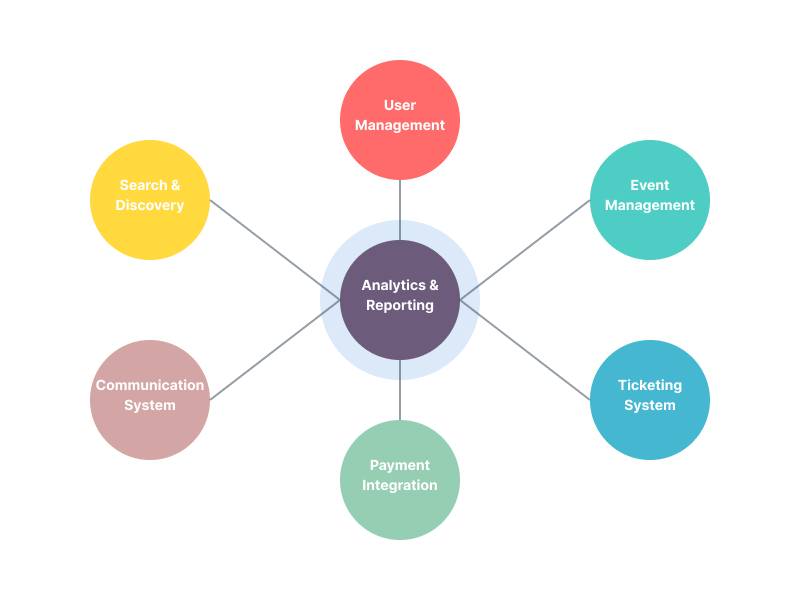
User Management System
The foundation of any event management platform is a robust user management system. This should include comprehensive registration and authentication mechanisms, supporting both email/password registration and social media authentication through providers like Google and Facebook. The system should implement role-based access control, distinguishing between administrators, organizers, and attendees. Users need the ability to manage their profiles with customizable settings, and the system must provide password recovery and email verification functionalities for security.
Event Creation and Management
Event creation should be intuitive yet comprehensive. Organizers need to input event details including titles, descriptions, and categories, along with date and time selection that supports multiple timezones. Venue information should be enhanced with map integration for easy location discovery. The platform should support various ticket types and pricing tiers, along with custom registration forms. Event capacity management is crucial, as is the ability to modify or cancel events. Additional features should include draft saving, event preview functionality, and the ability to duplicate events for recurring occasions. A rich text editor enhances event descriptions, while image upload capabilities allow for engaging event banners and galleries.
Ticketing System
The ticketing system forms the core revenue generator for most event platforms. It should support multiple ticket types, from VIP to Early Bird and Regular admission. Implementation of dynamic pricing based on dates helps maximize revenue, while promotional codes enable marketing strategies. The system should handle bulk ticket purchases and maintain waitlists for popular events. Clear refund and cancellation policies must be implemented, along with digital ticket generation featuring QR codes. Ticket transfer capabilities between users add flexibility for attendees.
Payment Integration
Secure payment processing is paramount. The system should integrate with reliable payment gateways and support multiple payment methods including credit/debit cards, digital wallets, and bank transfers. For international events, currency conversion is essential. The platform needs automated refund processing, comprehensive payment status tracking, automated invoice generation, and robust financial reporting tools.
Communication System
Effective communication ensures smooth event operations. The system should send automated email notifications for registration confirmations, payment receipts, event reminders, and important updates. An in-app messaging system facilitates direct communication between organizers and attendees. Organizers need mass communication tools with custom email template capabilities. Optional SMS notifications and communication history tracking enhance the user experience.
Search and Discovery
Users should easily find relevant events through advanced search functionality. This includes searching by category, location, date range, and price range. The platform should implement a recommended events algorithm and showcase popular events and trending categories. Users benefit from saved searches functionality and a comprehensive event tagging system.
Analytics and Reporting
Data-driven decision making requires robust analytics. Track ticket sales, attendance rates, revenue metrics, and traffic sources through a real-time dashboard. The system should generate custom reports exportable in various formats. User behavior analytics and marketing campaign tracking provide valuable insights for organizers.
Technical Implementation
Frontend Development
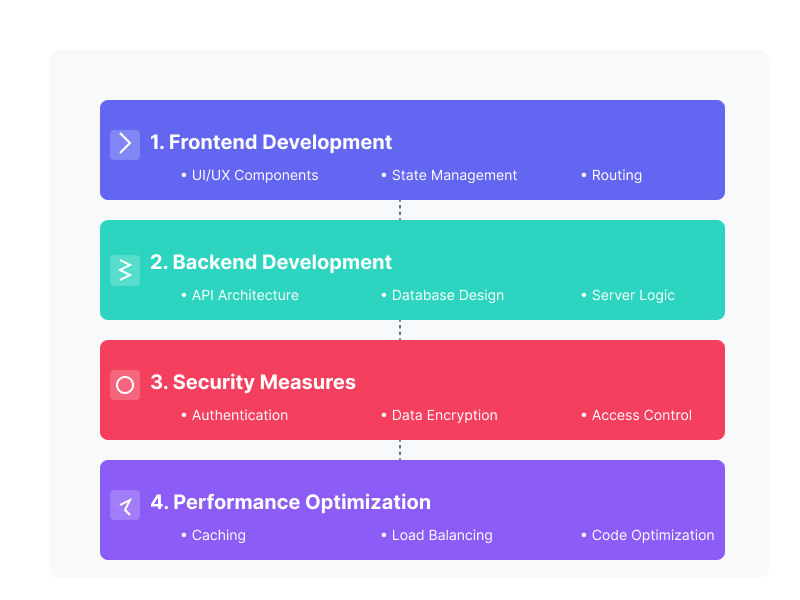
The frontend requires a modern JavaScript framework such as React, Vue, or Angular. Implement state management solutions, integrate UI component libraries, and ensure proper form validation. Include comprehensive date/time handling and maps integration. Real-time updates through WebSocket enhance the user experience.
The frontend architecture forms the foundation of user interaction with your event management platform. React, Vue, or Angular serve as excellent choices for the core framework, each offering robust component-based architecture. React, with its Virtual DOM and extensive ecosystem, particularly excels in building dynamic user interfaces required for real-time event management.
State management requires careful consideration. Redux or Redux Toolkit provides centralized state management for React applications, handling complex data flows like shopping cart management and user sessions. For Vue, Vuex offers similar capabilities, while Angular applications benefit from NgRx.
Backend Development
The backend architecture must handle high concurrency and maintain data consistency. A microservices approach using Node.js with Express or NestJS allows for better scalability and maintenance. Each major function (authentication, ticketing, payments) can operate as an independent service.
Database design requires careful consideration of relationships and access patterns. PostgreSQL excels for complex relationships in event management, while MongoDB offers flexibility for unstructured data like user preferences and event details. Implement database sharding for improved performance with large datasets.
API architecture should follow RESTful principles with clear versioning. Implement GraphQL for complex data requirements, allowing clients to request specific data combinations.
The API layer should include:
- Rate limiting for API endpoints
- Request validation middleware
- Response compression
- Error handling with meaningful messages
- Logging and monitoring capabilities
Security Measures
Security implementation includes SSL certification, data encryption, and GDPR compliance. Regular security audits, DDoS protection, thorough input validation, rate limiting, and secure payment handling are essential.
Security implementation requires a multi-layered approach. SSL/TLS encryption using modern protocols (TLS 1.3) secures data in transit. Implement HSTS headers to prevent protocol downgrade attacks.
Authentication security includes:
- JSON Web Tokens (JWT) with appropriate expiration times.
- Refresh token rotation for extended sessions.
- Password hashing using bcrypt with appropriate salt rounds.
- Multi-factor authentication for sensitive operations.
- Session management with secure cookie configuration
Performance Optimization
Frontend performance optimization starts with proper code splitting and lazy loading implementation. Use webpack's dynamic imports to load components on demand. Implement resource hints like preload and prefetch for critical assets.
Image optimization requires multiple approaches:
- Responsive images using srcset and sizes attributes
- WebP format with fallbacks
- Lazy loading for off-screen images
- Image CDN integration for automatic optimization
- Progressive image loading for larger assets
Caching strategy implementation:
- Browser caching with appropriate cache-control headers
- Service Worker for offline functionality
- Application shell architecture
- Local storage for user preferences
- IndexedDB for larger datasets
Database optimization includes:
- Proper indexing strategy
- Query optimization and monitoring
- Database connection pooling
- Partial data fetching
- Efficient pagination implementation
Server-side optimization requires:
- Load balancing configuration
- CDN integration for static assets
- Response compression
- API response caching
- Database query caching
Monitoring and analytics:
- Real-time performance monitoring
- Error tracking and reporting
- User behavior analytics
- Performance budget implementation
- Regular performance audits
These technical implementations require continuous monitoring and optimization. Regular performance testing and user feedback help identify bottlenecks and areas for improvement. Implementation should be iterative, focusing on critical paths first and gradually expanding to cover all aspects of the platform.
Development Phases
Phase 1: MVP Development
Begin with core functionalities: basic user authentication, simple event creation, fundamental ticket management, essential payment integration, and basic email notifications.
Phase 2: Enhanced Features
Build upon the MVP by adding advanced user roles, complex ticket types, promotional features, enhanced search capabilities, and basic analytics.
Phase 3: Advanced Features
Complete the platform with a comprehensive analytics suite, advanced integrations, mobile optimization, marketing tools, and sophisticated reporting capabilities.
Testing and Quality Assurance
Implement comprehensive testing including unit tests, integration tests, and user acceptance testing. Conduct thorough performance and security testing. Ensure cross-browser compatibility and mobile device optimization.
Maintenance and Updates
Maintain platform health through regular security updates, feature enhancements, and bug fixes. Monitor performance, implement user feedback, maintain system backups, and keep documentation current.
This comprehensive approach to building an event management platform ensures a robust and user-friendly system. Remember to prioritize features based on specific user needs and market requirements, implementing them iteratively to maintain quality throughout the development process.
Conclusion
Building a successful event management web application is a complex but rewarding endeavor that requires careful planning, systematic implementation, and continuous refinement. The key to success lies in understanding that such a platform is more than just a technical solution – it's a comprehensive ecosystem that brings together organizers, attendees, and service providers in a seamless digital environment.
The most successful event management platforms are those that strike the perfect balance between feature richness and user simplicity. While the technical infrastructure must be robust enough to handle complex operations, the user interface should remain intuitive and accessible. Throughout the development process, it's crucial to maintain focus on the end-user experience while ensuring the platform's scalability, security, and performance.
Remember that building an event management platform is an iterative process. Starting with a solid MVP and gradually expanding features based on user feedback and market demands will lead to a more sustainable and successful product. Regular updates, maintenance, and adaptation to emerging technologies and user needs will ensure the platform remains competitive and relevant in the dynamic event management landscape.
The future of event management platforms lies in their ability to adapt to hybrid events, integrate with emerging technologies, and provide increasingly personalized experiences. By following this comprehensive guide and staying attuned to industry trends and user needs, developers can create a platform that not only meets current requirements but is also prepared for future evolution in the event management space.
 WhatsApp
 Call Us
 Mail Us