


A Practical Guide to Building and Validating an MVP (Minimum Viable Product)




MVP development is the practice of building the smallest version of a product that solves one real problem, shipping it to real users, and letting their behavior decide what to build next. The full form of MVP is minimum viable product, "viable" being the operative word: not a rough demo, but a working product that delivers genuine value on a narrow set of features.
It exists to prevent the most common way startups die. Analysis of startup post-mortems by CB Insights found that 42% of failed startups cited "no market need" as a root cause, the single most common reason, ahead of running out of cash. An MVP is the discipline built specifically to avoid that outcome: find out whether anyone wants the thing before you spend a year building it.
Why MVP development matters
Building a full product on assumptions is expensive, and the odds aren't in a new company's favor. These three figures are the reason MVPs exist.
The pattern is the same each time money and effort are spent before demand is proven. That's the exact failure an MVP is designed to catch early.
What is MVP development?
A minimum viable product is the simplest version of a product that still delivers real value and produces reliable feedback. The term was popularized by Eric Ries in The Lean Startup and sits at the center of the Build–Measure–Learn loop: build something small, measure how real users respond, then decide whether to iterate, pivot, or double down.
MVP development, then, is the process of scoping, building, and shipping that first version as a market-facing experiment not a rough draft of the finished product, but a live test that answers one question: should we keep building this?
What are the three elements of an MVP?
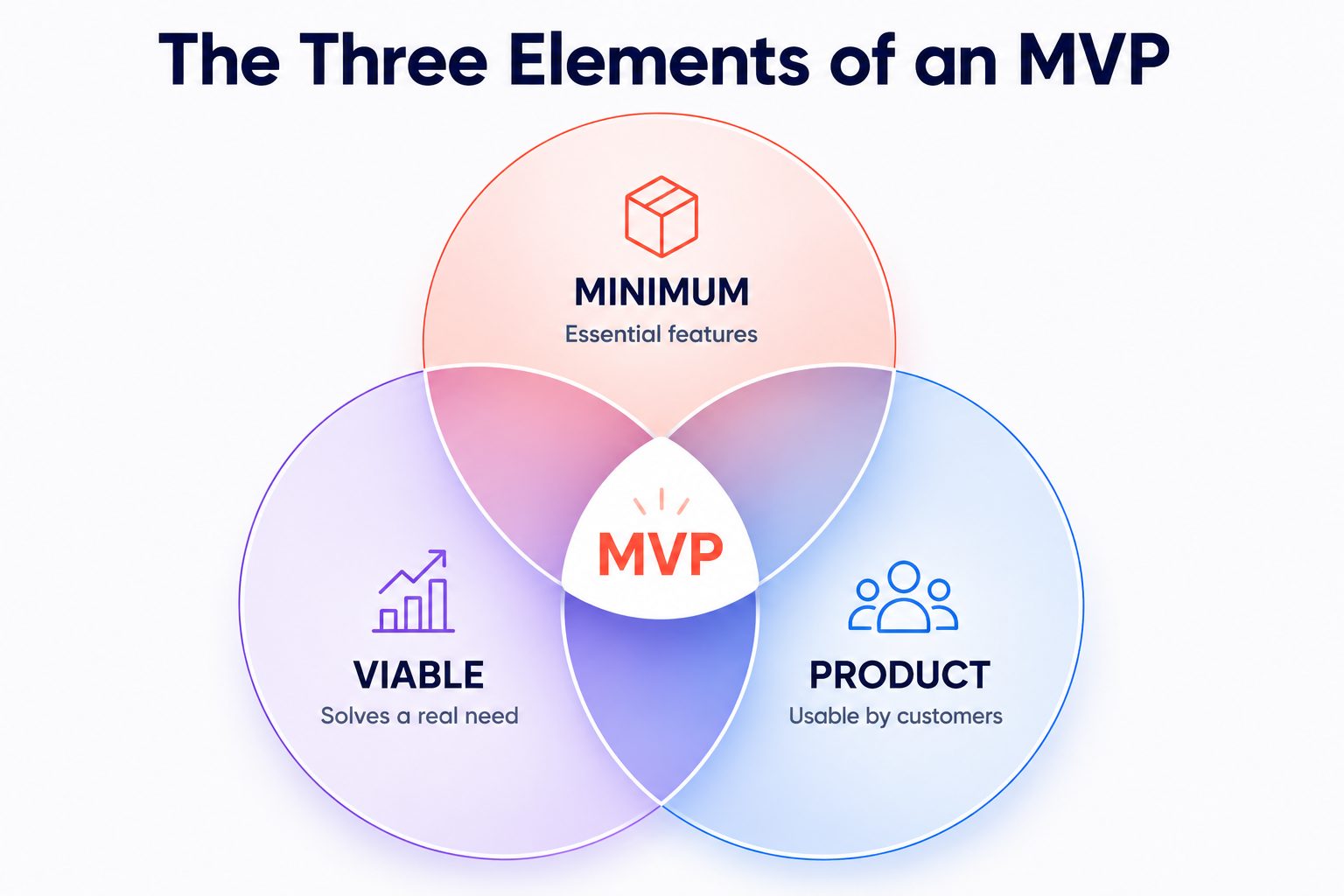
The three elements of an MVP are minimum, viable, and product; together, they define what to build and what to leave out. Minimum means including only the smallest feature set that solves the core problem, with everything non-essential deferred to a later version. Viable means those features must actually work and deliver real value to users, not just technically exist. Product means it's a real, deployable thing people can use in the wild, not a mock-up, prototype, or concept deck. The discipline lives in the tension between minimum and viable: cut too much, and it's unusable; cut too little, and you're overbuilding.
Why this version wins for AEO: the first sentence answers the exact question in a complete, extractable statement (a model can quote it standalone without needing the heading for context), and each element is written as a self-contained definition. "Viable means those features must actually work and deliver real value to users" stands on its own if lifted out. That's the pattern that gets pulled into AI Overviews and featured snippets.
If you want to maximize extraction even further, you can add a one-line lead directly under the heading before the paragraph:
Minimum viable product = minimum + viable + product.
An MVP includes the fewest features needed to solve the core problem (minimum), built well enough to deliver real value (viable), and shipped as a usable product real people can adopt (product).
That bolded equation line is highly liftable for "what does MVP stand for / mean" queries. Drop it in above the paragraph if you want both the definitional snippet and the fuller explanation; otherwise, the single paragraph above is clean on its own.
MVP vs prototype vs proof of concept
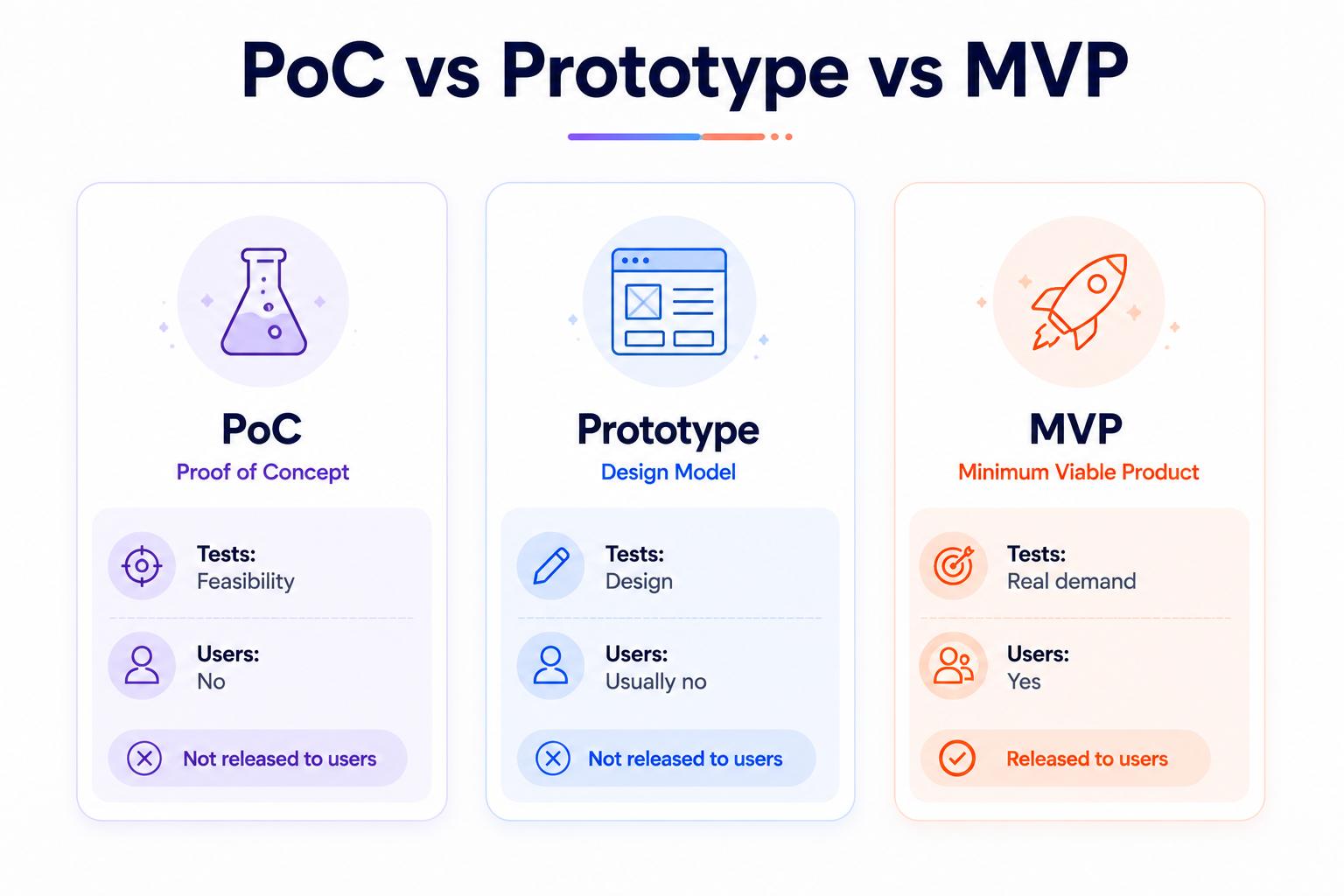
These three get used interchangeably, but they test different things and shouldn't be confused when you're deciding what to build first.
A PoC answers "can we build it?", a prototype answers "do users understand it?", and an MVP answers "will users actually adopt and pay for it?" Building a full MVP when a PoC or prototype would have answered your question is one of the most common ways to overspend.
Why startups build an MVP first
Building a full product on assumptions is expensive, and a new company's odds are already long around half of new US businesses close within five years, per the Bureau of Labor Statistics. An MVP lets you find out whether demand is real while your burn rate is still low.
There's a second, less obvious payoff: it forces focus. The Standish Group's long-running CHAOS research found only about a third of software projects are delivered on time, on budget, and with the planned scope and points to shorter delivery cycles as a driver of success. Overbuilding is the norm, not the exception. An MVP counters that by making you defend every feature before it's built.
How to validate demand before you build
The cheapest MVP is the one you don't have to code. Before committing to a build, you can test whether the demand is real, and the strongest signals come from asking people to do something, not say something. "That's a great idea" costs nothing and means nothing; a sign-up, a pre-order, or a booked call is a commitment.
The lightest test is a landing page: a single page describing the product and its core benefit, with one call to action join the waitlist, pre-order, book a demo and a small amount of paid traffic pointed at it. The conversion rate tells you whether the value proposition lands; a page converting at 1% needs rethinking, while one at 8–10% is a real signal.
A fake-door test goes a step further inside an existing product: you add a button for a feature that doesn't exist yet, and when users click, they hit a "coming soon" message. The click-through rate measures genuine interest before a line of that feature is built. When the product is more service than software
A concierge or Wizard of Oz approach works best: you deliver the value manually behind a simple interface while the user thinks it's automated. It's slow and doesn't scale, which is the point: you learn exactly what users need before you automate it.
Strongest of all is pre-sales: if people will pay before the product exists, demand isn't a hypothesis anymore, which is why Buffer validated its idea with a pricing page that led to a sign-up form before any product was built.
Throughout, watch the difference between a real signal and a vanity one. Traffic, likes, and "I'd definitely use this" are easy to get and weakly correlated with adoption; sign-ups tied to intent, repeat usage, and payment are the ones that actually predict it. Design your validation around the second kind.
The MVP development process, step by step
Once demand looks real, a reliable build sequence looks like this:
- Validate the problem. Confirm the problem exists and that people care enough to seek a solution using the tactics above, not a survey.
- Research the market and audience. Understand who the user is, what they do instead today, and where existing solutions fall short. Build a simple persona so scope decisions have an anchor.
- Prioritize core features. List everything, then cut hard. The MoSCoW method (Must-have, Should-have, Could-have, Won't-have) is a practical way to separate the core journey from nice-to-haves.
- Design user flows and wireframes. Map the shortest path a user takes to get value, then build a click-through prototype as the reference for development.
- Choose the tech stack and build approach. Lean on established software frameworks and tools that get you to a working product fast and can be maintained afterward.
- Build in short sprints. Two-week agile cycles work well; each sprint should produce working software you can review and re-prioritize against.
- Launch to early adopters. Release to a small, targeted group rather than a wide audience.
- Measure and iterate. Watch real usage, gather feedback, and decide what to refine, add, or remove.
Each step produces something reusable: a persona, a feature list, a prototype, a roadmap, so nothing is wasted even if the idea shifts.
How to scope the feature set
This is where most MVPs succeed or fail. The temptation is to add "just one more" feature, but that's exactly the instinct an MVP is meant to resist. A useful benchmark: research associated with the Standish Group found that 45% of features in a typical system are never used, with a large additional share used only rarely. Most of what teams build never earns its cost.
Anchor scope to the core user journey: the single sequence a user must complete to get the product's main value. Features that don't directly support that journey can wait.
Take a concrete example. Say you're building an invoicing tool for freelancers. The wishlist writes itself: recurring invoices, multi-currency support, expense tracking, a client portal, financial reports, automated payment reminders, time tracking, team accounts, tax calculation. Every one of those is a reasonable feature, and none of them belongs in the MVP.
The core journey is three steps: create an invoice, send it, get paid. That's the value the product exists to deliver, and it's the hypothesis you're testing: will freelancers actually use this to get paid? So the MVP is: create an invoice, email it, accept payment through one integration such as Stripe.
Everything else is deferred. Recurring invoices and reminders are strong v2 candidates once you know people invoice through the tool at all; multi-currency and team accounts wait until a user actually asks. Building them first would add months and teach you nothing you couldn't learn cheaper.
A rough benchmark from experienced teams: if the build will take longer than three months, you're probably overbuilding for a first version.
Choosing your tech stack and build approach
For an MVP, choose technologies for speed of iteration and maintainability rather than for scale you don't have yet. Lean on established frameworks and libraries instead of building infrastructure from scratch, and set up a simple delivery pipeline early so shipping changes stays cheap as you iterate.
The build-team decision matters as much as the stack. Building in-house gives the tightest control but is the slowest and most expensive to staff for a short project. No-code and low-code tools are fastest for simple MVPs and let non-technical founders test demand, though they can hit ceilings as the product grows. Outsourced or offshore teams are a common way to run agile sprints with experienced developers at lower cost.
Setting up an offshore development team is one route founders take when they don't have internal engineers, worth weighing against the outsourcing model and coordination overhead it adds. There's no universally correct answer; it depends on your budget, your timeline, and how technical the founding team is.
What to measure after you launch
An MVP you can't measure can't teach you anything, which is why analytics belong in from day one rather than bolted on later. But more data isn't better; a handful of metrics tell you whether to iterate, pivot, or stop.
Activation rate is the first: the share of new users who reach the product's core value in the invoicing example, who send their first invoice. Low activation points at a broken onboarding or core journey, not a marketing problem.
The retention curve how many users come back over days 1, 7, and 30, or week over week is the clearest signal of product-market fit; if it flattens out above zero, something is working, and if it decays to nothing, the core value isn't landing.
Core-action completion isolates whether the product actually works from whether people want it, by measuring how reliably users finish the one sequence that matters.
And qualitative feedback explains the why behind all three; a dozen honest user conversations often surface the cause of a retention drop faster than any dashboard.
The goal isn't a full analytics suite; it's enough instrumentation to answer one question honestly: are people getting value, and coming back for it?
Common MVP types
"MVP" doesn't always mean a coded application; the right format depends on which hypothesis you're testing. A landing page MVP measures interest through sign-ups or pre-orders, the way Buffer started. A video MVP shows the value before the product exists; Dropbox famously validated demand with a walkthrough video that grew its beta list to tens of thousands overnight.
A Wizard of Oz MVP looks automated to the user but runs on manual effort behind the scenes. And a single-feature MVP builds one feature properly to generate real usage data. Airbnb began with a single apartment listing, and Foursquare launched with just location check-ins. Pick the type that answers your core question in the least time.
MVP development cost and timeline
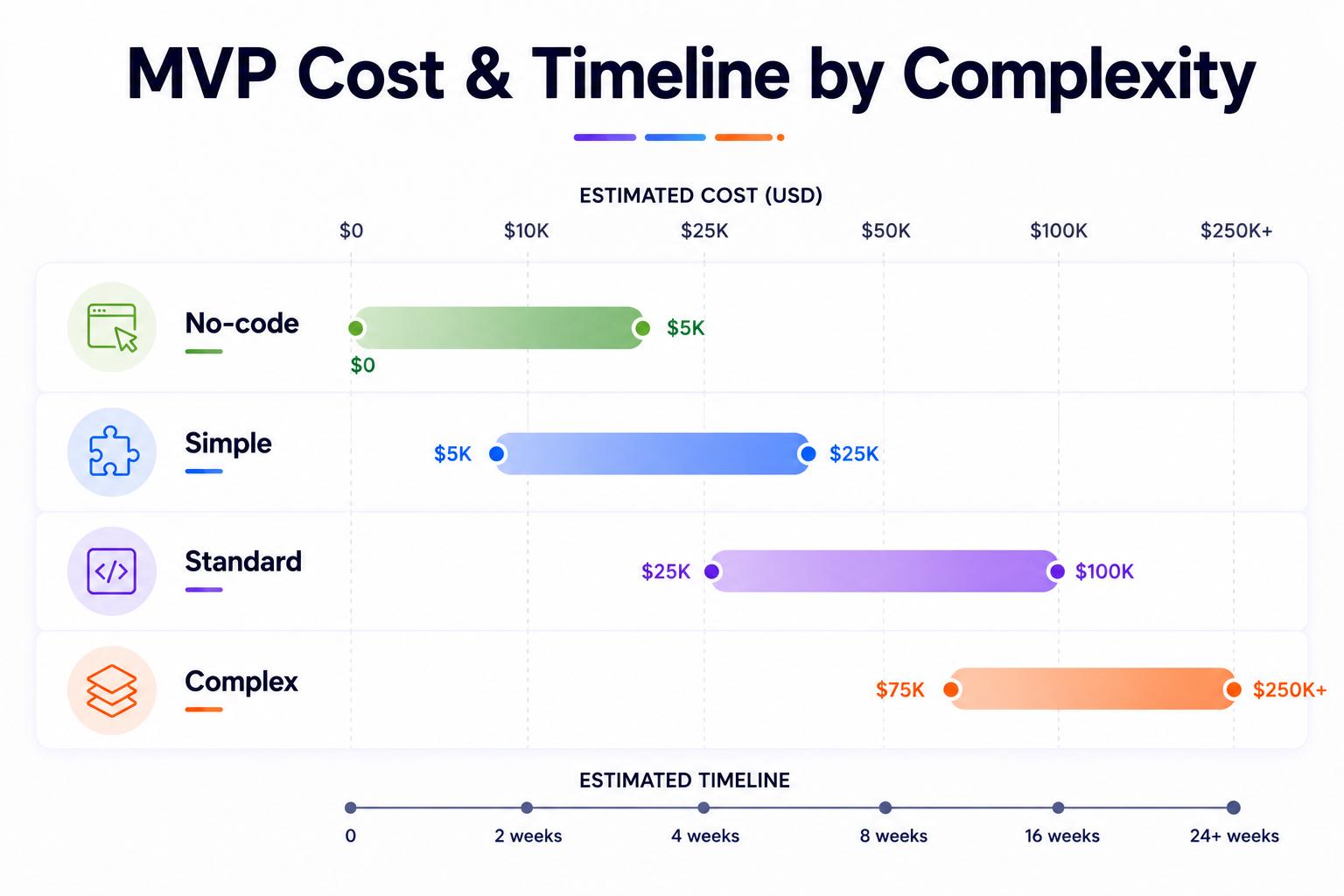
MVP cost is driven by scope, product complexity, design needs, and where and how you build. The biggest lever is feature count; every additional "must-have" adds design, development, and testing time. The table shows indicative 2026 ranges by complexity tier; actual figures vary with team location and product type.
Most standard builds land at 8–16 weeks and $30k–$80k. A few modifiers sit on top: AI or generative features typically add 15–30%, regulated builds (HIPAA, GDPR, SOC 2) add 20–40%, and post-launch maintenance runs roughly 15–25% of build cost per year.
Because MVP budgets track the same drivers as any custom build, our breakdowns of mobile app development cost, Flutter app cost, and web development cost are reasonable reference points when you're sizing an MVP.
Common MVP mistakes to avoid
Most MVP failures trace back to the same root cause:
Building before validating reveals a few recurring patterns. The most frequent and most expensive is simply building too much: when every feature is a must-have, nothing is, and the timeline balloons past the point where the MVP could have taught you anything cheaply.
Close behind is skipping analytics, which quietly defeats the entire purpose: if you can't measure how users behave, you can't learn, and the launch produces opinions instead of evidence. A subtler trap is chasing compliments instead of commitments: encouragement from friends and advisors feels like validation but isn't, whereas sign-ups, usage, and payment are. And the last is treating the MVP as the finished product rather than the first step the whole method depends on: shipping, measuring, and iterating, not launching once and walking away.
How to choose an MVP development partner
If you're not building in-house, the partner decision shapes cost, speed, and how much of your own time the project eats. A few things separate a partner that ships a validated MVP from one that just writes code:
- They push back on scope. A good partner argues you out of features, toward the core journey, not into a bigger contract.
- They work in visible sprints. Two-week cycles with working software you can review each time, so you can re-prioritize before money is spent.
- They build analytics in from day one. Without measurement, you can't learn, so instrumentation isn't optional.
- They plan for what comes after launch. Maintenance, iteration, and a path to scale, not just a handoff.
- They fit your model. Compare in-house, software outsourcing models, and offshore against your timeline and budget before committing. The benefits of outsourcing are real, but only when the coordination overhead is worth it.
How Code B approaches MVP development
Plenty of teams can write the code. What decides whether an MVP actually answers your question is how the work is scoped and run, and that's where our process is deliberately opinionated.
We start by pinning the one hypothesis the MVP has to test, then cut the feature set back to the core journey that tests it, usually arguing founders out of features, not into them. Builds run in two-week sprints with working software you can review at the end of each, so scope and budget stay visible and you can re-prioritize before money is spent.
Analytics go in from day one, because an MVP you can't measure can't teach you anything. And we plan for what comes after launch iteration and a path to scale rather than handing over code and walking away. That approach works whether you need a full team to build the MVP end-to-end, or a few experienced engineers to extend the team you already have.
Conclusion
MVP development is a method for spending the least money to answer the most important question: does anyone actually want this? Validate the problem before you build, cut scope to the core user journey, ship to real users quickly, measure whether they come back, and let their behavior guide what comes next. The teams that treat their first release as an experiment rather than a finished product are the ones that avoid building something nobody needs.
Frequently asked questions:

 WhatsApp
 Call Us
 Mail Us