


The Role of NLP in Healthcare: Use Cases, Benefits, and How It Works




In healthcare, natural language processing (NLP) converts unstructured text and speech, such as clinical notes, lab reports, and voice recordings, into structured data that systems can search and analyze. It reduces manual documentation, speeds up coding and record review, and gives healthcare teams cleaner data to work with.
Around 80% of healthcare data is unstructured, so most of it sits in free-text notes that traditional systems can't use. That gap is also why the market around it is growing fast: MarketsandMarkets puts the NLP in healthcare and life sciences market at $8.14 billion in 2026, rising to $30.06 billion by 2031. This guide covers what NLP does, the problems it solves, its main use cases, and what to consider before implementing it.
What Is NLP in Healthcare, and What Does It Actually Do?
You've heard NLP is AI that understands language. Here's what that looks like in a hospital or health-tech setting, and what kind of data it actually works with.
NLP in Simple Terms
Healthcare is a harder test for it. Clinicians write fast and use shorthand, abbreviations, and half-finished sentences. Take a note like "pt c/o SOB, denies chest pain." A person can tell this means the patient reports shortness of breath but has no chest pain. A traditional system sees a string of characters. NLP can identify the medical terms, expand the abbreviations, and recognize that "denies" turns chest pain into something the patient does not have.
In practice, NLP does three things:
- Reads free text or speech and works out what it means, including context and negation.
- Extracts the useful details, such as conditions, medications, dosages, dates, and procedures.
- Structures those details into fields that EHRs, analytics tools, and other software can search and use.
It doesn't replace a clinician's judgment. It does the reading and sorting work so people don't have to, and the data becomes usable by the systems around them.
What Kind of Healthcare Data Does It Work With?
Healthcare runs on language. Every visit, test, and claim leaves behind text or speech, and most of it never fits into a neat database field. That is the gap NLP fills. Here's where it does most of its work.
How clinical notes get written
This is the biggest source. Progress notes, consultation notes, and visit summaries are usually typed or dictated in a hurry, so they're full of shorthand and personal phrasing. Two doctors can describe the same condition in completely different ways, and NLP has to recognize that both mean the same thing. Discharge summaries add another layer: they're long documents covering a patient's stay, medications, and follow-up plan, and the useful details are buried in paragraphs.
What test reports look like
Lab, pathology, and radiology reports often look structured, but the important findings are frequently written as narrative. A radiology report might say a scan shows "no significant change from prior imaging," which a database can't filter or count. NLP reads that sentence and pulls out the finding so a system can act on it.
How voice and conversation get captured
Doctors increasingly dictate notes or use ambient tools that record the visit. Speech recognition first converts the audio into text, then NLP works out who said what, picks out the medical details, and drafts a structured note. The same approach applies to patient portal messages, symptom descriptions, and chatbot conversations.
Where admin and research fit in
Away from the clinic, NLP also handles insurance claims, prior authorization requests, and referral letters, where manual review slows everything down. On the research side, it scans clinical trial protocols and published studies, helping teams find relevant information without reading thousands of pages.
Here's what I tell teams evaluating NLP tools: don't judge a vendor by how well it reads clinical notes. Judge it by whether it holds up on messier inputs, like a radiology narrative or a patient's own words. That's where most tools actually fall apart.
Why Does Healthcare Need NLP in the ?
Healthcare has never had a shortage of data. The trouble is that much of it is written for people to read, not for systems to use. Here's what that costs organizations, and why NLP keeps coming up as the fix.
The Unstructured Data Problem
After a routine visit, a few fields get filled in, like blood pressure or a diagnosis code. The real story of the visit, what the patient described and what the doctor noticed, ends up in a free-text note. Multiply that by thousands of patients a day and you get a mountain of information no database can filter or count.
Roughly 80% of healthcare data is unstructured, and it's scattered across EHRs, lab systems, scanned letters, and billing platforms. So a simple question like "how many patients mention chest pain at follow-up?" usually gets answered by someone reading notes by hand. NLP reads the text once, extracts what matters, and puts it into a form other systems can use.
The Documentation and Admin Burden
The second problem is paperwork. Clinicians document each visit, coding teams read the same notes to assign billing codes, and claims staff go through them again for submissions. Every handoff is manual reading and retyping. One widely cited study in the Annals of Internal Medicine found physicians spent nearly two hours on EHR and desk work for every hour of face time with patients.
For IT and operations leaders, this is a workflow problem with a technical fix. Slow documentation delays coding, delayed coding slows billing, and each manual step risks a missed detail or a denied claim. NLP doesn't remove people from the process. It takes over the reading and sorting so they can focus on work that needs judgment.
How Does NLP Work Inside Healthcare Systems?
From Raw Text to Structured Data
Most healthcare NLP tools follow the same five-step process. First, they capture the input, whether text from the EHR, scanned documents, or messages, or a voice recording converted to text through speech recognition.
Next, the system cleans and breaks down that text, expanding abbreviations and resolving inconsistent formatting, then uses named entity recognition to identify key terms: conditions, medications, dosages, procedures, and dates.
The step that matters most in healthcare comes next: adding clinical context, determining whether a condition is present or ruled out ("denies chest pain") and whether it applies to the patient or a family member. Finally, the findings are standardized to vocabularies like ICD-10, SNOMED CT, or RxNorm and delivered as structured fields. Newer LLM-based tools often handle several steps at once, but the goal stays the same: free text in, clean data out.
How NLP Connects With EHRs and Existing Systems
NLP typically doesn't replace existing systems. It runs as a supporting service alongside the EHR, receiving notes through an API, processing them, and returning structured data to the record or an analytics tool.
This works because healthcare systems share common standards: HL7 messages and FHIR APIs are the established methods for moving data between platforms, letting an NLP service integrate without rebuilding existing infrastructure.
Teams also need to decide where it runs, whether in the cloud, on-premises, or a hybrid deployment, since that affects both integration effort and data governance.
Why Are Healthcare Teams Adopting AI and NLP So Quickly?
This isn't a slow, experimental trend anymore. Three numbers from recent studies show how quickly AI, especially language-based documentation and summarization, has moved into daily practice.
What Are the Main Use Cases and Applications of NLP in Healthcare?
Most NLP projects in healthcare start with a specific bottleneck, like slow notes, buried data, or backed-up billing. Here are the applications you'll see most often, and the problem each one solves.
Clinical Documentation and Ambient Note-Taking
Writing notes is one of the biggest time drains in a clinic. Ambient tools listen to the visit (with consent), turn the conversation into text, and draft a structured note for the clinician to review and sign. The clinician spends less time typing after hours and more time on the patient in front of them.
EHR Data Extraction and Search
A patient's record can run to hundreds of pages, and the detail you need is usually buried in free text. NLP pulls out conditions, medications, and test results, and makes the record searchable by meaning and not just by keyword. Teams can then build cohorts, run reports, and spot gaps without reading notes one by one.
Medical Coding and Billing
Coders read clinical notes to assign billing codes, which is slow and easy to get wrong. NLP suggests codes based on what the note actually says, and flags missing documentation before a claim goes out. The result is faster billing cycles and fewer denials, with a coder still confirming the final call.
Chatbots and Virtual Assistants
Patients ask the same things again and again: appointment times, medication instructions, what a test result means. NLP-powered assistants understand these questions in everyday language and answer routine ones around the clock, so staff can handle the cases that need a person. They work best with clear limits and a smooth handoff to a human.
Research and Clinical Trial Matching
Finding the right patients for a trial means matching eligibility criteria against years of notes. NLP reads both sides, so teams can shortlist candidates in hours instead of weeks, work that would otherwise mean manually screening records one at a time.
How Are AI and LLMs Changing NLP in Healthcare?
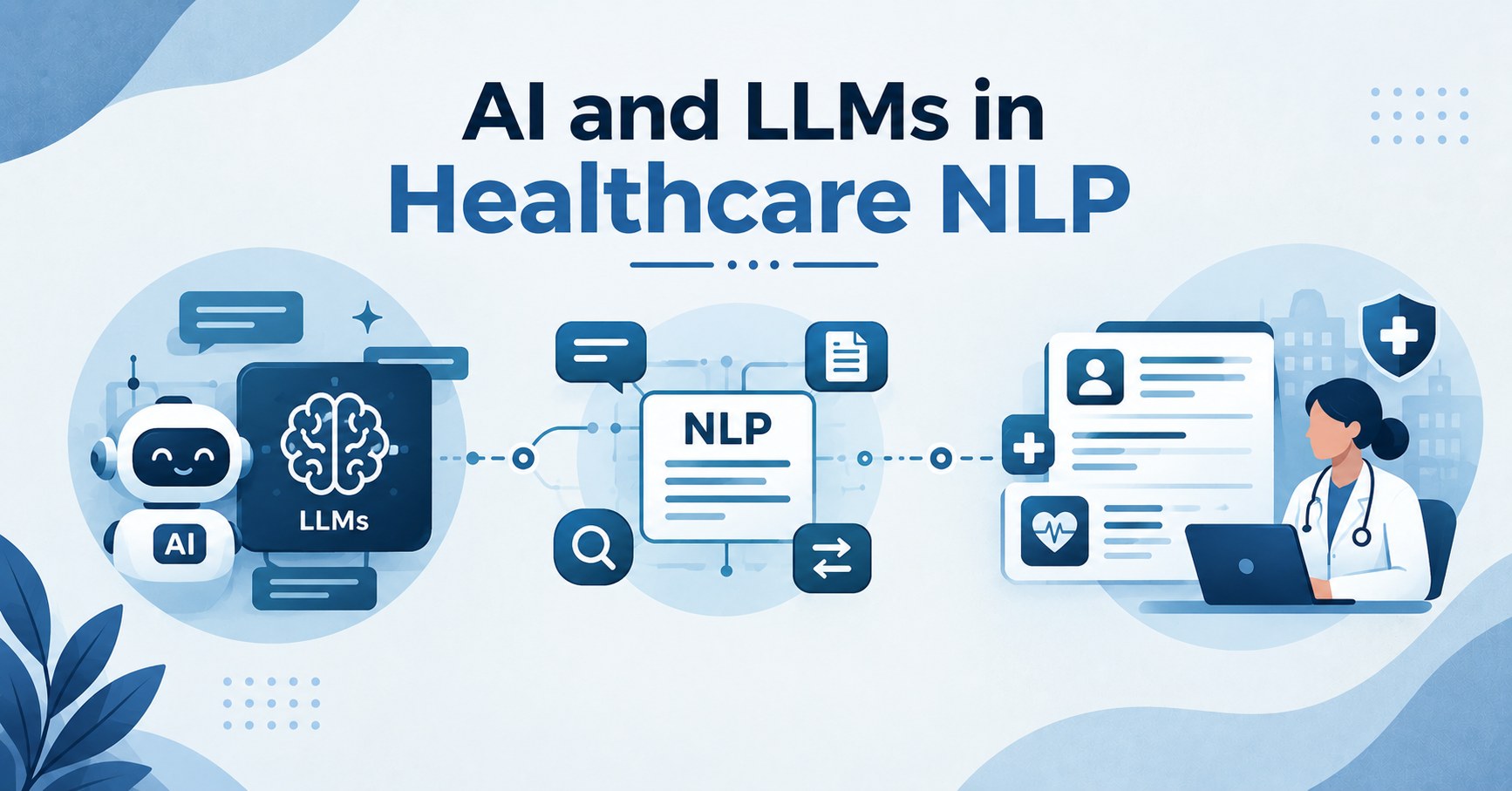
Large language models (LLMs) have changed what NLP can do with clinical text. Here's how they differ from earlier approaches, and why healthcare teams still keep a person in the loop.
Traditional NLP vs. LLM-Based NLP
Earlier healthcare NLP relied on narrow, task-built models. LLMs changed that by handling multiple tasks with one system. Here's how the two approaches actually compare.
Most teams don't pick one over the other. They combine specialized models where precision and auditability matter, and LLMs where flexibility and language understanding matter.
Why Human-in-the-Loop Still Matters
LLMs can produce text that sounds confident and is still wrong. They can invent a detail, miss a negation, or misread an ambiguous abbreviation, and in healthcare a small error in a note or a code can travel through billing, reporting, and care decisions. That's why well-designed NLP systems keep a person in the loop, with a clinician or coder approving AI-drafted notes and suggested codes before they enter the record.
Review is only part of it. Good systems also link every extracted fact back to the original text, so reviewers can check the source in seconds and not hunt for it. Behind that, teams track accuracy over time, test for bias, and control who can access what data. The goal is a system that saves time while people stay accountable for the final result, because NLP supports healthcare teams and doesn't replace their judgment.
What Are the Benefits of NLP for Healthcare Organizations?
NLP gets called a buzzword a lot, so here's the practical side: what it changes in day-to-day operations, and where you'd actually notice it. The value comes from one shift. When free text becomes structured data, work that used to depend on people reading and retyping can be partly automated, searched, and measured. That affects speed, cost, and data quality all at once, and it also gives teams a better base for analytics and developing other AI projects.
The table below maps each benefit to its operational impact and the place in the organization where it shows up first.
What Challenges Come With Implementing NLP in Healthcare?
NLP projects rarely fail because the model can't read text. They stall on privacy, integration, and data quality, and each has a practical fix.
Data Privacy and HIPAA Compliance
Clinical text is full of protected health information (PHI), so privacy comes first. HIPAA has no AI exemption: any tool that handles PHI must meet its Privacy, Security, and Breach Notification Rules. A vendor that accesses PHI on your behalf is a business associate, which means a signed agreement (BAA) before any data is processed. Responsibility also stays with you, because covered entities can't hand their HIPAA obligations to a vendor.
The rules are still moving. HHS proposed a major update to the HIPAA Security Rule in December 2024, and it was still reported as pending in August 2026. Build to the strictest reasonable standard now, and check the current status before you launch.
Integration With Legacy Systems
Older EHRs and lab systems weren't built to call an NLP service, and getting results back into the right place in the record can take more work than the NLP itself. Standards like HL7 and FHIR help, and a pilot limited to one workflow keeps the scope realistic.
Data Quality and Bias
NLP is only as good as the text it reads. Messy abbreviations, inconsistent templates, and scanned files all reduce accuracy, and a model trained on one hospital's writing style may perform worse at another. Testing on your own data and keeping human review for high-impact outputs are the standard safeguards.
How Can Healthcare Teams Get Started With NLP?
You don't need a big-bang rollout. The most successful NLP projects start with one painful workflow, where people are visibly reading and retyping text, like note summarization, code suggestions, or patient message triage. A narrow scope makes success easy to measure. Before building anything, look at what text you have, where it lives, and how clean it is, then confirm you're allowed to use it and decide early whether it needs to be de-identified under HIPAA.
Next comes the build-or-buy decision. Ready-made platforms are faster for common tasks, custom development makes sense when your workflow or data is unusual, and many teams combine both. Whichever route you choose, settle security and EHR integration before development starts, run a small pilot with a clinician or coder reviewing the output, and track time saved, error rates, and user feedback. If the numbers hold up, extend to the next workflow.
NLP Healthcare Project Ideas to Start Small
If you're learning or prototyping before committing budget, good starting points include extracting conditions and medications from sample notes, detecting negation ("has fever" vs. "denies fever"), summarizing long discharge summaries, and building a patient FAQ chatbot with a clear handoff to staff. Use synthetic or properly de-identified datasets for all of these, since real patient data doesn't belong in a test project.
How Can Code B Help You Implement NLP in Healthcare?
Getting NLP into a healthcare product or workflow takes more than a model. It needs integration with your EHR, secure handling of patient data, and people who have built this kind of system before. Here's where Code B fits in.
Code B's team works across AI development, system integration, and healthcare software, which covers the pieces this article has described: reading clinical text, connecting it to existing platforms through APIs and standards like HL7 and FHIR, and building it with privacy and compliance in mind from day one. You can hand over the whole build, or bring in engineers to strengthen a team you already have.
Whichever route you take, the goal is the same: start with one workflow, prove it works, and scale from there. If you're weighing a pilot or an integration and want a second opinion on scope.
What Else Do People Ask About NLP in Healthcare?

 WhatsApp
 Call Us
 Mail Us