


AI Workflow Automation Statistics: Adoption, ROI, and Future Trends



The workflow automation market is on track to reach USD 26.01 billion in 2026 and is projected to grow to USD 40.77 billion by 2031. The growth is no longer driven by simple task automation or rules-based bots.
What has changed is the nature of the work being automated. Businesses have moved beyond automating repetitive tasks and are now deploying intelligent workflows that support complex, multi-step business processes, make decisions, and coordinate activities across departments.
Enterprise adoption of AI has accelerated alongside this shift. Worker access to sanctioned AI tools has increased from less than 40% to roughly 60% within a year, reflecting how quickly AI capabilities are becoming part of day-to-day business operations.
That shift has changed what "automation" means at the enterprise level. The systems being deployed today combine automation, AI agents, and decision-making capabilities in a single layer. The metric that matters is no longer how many individual tasks have been automated, but how effectively organizations can automate and orchestrate end-to-end business processes across teams and systems.
AI Workflow Automation Market Size, Growth, and Forecast
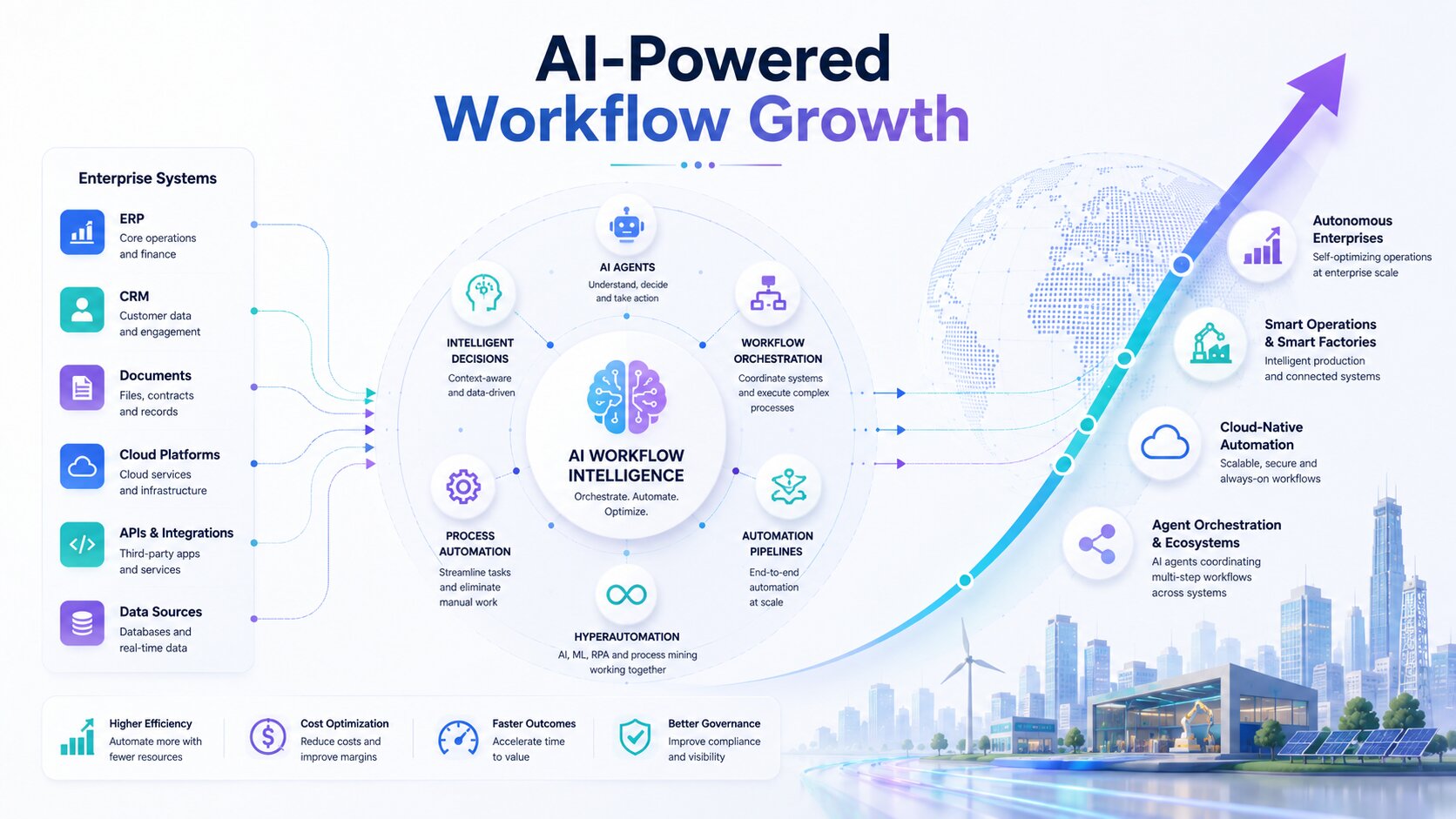
AI workflow automation has become one of the fastest-growing categories in enterprise technology. Unlike traditional automation platforms built for repetitive tasks, AI-powered workflows can support complex processes, automate decisions, and coordinate activities across multiple business systems simultaneously.
Market Overview
The workflow automation market is projected to grow from USD 23.77 billion in 2025 to USD 26.01 billion in 2026, and reach USD 40.77 billion by 2031, according to Mordor Intelligence's Workflow Automation Market Report.
Enterprise spending is concentrated at the top of the market. Cloud-based deployments account for approximately 62% of workflow automation revenue, reflecting the broader trend of enterprise cloud adoption across modern business operations,while large enterprises alone contribute around 71% of total market spending, per Persistence Market Research's Workflow Automation Market Report.
Automation Technology Trends
The broader Business Process Automation (BPA) market, the wider category workflow automation sits inside, is projected to grow from USD 22.3 billion in 2026 to USD 56.68 billion by 2034 at a 12.37% CAGR, per Fortune Business Insights, driven by cloud-based automation software, RPA, and AI-enabled workflow systems moving into mainstream enterprise infrastructure.
Hyperautomation, the combined use of AI, machine learning, RPA, and process mining to automate as many processes as possible, has moved from experimental to standard practice at scale.
Gartner reports hyperautomation remains a staple discipline for 90% of large enterprises, with 30% expected to automate more than half of their network activities by 2026, up from under 10% in mid-2023. Less than 20% of organizations, however, have mastered measuring hyperautomation ROI a maturity gap that mirrors the wider AI governance picture covered later in this piece.
The low-code/no-code layer underneath this stack is scaling in step: Gartner projects the low-code development technologies market will reach roughly USD 44.5 billion in 2026, growing at a 19% CAGR, with 70% of new enterprise applications expected to use low-code or no-code technologies by 2026.
Emerging Enterprise Markets
The pattern isn't isolated to workflow tools. The Autonomous Enterprise market is projected to reach USD 114.4 billion by 2029, growing at a 17.6% CAGR, per MarketsandMarkets. Smart Factory adoption is projected to grow from USD 96.47 billion in 2025 to USD 169.73 billion by 2030, per MarketsandMarkets' Smart Factory Market Report.
AI in Manufacturing specifically is set to grow from USD 34.18 billion in 2025 to USD 155.04 billion by 2030 at a 35.3% CAGR, per MarketsandMarkets' AI in Manufacturing Market Report.
Agent orchestration, the layer that lets AI systems execute multi-step workflows rather than single tasks, is itself projected to grow at a 35.3% CAGR through 2030.
Enterprises are no longer treating intelligent workflows as isolated automation projects. Market forecasts across manufacturing, hyperautomation, autonomous operations, and orchestration infrastructure are converging on the same conclusion: workflow intelligence is becoming a core operational investment, not a pilot-stage experiment.
What's Driving AI Workflow Automation Growth
Five converging forces explain why this market is compounding rather than plateauing. Each is covered in full depth in a dedicated section further down this page. This table is the summary view, so the underlying data isn't repeated twice.
Together, these five forces answer the "why now" question directly: adoption has cleared the awareness stage, agents have moved from novelty to default, cloud has removed the deployment friction, and competitive productivity pressure is making automation a requirement rather than an option.
AI Workflow Automation Adoption
Enterprise adoption is accelerating faster than the tooling maturity curve typically allows; organizations are moving from experimentation to production before governance models have fully caught up, and the 2026 data makes that gap sharper than it looked even a year ago.
Enterprise Adoption Landscape
Overall AI use is now close to universal. 88% of organizations report regular AI use in at least one business function, up from 78% a year earlier, per McKinsey's State of AI 2025 survey of nearly 2,000 organizations across 105 countries.
Access has scaled in step: worker access to sanctioned AI tools rose from under 40% to roughly 60% within a year, per Deloitte's State of AI in the Enterprise Report.
Breadth of use isn't the same as depth of trust. Only 27% of organizations have successfully embedded an AI strategy across the entire business, and just 37% are comfortable letting AI agents manage complete end-to-end processes without human involvement, according to PwC's Digital Trends in Operations Survey.
AI Implementation Challenges
This is the single most important adoption pattern in 2026. McKinsey's own State of AI research is blunt about it: the majority of organizations are still in the experimenting or piloting stages, with only about one-third reporting they've begun scaling AI across the enterprise, meaning roughly two in three enterprises using AI still haven't moved past pilot mode. Scaling enterprise AI initiatives requires the right mix of governance, infrastructure, and offshore AI expertise.
PwC's 2026 Global CEO Survey of 4,454 executives across 95 countries found the value gap is just as stark at the top: only 12% of CEOs report achieving both revenue gains and cost reduction from AI in the past year, while 56% report neither.
The picture gets sharper at the spending level. 59% of companies are investing at least USD 1 million annually in AI technology, but only 29% report seeing significant returns, and 75% of executives privately admit their AI strategy is "more for show" than actual operating guidance, per WRITER's 2026 AI Adoption in the Enterprise survey of 2,400 global leaders.
A companion finding from the same research: 79% of organizations report facing real challenges adopting AI in 2026, a double-digit increase over 2025, with 54% of C-suite executives admitting AI adoption is straining internal culture and structure.
AI Deployment Trends
Deployment maturity varies sharply by sector. In financial services, one of the earliest and most closely tracked adopter industries, 54% of companies had deployed AI initiatives as of January 2025, up from 40% a year earlier, ahead of the 46% average across all sectors, per S&P Global Market Intelligence's 451 Research.
That sector-lead pattern financial services outpacing the cross-industry average by roughly 8 points is consistent with the broader theme in this section: deployment concentrates where the ROI case is easiest to measure.
Agentic AI Adoption
Agentic AI specifically is already in production at scale: 37% of organizations are using Agentic AI technologies today, and 87% believe interoperability between AI and modern GenAI architectures will be critical to automation success.
Governance has not kept pace with deployment speed. Deloitte's 2026 State of AI in the Enterprise survey of 3,235 leaders found close to three-quarters of companies plan to deploy agentic AI within two years, but only 21% currently have a mature governance model for it.
Security is the sharpest edge of that gap: 67% of executives believe their company has already suffered a data breach or leak tied to unapproved AI tool use, per WRITER's 2026 enterprise AI adoption survey.
AI Workflow Automation ROI and Productivity
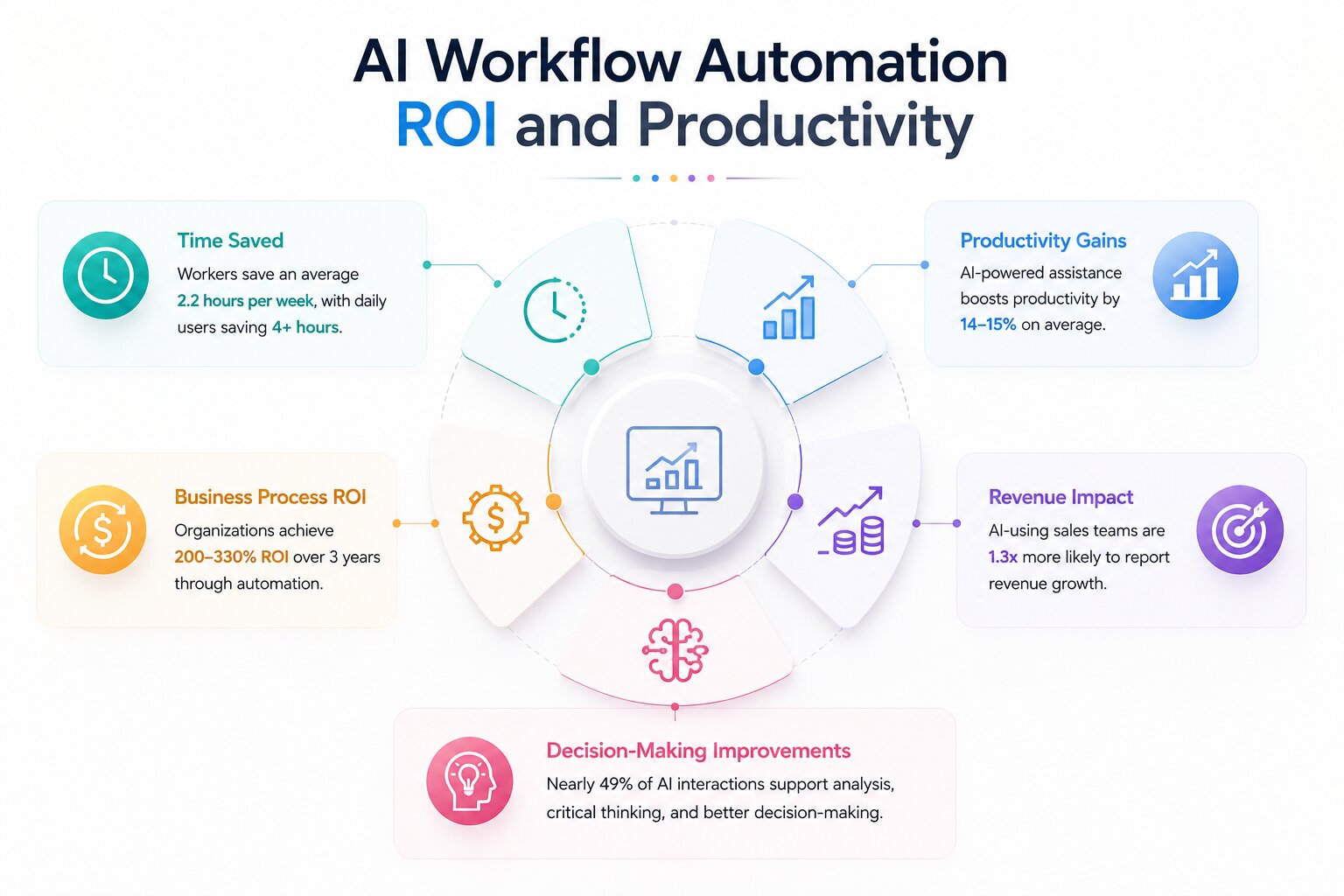
This is where the business case gets made or broken and where the data is starting to move from anecdotal to measurable.
Time Saved
Among US workers who used generative AI in the previous week, self-reported time savings averaged 5.4% of work hours - about 2.2 hours in a 40-hour week, per the Federal Reserve Bank of St. Louis.
Savings scale with usage intensity: 20.5% of weekly users saved four or more hours that week, rising to 33.5% among daily users. Separately, service professionals using AI report saving an average of five hours every week, per Salesforce's State of Service Report 2025.
Productivity Gains at the Task Level
The most rigorously tested productivity number in this space comes from a peer-reviewed field study, not a vendor survey. Brynjolfsson, Li, and Raymond studied the staggered rollout of a generative AI assistant across more than 5,000 customer support agents at a Fortune 500 company and found access to the tool increased productivity issues resolved per hour - by 14–15% on average.
The gain was uneven: novice and lower-skilled agents improved by 34%, while the most experienced agents saw only marginal change, evidence that AI assistance works largely by spreading the practices of top performers to everyone else.
Business Process ROI
Forrester's Total Economic Impact research on Microsoft's AI-driven industrial transformation tools projected a 167% ROI and USD 9.3 million in net present value over three years, reinforcing the growing business case for investments in AI across enterprise automation initiatives.
Forrester TEI studies on other AI-driven automation platforms have found ROI in a similar 200–330% range over three years, suggesting the Microsoft figure sits toward the conservative end of what's currently being measured.
Revenue Impact
On the revenue side, Salesforce's State of Sales report found 83% of sales teams using AI reported revenue growth this year, versus 66% of teams without AI, making AI-using teams roughly 1.3x more likely to report revenue growth, based on a survey of 5,500 sales professionals.
Decision-Making Improvements
Nearly 49% of Microsoft 365 Copilot conversations involve cognitive work analysis, critical thinking, and problem-solving rather than simple task execution, per Microsoft's Work Trend Index 2026 Report, a meaningful shift from AI-as-productivity-shortcut toward AI-as-decision-support.
Individually, these numbers can look like marketing claims. Together, they form a consistent pattern: the return is real and independently verifiable, including in peer-reviewed research, not just vendor-commissioned studies, but it concentrates in narrow, well-instrumented workflows rather than showing up as a blanket enterprise-wide productivity jump. That's exactly why the "top 20% capture 74% of the value" finding later in this piece holds up.
AI Workflow Automation by Region, Industry, and Business Function
Adoption is not evenly distributed. Where a company operates, what industry it's in, and which business function is being automated all independently shape how fast automation moves from pilot to production.
Regional Adoption
Industry Adoption
Business Adoption
AI workflow automation is already producing measurable results across a widening set of business functions, moving well beyond the customer service and document-processing use cases that defined the first wave of adoption.
Customer Service
Customer service organizations expect AI to handle approximately 50% of service cases by 2027, up from 30% today, according to Salesforce's State of Service Report (7th edition, 2025). 79% of service leaders say investing in AI agents is essential to meet current business demands.
Document-Heavy Workflows
Invoices, claims, contracts, onboarding, and compliance remain among the strongest automation use cases because they involve large volumes of structured information and intelligent document processing. The Intelligent Document Processing market was valued at USD 2.30 billion in 2024 and is projected to reach USD 12.35 billion by 2030 at a 33.1% CAGR.
Finance, Operations, and Compliance
Finance is emerging as one of the strongest candidates for AI workflow automation because many of its processes are high-volume, rules-based, and highly structured.
According to the Study, 33% of organizations have already scaled AI initiatives in accounts payable workflows, while AI adoption in planning and forecasting has reached 19%, with another 22% of organizations currently piloting use cases.
AI adoption is also expanding across treasury, tax, compliance, and operational finance functions as enterprises look to automate repetitive and data-intensive workflows.
Marketing and HR
87% of marketers use generative AI in at least one recurring workflow, per Salesforce's State of Marketing 2026 - up from 51% in 2024 and 76% in 2025, one of the highest functional adoption rates in the enterprise.AI adoption in HR continues to expand across recruiting, employee support, and internal workflow automation.
None of these patterns hold on their own, though. 82% of executives believe organizational silos and model capability are what prevent businesses from realizing the full value of autonomous workflows, per IBM's
The blueprint for agentic operations" report, and organizations with six foundational capabilities in place (change management readiness, AI governance, data governance, real-time shared data integration, system interoperability, and financial integration) are 5.4 times more likely to successfully adopt autonomous workflows.
That readiness gap shows up directly in the benefit numbers: per Deloitte's 2026 State of AI in the Enterprise report, 66% of organizations report current productivity gains and 53% cite improved decision-making, but only 20% are seeing the revenue growth 74% of them are hoping for.
Enterprise Investment and Spending Trends
AI Agents and Intelligent Automation Trends
AI agents are the defining shift in 2026 workflow automation systems, built to complete multi-step tasks, make decisions, and act across business systems, rather than respond to single prompts.
AI Agent Adoption Growth Statistics
Agent adoption inside Microsoft's ecosystem grew 15x year-over-year, with large-enterprise adoption growing 18x over the same window, per the Work Trend Index 2026 Report.
In customer operations specifically, Salesforce's Agentforce research found agent adoption grew 233% in the second half of 2025 alone, with agent actions increasing at an average of 96% month-over-month.
Multi-Agent Systems and MCP Adoption
A parallel technical shift is underway: organizations are moving from single-task agents toward coordinated multi-agent systems, where specialized agents divide complex processes the way expert teams do.
The infrastructure enabling this shift is scaling fast: Anthropic reported more than 10,000 active public MCP servers as of its December 2025 ecosystem update, the emerging standard for connecting agents from modern Agentic AI vendors to external tools, up from a standing start in November 2024, a leading indicator of how fast multi-vendor agent ecosystems are forming.
Executive Confidence in AI Agent Adoption
Confidence is rising in step with deployment: 86% of executives say AI agents will make process automation and workflow reinvention more effective by 2027, per IBM Institute for Business Value research of 750 cross-industry operations executives.
A separate IBM brief found 75% of executives believe AI agents will execute transactional processes and workflows autonomously within two years. But enterprises deploying agents without clear workflows, defined business rules, and proper data access are seeing capped returns; the technology outruns the governance structure around it far more often than it fails on its own.
Future Trends Shaping AI Workflow Automation Through 2030
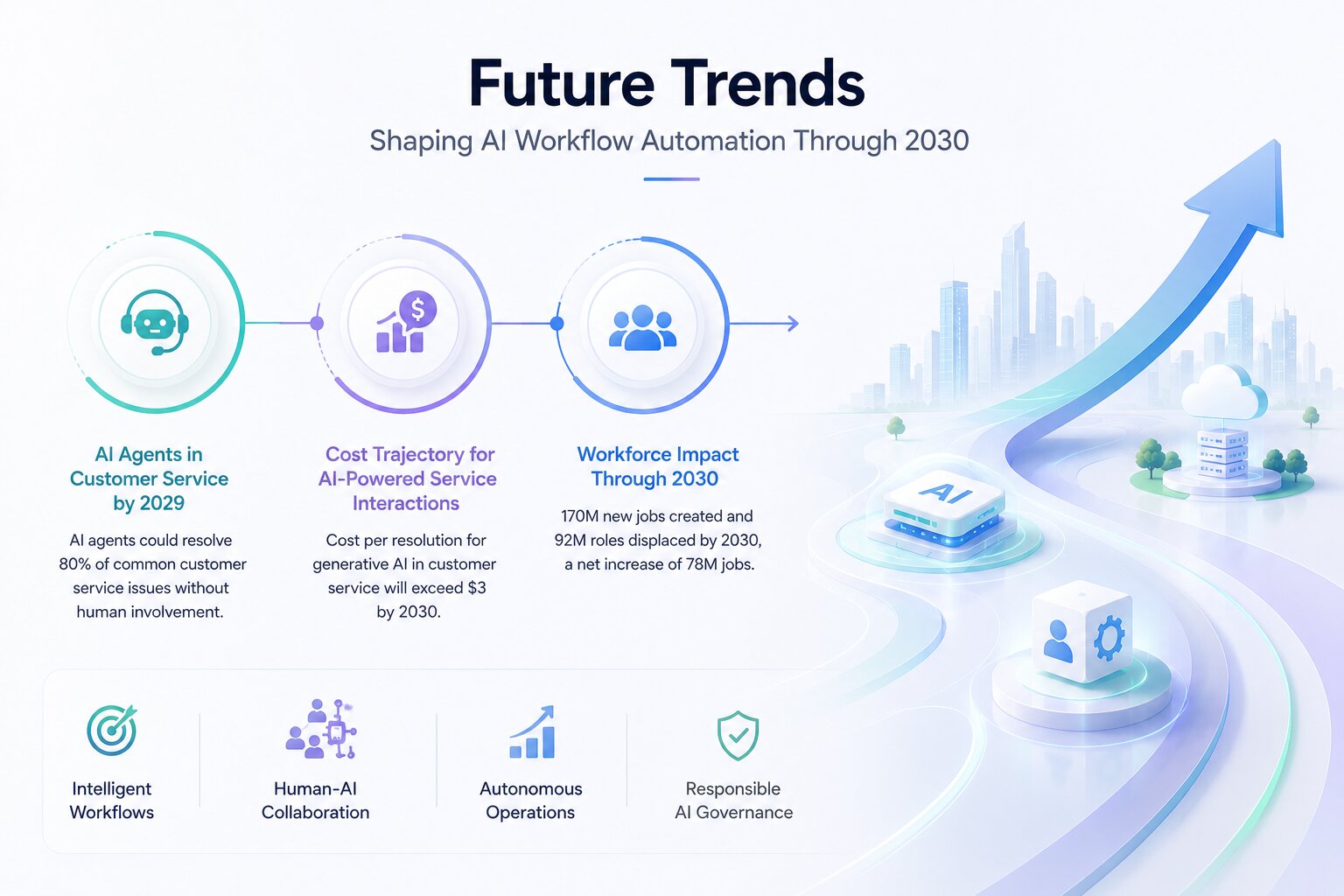
The future of AI workflow automation will be shaped by intelligent workflows, AI agents, autonomous operations, and deeper integration between humans and AI systems, building on the adoption and agent trends already covered, with the execution risks in the Challenges section above determining how much of this trajectory actually materializes.
AI Agents in Customer Service by 2029
Customer service is expected to be one of the fastest-moving areas of AI agent adoption. AI agents could resolve 80% of common customer service issues without human involvement by 2029, helping organizations reduce operational costs while improving service delivery.
Cost Trajectory for AI-Powered Service Interactions
Enterprises should not assume agent adoption is a pure cost play. It's predicted that by 2030, cost per resolution for generative AI in customer service will exceed $3, higher than many B2C offshore human agents, per a January 2026 press release.
The rise to increasing infrastructure and compute costs as AI vendors shift from subsidized growth toward profitability, and as use cases grow more complex, a budgeting consideration worth factoring into multi-year ROI projections rather than treating agent deployment as a one-time cost
Workforce Impact Through 2030
The workforce impact of AI automation is a major area of discussion in its own right. The World Economic Forum's Future of Jobs Report 2025 projects 170 million new jobs created and 92 million roles displaced by 2030, a net increase of 78 million jobs with AI and information-processing technologies reshaping role requirements rather than simply eliminating headcount.
These trends indicate that the future of AI workflow automation won't be determined by AI models or technology capability alone. The organizations that succeed will be those that combine AI with strong processes, reliable data, clear objectives, and effective change management the same readiness gaps quantified throughout this report.
FAQs

 WhatsApp
 Call Us
 Mail Us