


List of Cloud Computing Statistics for 2026: Market Data, Usage & Insights



The market is approaching the trillion-dollar mark, and more than 90% of enterprises now rely on cloud in some form, whether for core systems, data storage, or scaling applications.
What’s changed over the past few years is not just adoption, but how deeply cloud is embedded into day-to-day operations. Organizations are running more workloads in the cloud, expanding into multi-cloud setups, and increasing overall spend.
At the same time, that growth has introduced a different set of challenges: managing costs, maintaining performance at scale, and dealing with the complexity of distributed environments.
This is where the gap usually appears. While cloud usage continues to grow, many teams are still figuring out how to use it efficiently. It’s common to see rising cloud bills without a clear understanding of where that spend is going, or how it translates into actual business value.
To get a clearer view of what’s happening, it helps to look at the data. On this page, we’ve compiled key cloud computing statistics for 2026, covering market size, adoption, provider market share, costs, and emerging trends, to provide a grounded picture of how cloud is evolving across industries today.
Cloud Market Size & Growth Statistics
Cloud computing has become one of the largest and fastest-growing segments in the technology market, with enterprise spending continuing to shift toward scalable infrastructure and services.
Market Size
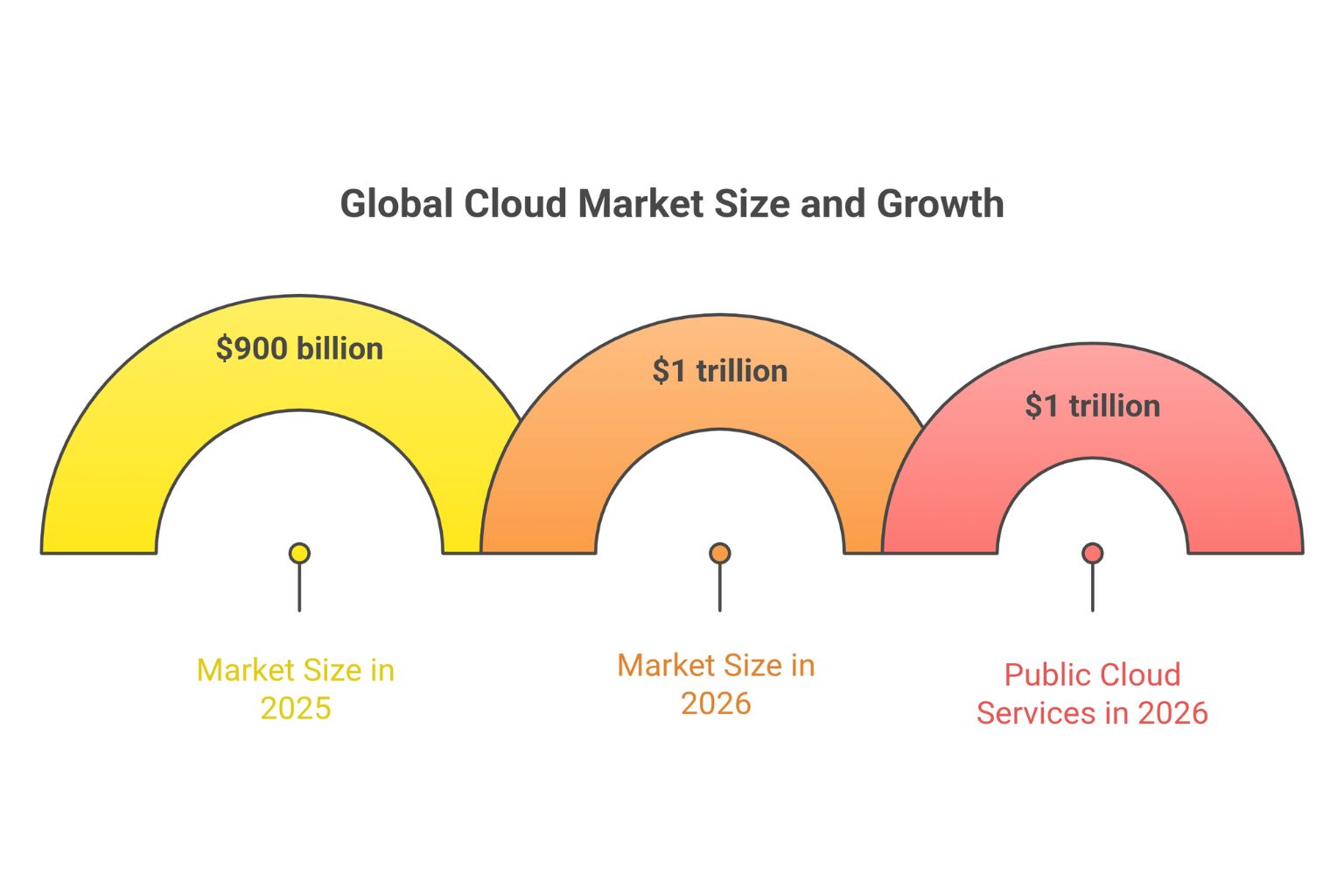
- The global cloud computing market crossed approximately $900 billion in 2025 and is projected to exceed $1 trillion in 2026, reflecting sustained growth across industries.
- Public cloud services spending is projected to surpass $1 trillion in 2026, driven by enterprise demand for infrastructure, platforms, and software, particularly as AI and cloud-native adoption accelerate.
Growth Rate
- The cloud market continues to expand at ~16–18% CAGR, maintaining double-digit growth across infrastructure and platform services.
- Public cloud services are growing at over 18-20% annually, outpacing most other enterprise IT segments.
Cloud & IT Spending Trends
- Cloud spending accounts for ~30–35% of enterprise IT budgets, reflecting a major shift from traditional infrastructure.
- A growing share of new IT investments (over 50% in many organizations) is now directed toward cloud-based solutions.
Cloud Growth Drivers
- AI and data-intensive workloads are significantly increasing cloud demand, with cloud infrastructure services growing at around 30% annually, as enterprises scale compute, storage, and specialized hardware to support AI-driven use cases.
- Cloud-native and containerized architectures continue to drive infrastructure demand, with over 80% of organizations adopting or exploring container technologies, while enterprises are running 50%+ of new applications in cloud-native environments, increasing reliance on scalable cloud platforms.
- This surge lines up with what businesses are actually gaining from containers: faster deployments, easier scaling, and lower infrastructure overhead.
Cloud Adoption & Usage Statistics
Cloud computing is now widely embedded across enterprise infrastructure, with most organizations relying on the cloud to run applications, store data, and scale operations.
Enterprise Cloud Adoption
- Over 90% of enterprises use cloud services, reflecting near-universal adoption.
- Only around 3% of enterprises report no plans to adopt cloud, highlighting minimal resistance to enterprise cloud adoption.
Workloads & Data in Cloud
- Cloud adoption continues to expand globally, with 45% of enterprises already using cloud computing services, reflecting a growing shift of workloads from traditional infrastructure to scalable cloud environments.
- More than 60% of corporate data is now stored in the cloud, reflecting a significant shift away from traditional on-premise storage as organizations adopt scalable, cloud-based infrastructure.
- Large enterprises use over 100 SaaS applications on average, reflecting the growing scale and complexity of modern cloud environments.
Multi-cloud & Hybrid Adoption
- Around 89% of organizations use a multi-cloud strategy, relying on multiple providers for flexibility and resilience.
- Approximately 72–73% of enterprises operate in hybrid environments, combining on-premise and cloud infrastructure to support flexibility, scalability, and workload distribution.
Industry-wise Cloud Adoption
- Cloud adoption has become widespread across industries, with 41% of EU enterprises using cloud computing services in 2021, rising to 45% in 2023, reflecting steady growth and increasing reliance on cloud infrastructure.
- BFSI is one of the largest cloud-adopting sectors, accounting for ~28% of the total cloud market share.
- The retail and e-commerce sector has reached around 70–73% cloud adoption, supporting scalability and customer experience demands.
- Healthcare organizations are steadily adopting cloud technologies, with over 60% of healthcare providers using digital and cloud-based systems to manage data and operations, reflecting a growing shift toward data-driven infrastructure and analytics platforms.
- The manufacturing sector has reached around 65–67% cloud adoption, driven by Industry 4.0 and IoT integration.
- Cloud adoption varies significantly across industries, with over 90% of enterprises using cloud services overall, while sectors such as manufacturing report around 65–67% adoption, and healthcare-driven data workloads reflect roughly 60% cloud utilization, highlighting a clear gap in cloud maturity across industries.
-3.jpg)
Cloud Provider Market Share (AWS vs Azure vs GCP)
A small group of hyperscalers dominates the cloud market, with AWS, Microsoft Azure, and Google Cloud accounting for the majority of global cloud infrastructure usage, a reflection of how concentrated the market is among the top cloud computing companies enterprises actually choose from.
Market Share of Leading Providers
- AWS continues to dominate cloud infrastructure, holding roughly 30–32% market share, while Microsoft Azure follows at ~20–23% and Google Cloud at ~12–13%. Together, these providers account for nearly 68–71% of global cloud spending, showing how the market is heavily concentrated around a few large ecosystems rather than evenly distributed.
- Despite Azure’s growth, AWS still maintains a ~8–10 percentage point lead, reinforcing how early mover advantage and global infrastructure scale continue to define leadership in cloud computing.
Market Concentration
- Beyond the top three providers, the remaining ~30–35% of the cloud infrastructure market is distributed among smaller players, including Alibaba Cloud (~4%) and Oracle Cloud and IBM Cloud (~2–3% each), highlighting continued competition across regional and specialized segments.
- Smaller providers compete through specialization rather than scale, as enterprises increasingly distribute workloads across multiple cloud platforms, with 89% adopting multi-cloud strategies, reflecting a fragmented and capability-driven cloud ecosystem.
- While infrastructure providers dominate market share discussions, SaaS generates the largest share of cloud revenue (~$390 billion), significantly ahead of PaaS (~$209 billion) and IaaS (~$180 billion). This highlights that most enterprise value in cloud computing is captured at the application and platform layer.
Provider Positioning & Enterprise Preference
- Enterprises are increasingly avoiding single-provider dependency, with over 89% of organizations using multiple cloud platforms, while only about 9% rely on a single provider exclusively.
- At the same time, 72-73% of organizations operate hybrid cloud environments, combining on-premise and cloud systems. This shift reflects a strategic move toward flexibility, resilience, and vendor diversification rather than toward reliance on centralized cloud services
-3.jpg)
Cloud Cost & Spending Statistics
As cloud usage scales, organizations are not just spending more; they are struggling to control, allocate, and optimize that spend effectively.
Cloud Spending Growth
- At the same time, public cloud spending is projected to exceed $1 trillion in the near term, highlighting the accelerating scale of cloud investment across industries.
Global cloud spending has surpassed $720+ billion, up from approximately $590+ billion year-over-year, reflecting continued expansion in enterprise cloud adoption.
Cloud Waste & Inefficiency
- Despite Cloud inefficiency remaining significant, with 20–30% of cloud spend wasted, while in some organizations, up to 50% of provisioned resources remain unused or underutilized. Over-provisioning alone contributes to 20–50% excess capacity, leading to substantial cost leakage.
- Cloud inefficiencies are largely driven by poor resource utilization, with studies showing that only 60–85% of cloud capacity is effectively utilized, while unoptimized environments may operate at just 25–40% utilization, leaving a significant portion of resources idle or underused and resulting in persistent inefficiencies across cloud environments.
Limited cost visibility
- Cost visibility remains a major challenge, with 82% of organizations citing managing cloud spend as their top concern, while 84% struggle to control cloud costs effectively, making it difficult to track usage patterns and identify inefficiencies.
- This challenge increases with scale, as 89% of organizations adopt multi-cloud strategies, adding complexity to cost allocation and usage tracking across multiple providers and services.
FinOps Adoption
- FinOps adoption is expanding across enterprises, with 59% of organizations increasing or expanding their FinOps practices, reflecting a shift toward structured financial accountability and cross-team collaboration in cloud usage.
- Cost optimization mechanisms such as reserved instances and savings plans can reduce cloud costs by 30–60%, yet many organizations still rely heavily on on-demand pricing, leaving a significant portion of potential savings unrealized.
Continuous cost optimization
Cloud is now ongoing, with over 70% of organizations continuously or regularly reviewing and optimizing cloud spend, rather than treating it as a one-time effort.
- Automation is playing a growing role, with more than 50% of enterprises using automated tools for cost monitoring and optimization, helping manage dynamic workloads and reduce inefficiencies at scale.
Cloud Security & Risk Statistics
As cloud environments scale, security risks, breaches, and compliance pressures continue to grow, making cloud security a top priority for organizations.
Security concerns
- Cloud security risk is increasing, with misconfigurations responsible for up to 80% of cloud security failures, while human error contributes to the majority of breaches, highlighting the growing challenge of securing dynamic cloud environments.
- Cloud security complexity is increasing, with 82% of breaches attributed to a lack of visibility in cloud and hybrid environments, highlighting the growing challenge of securing dynamic and distributed infrastructure.
Misconfigurations
- Misconfigurations remain a leading cause of vulnerabilities in virtual machine–level cloud security, with up to 95–99% of cloud security failures attributed to customer-side misconfigurations, including exposed storage, open ports, and insecure APIs, significantly increasing breach risk.
- Human error plays a major role, contributing to nearly 90% of misconfiguration-related incidents, while studies show that a large percentage of environments contain at least one critical misconfiguration at any given time, significantly increasing breach risk.
IAM risks
- Identity and access issues remain a major threat vector, with studies showing that 80% of cloud security incidents are linked to identity-related weaknesses, including excessive permissions and misuse of privileged accounts.
- Compromised credentials remain a key attack vector, with over 60% of data breaches linked to human factors such as phishing, credential theft, or misuse, highlighting the growing impact of identity-based threats in cloud environments.
Compliance challenges
- Compliance remains a major concern, with over 75% of organizations identifying governance, risk, and compliance as a major cloud challenge, particularly in industries handling sensitive or regulated data.
- Data-related risks are increasing, with the global average cost of a data breach reaching $4.45 million, while breaches involving complex, distributed environments take significantly longer to identify and contain, highlighting the growing complexity of modern cloud systems.
Security investment
- As the cloud threat landscape expands, global security and risk management spending is projected to surpass $215 billion, underscoring increased investment in cloud security, threat detection, and compliance.
- At the same time, investment in modern security models is accelerating, with the zero-trust security market projected to reach over $75 billion by 2029, while more than 60% of enterprises are expected to adopt zero-trust strategies, reflecting a shift toward identity-centric and distributed cloud security.
Cloud Computing Trends
Cloud computing is evolving rapidly, driven by AI workloads, distributed architectures, and changing enterprise infrastructure strategies.
AI is driving cloud demand
- AI workloads are a key driver of cloud demand, with cloud infrastructure spending growing at around 30%+ year-over-year, driven by AI and data-intensive workloads
- Investment is accelerating further, with AI-ready data center demand expected to grow at approximately 33% annually through 2030, prompting hyperscalers to expand data centers and specialized hardware to support rising AI demand
- Multi-cloud and hybrid architectures are becoming standard approaches, with enterprises running over 50% of their workloads across cloud environments, reflecting a shift toward distributed infrastructure for flexibility, resilience, and performance optimization.
Serverless and cloud-native are expanding
- Cloud-native adoption is accelerating, with studies showing that around 89% of enterprises are using cloud-native technologies, reflecting a strong shift toward modern application architectures.
- The serverless computing market is projected to grow from approximately $28 billion in 2025 to over $90 billion by 2034, highlighting rapid expansion driven by event-driven architectures and faster development cycles. That growth tracks with how serverless functions remove the need to provision or manage servers at all, letting teams ship event-driven code faster
Edge computing is expanding cloud boundaries
- Edge computing is growing as organizations move workloads closer to users, with the edge computing market projected to grow at 30%+ CAGR through 2030, supporting real-time processing and low-latency applications.
- A significant portion of enterprise data is expected to move beyond traditional data centers, with around 50% of data projected to be created and processed outside centralized environments (at the edge), reflecting a shift toward distributed cloud architectures.
Future Outlook and Projections
Cloud computing is moving from adoption to becoming foundational infrastructure, with future growth driven by AI, distributed systems, and increasing enterprise reliance
- Cloud-first strategies are becoming the default, with over 85% of organizations expected to adopt a cloud-first approach, meaning most new applications are built directly in cloud environments rather than on-premise systems. This shift is already evident, with 95% of new digital workloads expected to be deployed on cloud-native platforms, underscoring how cloud has become the foundation for modern application development.
- AI-driven workloads are emerging as a major growth driver for cloud infrastructure, with demand for AI-ready data center capacity projected to grow at around 30–33% annually through 2030, reflecting increasing investment in compute, storage, and specialized hardware.
- Cloud providers are rapidly expanding their global infrastructure, with the number of hyperscale data centers exceeding 1,100 worldwide, reflecting a significant scale-up to support growing AI and cloud workloads.
- Enterprise data volumes are expanding rapidly, with global data creation projected to reach 175 zettabytes by 2025, significantly increasing demand for distributed cloud storage, analytics, and edge processing capabilities.
As we move through 2026, cloud computing is no longer just about adoption; it’s about how effectively organizations manage, optimize, and scale their environments. With increasing complexity across multi-cloud setups, AI workloads, and distributed systems, the focus is shifting toward efficiency, control, and long-term sustainability.
For teams navigating cloud migration, cost optimization, or infrastructure modernization, these challenges increasingly surface in everyday decisions about how resources are allocated, how systems are designed, and how environments scale over time. Addressing these factors thoughtfully will play a key role in building resilient and efficient cloud ecosystems.
FAQs

 WhatsApp
 Call Us
 Mail Us