


Microservices Based Architecture in E-Commerce


Microservices architecture is a modern design approach that structures an application as a collection of smaller, independent services instead of a single large system.
These services communicate with each other through APIs, allowing them to work together while staying loosely connected
In an e-commerce system, each service handles a specific part of the system such as users, payments, or products and can be developed, tested, and deployed on its own.
Updates can be rolled out faster, and changes in one service are far less likely to affect the rest of the platform.
Each component in a microservices architecture can be developed, tested, and deployed independently, making it easier to roll out updates and limit the impact of changes on the rest of the system.
How E-Commerce Platforms Benefit from Microservices
E-commerce platforms operate in a fast-paced environment where performance, scalability, and continuous updates are critical for success.
As user demand grows and system complexity increases, traditional architectures often struggle to keep up. Microservices architecture provides a more efficient approach by enabling platforms to handle challenges in a flexible and scalable way.
Handling High Traffic Spikes
E-commerce apps often face sudden increases in users during sales or promotions. A large number of users accessing the system at the same time can put a heavy load on servers.
Traditional systems may struggle, leading to slow performance or crashes. Handling such spikes efficiently is important to maintain a smooth user experience.
Managing Complex Product Data
Platforms manage large catalogs with thousands of items, categories, images, and pricing details. Keeping this data accurate and well-organized becomes difficult as the system grows.
Poor management can lead to delays and errors. Efficient data handling is essential for a better user experience.
Integration with Multiple Payment Systems
Supporting multiple payment methods requires integration with different external services. Each integration adds complexity and requires secure communication.
Any failure in these systems can affect transactions. Proper handling ensures reliable and smooth payment processing.
Frequent Feature Updates
E-commerce platforms need regular updates such as recommendations, offers, and delivery options. In traditional systems, even small changes can impact the entire application.
This makes updates slower and riskier. Efficient update processes are important to keep the platform competitive.
Independent Services in Microservices
Microservices divide the platform into smaller, independent services. Each service handles a specific function like products, payments, or orders.
This separation improves system organization. It also allows services to operate and evolve independently.
Better Performance and Load Handling
Microservices allow high-demand services to handle increased load separately. Additional resources can be assigned only where needed. This prevents the entire system from slowing down. It helps maintain stable performance during peak traffic.
Easier Maintenance and Updates
Microservices make it easier to update or fix individual services. Changes can be made without affecting the entire system. This reduces downtime and risk of errors. It also speeds up development and maintenance processes.
Core Components of a Microservices-Based E-Commerce System
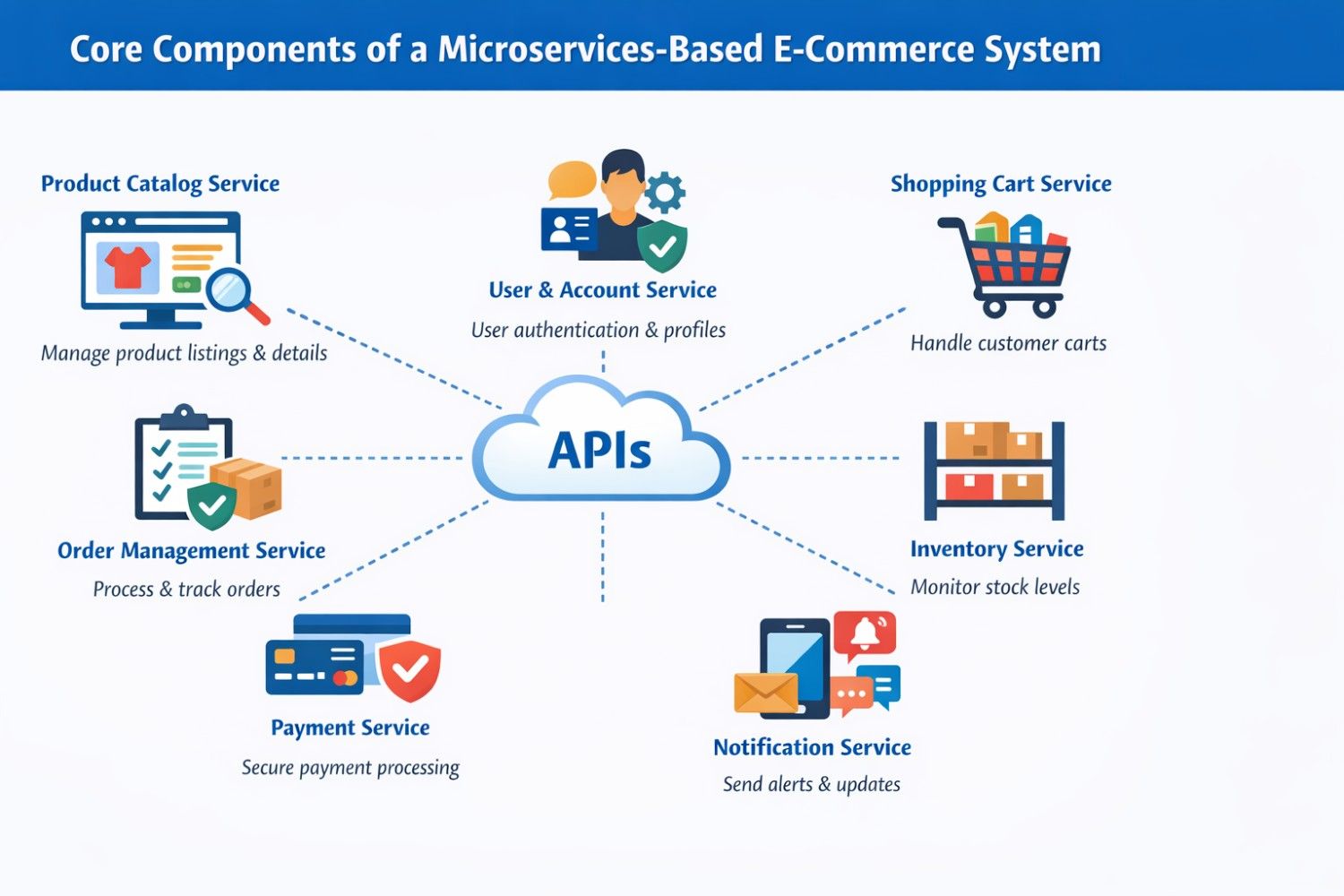
A microservices-based e-commerce system is built using multiple independent services, where each service is responsible for a specific function.
These services communicate with each other through APIs, allowing the platform to operate smoothly while keeping each component loosely connected.
Product Catalog Service
The Product Catalog Service is responsible for managing all information related to items available on the platform. It maintains listings, descriptions, categories, images, and pricing details, ensuring that accurate and up-to-date information is available for customers.
This service organizes the catalog in a structured way so users can easily search, filter, and browse through different categories. It also supports features such as product updates, category management, and detailed item information.
By handling catalog data efficiently, this service plays an important role in improving the overall shopping experience and helping customers quickly find the items they are looking for.
User and Account Service
The User and Account Service manages all activities related to customer accounts on the platform. It supports user registration, authentication, profile management, and account preferences.
This service ensures that account information is securely stored and properly managed, allowing customers to access their profiles whenever they log in. It also helps maintain important details such as personal information, saved addresses, and account settings.
By handling account-related operations efficiently, this service provides a secure and smooth login experience while ensuring that user data remains protected and easily accessible when needed.
Shopping Cart Service
The Shopping Cart Service manages the items that customers select while browsing the platform before completing a purchase.
It temporarily stores selected items and allows customers to add new ones, remove existing ones, or modify quantities during the shopping process. This service maintains the current state of a user’s cart and ensures that the selected items remain available until checkout.
Handling cart-related actions efficiently, it provides a smooth and convenient shopping experience, allowing customers to review and manage their selections before placing an order.
Order Management Service
The Order Management Service handles all activities related to customer orders after the checkout process is completed. It is responsible for creating new orders, storing order details, and maintaining a record of past purchases.
This service also tracks the progress of each order and updates its status at different stages, such as processing, shipped, or delivered. By managing order information and tracking updates efficiently, it ensures that both customers and the platform can monitor the progress of purchases throughout the order lifecycle.
Payment Service
The Payment Service is responsible for processing transactions during the checkout process. It connects the platform with external payment gateways to support multiple payment methods such as credit cards, debit cards, digital wallets, or online banking.
This service ensures that payments are securely processed and verified before an order is confirmed. It also manages payment validation, transaction status updates, and communication with external financial systems, helping provide a safe and reliable payment experience for customers.
Inventory Service
The Inventory Service manages stock levels and product availability across the platform. It continuously tracks the quantity of items available and updates stock information whenever products are purchased, returned, or restocked.
This service helps prevent issues such as overselling and ensures that customers see accurate availability while browsing or placing orders. Maintaining up-to-date inventory records, it supports smooth order processing and helps the platform manage stock efficiently.
Notification Service
The Notification Service manages communication between the platform and customers by sending important updates and alerts.
It delivers messages such as order confirmations, shipping notifications, delivery updates, and promotional offers through channels like email, SMS, or push notifications.
This service ensures that customers stay informed about their purchases and any important platform activities, improving the overall user experience.
Although these services operate independently, they communicate with each other through APIs to exchange information and coordinate actions.
This interaction allows different parts of the system to work together smoothly while maintaining independence, ensuring that the entire e-commerce platform functions efficiently.
Service Communication Patterns in E-Commerce Microservices
In a microservices-based e-commerce platform, multiple independent services must work together to complete business operations smoothly.
Since these services are loosely connected, efficient communication becomes essential for maintaining system performance and reliability.
Different communication methods are used to ensure that services can exchange data quickly, handle high loads, and operate without delays.
Need for Communication Between Services
Microservices must interact to complete tasks like order processing, payments, and inventory updates. Since each service operates independently, communication becomes essential.
Without proper interaction, the system cannot function as a whole. Well-managed communication ensures smooth workflow across services.
Use of Well-Defined Interfaces
Services communicate through structured interfaces that define how data is exchanged. These interfaces ensure consistency between different services.
They also reduce errors and misunderstandings in communication. Clear interfaces help maintain system stability and reliability.
REST API Communication
REST APIs are a common way for services to communicate using HTTP requests. They allow services to send and receive data in a simple and standardized format.
This approach is easy to implement and widely supported. It works well for most real-time interactions.
GraphQL API Approach
GraphQL allows services to request only the specific data they need. This reduces unnecessary data transfer and improves efficiency. It is especially useful when dealing with complex or large datasets. It also provides more control over data queries.
Message Queues for Communication
Message queues allow services to send messages that can be processed later. This removes the need for immediate responses between services. It improves reliability, especially during heavy system load. It also helps prevent data loss during failures.
Event-Driven Communication
In this approach, services publish events such as “order placed” or “payment completed.” Other services listen to these events and react automatically. This reduces direct dependencies between services. It helps create a more flexible and responsive system.
Asynchronous Processing Benefits
Asynchronous communication allows services to work independently without waiting for responses. This improves overall system performance and efficiency. It helps handle high volumes of requests smoothly. It also reduces delays during peak traffic conditions.
Data Management Strategies in Microservices Architecture
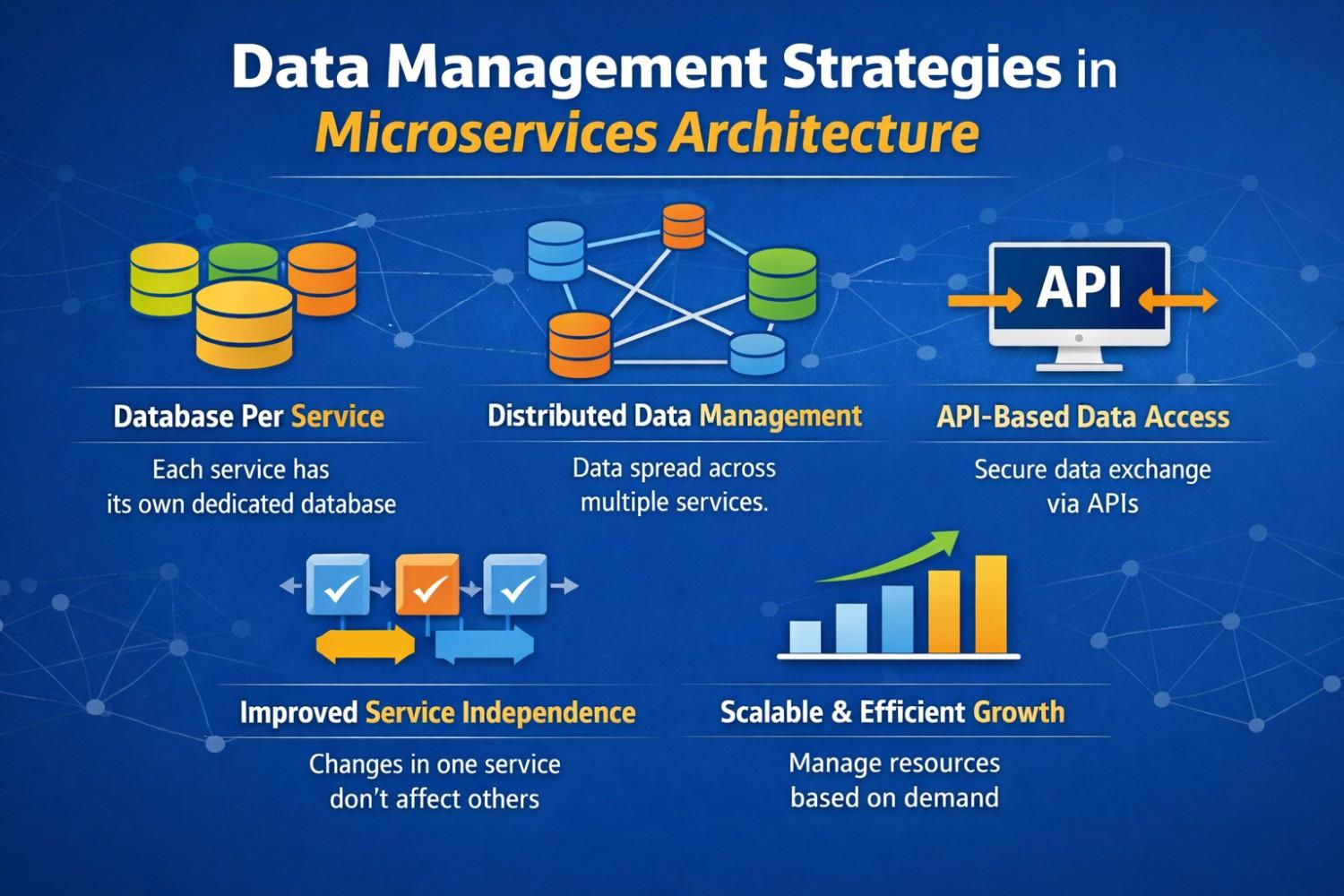
Data management is a critical aspect of microservices architecture, especially in e-commerce platforms where large volumes of data are processed continuously.
Unlike traditional systems that rely on a single shared database, microservices distribute data across multiple services. This approach improves scalability and independence but requires careful design to ensure consistency and efficient data access.
Data Handling Across Microservices
In a microservices architecture, each service manages its own data instead of relying on a shared database. This separation helps maintain clear boundaries between services.
It also allows services to function independently without tight dependencies. As a result, the system becomes easier to manage and more reliable.
Database per Service Approach
Each microservice uses its own dedicated database based on its requirements. This allows teams to choose suitable database technologies for different services.
It also prevents one service from affecting another’s data or performance. This approach improves independence and system organization.
Distributed Data Management
Data is distributed across multiple services and databases instead of being stored in a single location. This helps handle large volumes of data more efficiently.
However, it requires proper coordination to maintain consistency. Managing distributed data becomes important for system reliability.
API-Based Data Access
Services access data from other services through APIs instead of directly connecting to their databases. This ensures secure and controlled data exchange. It also maintains a clear separation between services. API-based access reduces dependency and improves system design.
Improved Service Independence
Separating databases ensures that changes in one service do not affect others. Each service can update its data structure independently. This reduces the risk of system-wide issues. It also supports faster development and easier maintenance.
Better Growth and Resource Management
Each service can manage its data and resources based on its own needs. High-demand services can handle increased load without affecting others. This improves overall system efficiency. It also makes the platform easier to manage as it grows.
Challenges of Microservices in E-Commerce Systems
While microservices architecture offers significant benefits in scalability and flexibility, it also introduces several challenges that e-commerce platforms must address.
As systems become more distributed, managing multiple independent services requires careful planning, coordination, and monitoring to ensure smooth and reliable operations.
Increased System Complexity
Microservices divide an application into many smaller services. Managing communication, deployment, and dependencies between them becomes more complicated.
This increases the effort required to maintain the system. Proper planning is needed to handle this complexity effectively.
Service Coordination Issues
Multiple services must work together to complete tasks such as orders, payments, and inventory updates. Smooth coordination depends on well-designed APIs and reliable communication.
Any failure in interaction can affect the workflow. Strong coordination is essential for system efficiency.
Data Consistency Challenges
Each service typically manages its own database. Keeping data consistent across multiple services becomes difficult. This is especially challenging when a single operation involves several services. Proper data handling strategies are required to maintain accuracy.
Network Latency Problems
Services communicate over a network rather than within a single system. This can introduce delays in data exchange. Increased latency may affect overall performance. Efficient communication methods help reduce these delays.
Monitoring and Debugging Difficulty
Tracking issues becomes harder in a distributed system. Problems may involve multiple services at the same time. Identifying the root cause requires proper monitoring tools. Centralized logging helps simplify debugging.
Need for Careful Architecture
Strong system design is important to manage communication and complexity. Well-planned architecture improves system reliability and performance. Monitoring and management tools play a key role in smooth operations. Careful planning ensures long-term system stability.
Best Practices for Building Microservices-Based E-Commerce Platforms
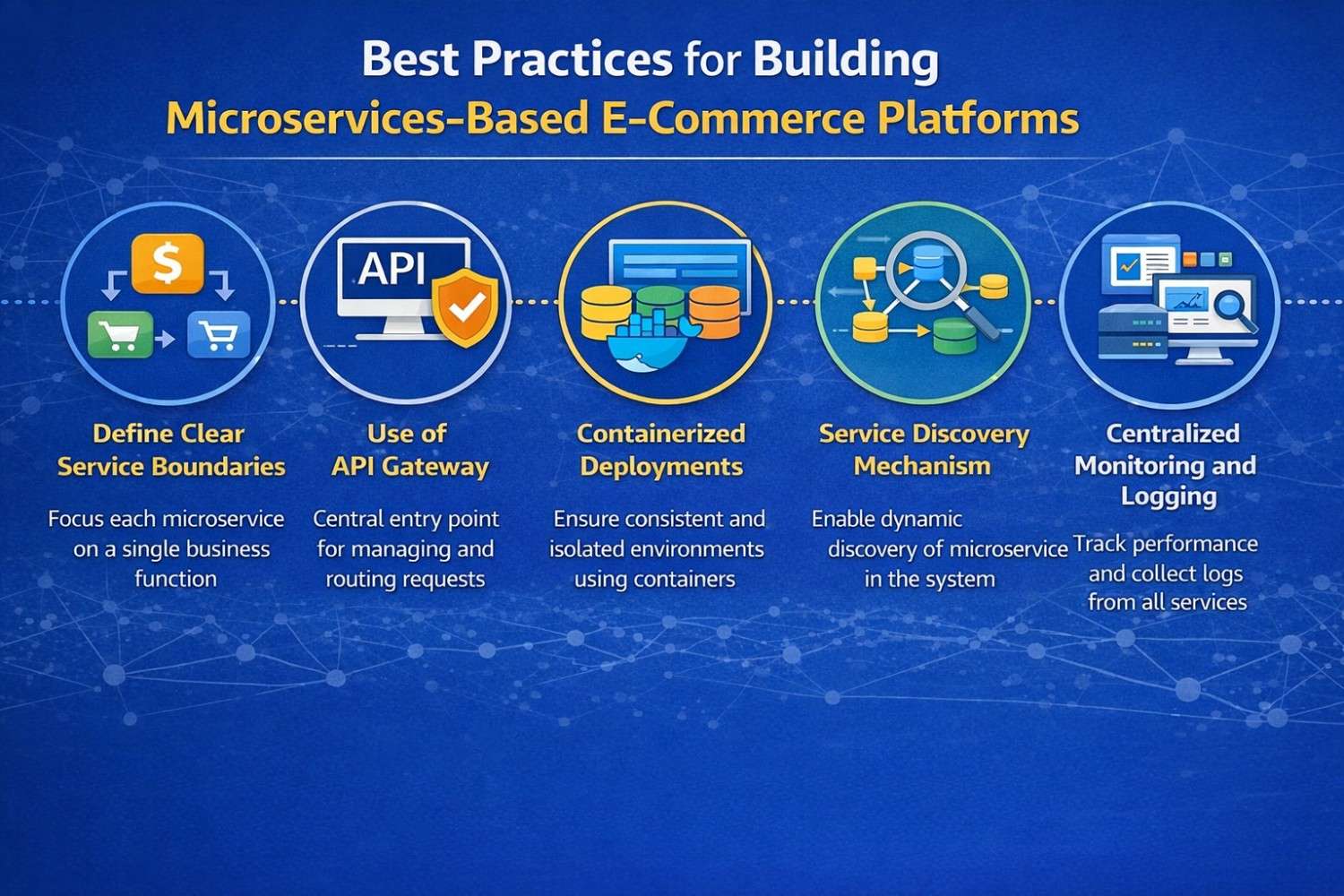
Building a microservices-based e-commerce platform requires careful planning and the adoption of best practices to ensure reliability, scalability, and efficient management.
By following well-defined architectural and operational strategies, organizations can handle system complexity and maintain smooth performance across multiple independent services.
Define Clear Service Boundaries
Each microservice should focus on a single business function such as payments, orders, or product management. This reduces dependencies between services and keeps responsibilities well defined.
Clear boundaries make the system easier to understand and manage. They also support independent development and updates.
Use of API Gateway
An API gateway acts as a central entry point for all client requests. It handles request routing, authentication, and traffic control efficiently.
This reduces direct interaction between clients and services. It also improves security and simplifies communication.
Containerized Deployments
Using containers, such as Docker, ensures consistent environments across development and production. This reduces issues caused by environment differences.
It also simplifies deployment across servers and cloud platforms. Containers help make the deployment process faster and more reliable.
Service Discovery Mechanism
Service discovery allows microservices to locate and communicate with each other dynamically. This removes the need for fixed IP addresses or manual configuration.
It improves system flexibility and adaptability. Services can scale or move without affecting communication.
Centralized Monitoring and Logging
Monitoring tools track performance and health across all services. Centralized logging collects data from different services in one place. This helps quickly identify and resolve issues. It also improves visibility into system behavior.
Role of DevOps in Microservices-Based E-Commerce Systems
DevOps plays a crucial role in managing microservices-based e-commerce platforms by ensuring smooth development, deployment, and operations.
As the number of independent services increases, efficient automation and coordination become essential.
DevOps practices help maintain system reliability, speed up delivery, and simplify the management of complex distributed systems.
Operational Role of DevOps
DevOps plays a key role in managing microservices by streamlining development, deployment, and operations. It helps teams handle multiple independent services efficiently.
By improving collaboration between development and operations, it ensures smoother workflows. This leads to faster delivery and more stable systems.
CI/CD Pipelines for Deployment
CI/CD pipelines automate the process of building, testing, and deploying services. This reduces manual effort and speeds up releases. Automated pipelines also improve consistency and reduce errors. As a result, updates can be delivered quickly and reliably.
Container Orchestration Platforms
Container orchestration tools like Kubernetes manage services across multiple servers. They handle tasks such as scaling, load balancing, and maintaining availability. This reduces the need for manual intervention. It also ensures that services run smoothly under varying loads.
Automated Testing and Monitoring
Automated testing ensures that each service functions correctly before deployment. Monitoring tools track system performance and detect issues in real time. This helps teams respond quickly to problems. It also improves overall system reliability.
Infrastructure Automation
Infrastructure as Code allows teams to manage servers and environments using code. This makes setup and configuration faster and more consistent. It reduces manual errors and improves efficiency. It also simplifies scaling and environment management.
Real-World Examples of Microservices in E-Commerce
Microservices architecture is widely adopted by leading e-commerce platforms to handle large-scale operations and complex system requirements.
By breaking applications into smaller, independent services, these platforms can efficiently manage high traffic, vast product catalogs, and continuous transactions while maintaining performance and reliability.
Adoption by Major E-Commerce Platforms
Leading platforms like Amazon, eBay, and Alibaba use microservices architecture to manage large-scale operations. This approach allows them to handle millions of users and transactions efficiently.
By dividing systems into smaller services, they maintain better control over performance. It also helps ensure reliability during high demand.
Handling Large Product Catalogs
These platforms manage large catalogs by dividing product-related tasks into separate services. Different services handle categories, pricing, inventory, and product details independently.
This separation improves organization and data management. It also makes updates easier without affecting the entire system.
Managing High User Traffic
Microservices allow platforms to handle high user traffic more effectively. Services such as search or checkout can handle increased demand independently.
During peak times, only the required services need additional resources. This helps maintain consistent performance across the platform.
Efficient Transaction Processing
Payment, order processing, and delivery services operate independently but communicate smoothly. This ensures faster and more reliable transactions.
If one service faces an issue, others can continue working. This improves overall system reliability and user experience.
Use of Distributed Services
Services are distributed across multiple servers and locations. This improves system availability and reduces the risk of complete system failure. It also helps in balancing load efficiently. As a result, platforms can provide consistent performance globally.
Continuous Updates and Innovation
Microservices allow updates to individual services without affecting the entire platform. This reduces downtime and speeds up feature releases. Teams can introduce improvements more frequently. It also helps platforms stay competitive by continuously enhancing user experience.
When to Use Microservices for an E-Commerce Platform
Choosing the right architecture is an important decision when building an e-commerce platform. While microservices offer flexibility and scalability, they are not always necessary for every use case.
Understanding when to adopt microservices helps organizations balance performance, complexity, and development effort effectively.
Suitable for Rapidly Growing Platforms
Microservices are well-suited for platforms that are expanding quickly. As user traffic increases, individual services can handle higher demand without affecting the entire system. This helps maintain stable performance during growth. It also allows the platform to evolve without major disruptions.
Best for Frequent Updates and Changes
Platforms that frequently introduce features such as offers, recommendations, or delivery options benefit from microservices.
Updates can be applied to specific services without impacting others. This reduces downtime and speeds up release cycles. It also allows faster response to market changes.
Useful for Multiple External Integrations
The Architecture simplifies integration with external systems like payment gateways, shipping providers, and third-party APIs. Each integration can be managed by a separate service. This reduces complexity and improves reliability. It also makes it easier to update or replace integrations when needed.
Improves System Flexibility and Performance
It allows different parts of the system to handle demand independently. High-traffic services can be supported with additional resources without affecting others. This improves overall system efficiency. It also ensures better performance during peak usage.
Avoid Unnecessary Complexity
Microservices introduce additional complexity in communication and management. If the platform does not require frequent updates or large-scale operations, this approach may not be necessary. Simpler designs can be more efficient in such cases. Choosing the right architecture depends on the platform’s needs.
 WhatsApp
 Call Us
 Mail Us