


15 Best MLOps Tools and Platforms in 2026




There is no single best MLOps tool in 2026. MLflow is the strongest starting point for experiment tracking and model management. Kubeflow fits Kubernetes-heavy environments, and managed platforms like Amazon SageMaker, Google Vertex AI, and Databricks cover most of the lifecycle for teams that would rather not run their own infrastructure.
Most teams don't need all 15. They need a small combination of tools that covers the weakest parts of their machine learning lifecycle, and getting that combination right is the actual decision this guide exists to help with.
That's what most "top tools" lists miss. They rank platforms as if you're crowning one winner, when the real question is which tool owns which stage of your pipeline and where the seams between them will hurt. A model that runs beautifully in a notebook is worth nothing until it's deployed, versioned, and monitored in production, and closing that gap is the entire point of MLOps tooling.
According to Global market research, the global MLOps market is projected to reach $16.6 billion by 2030, growing at a 40.5% CAGR, and the number of tools has expanded just as fast.
Quick picks
Here are the best picks by use case:
What are MLOps tools?
MLOps tools are the software that operationalizes machine learning: they version data and models, track experiments, orchestrate training pipelines, serve models as APIs, and monitor them in production. MLOps (machine learning operations) applies the automation and version-control discipline of DevOps to ML, with one added complication
An ML system's behavior depends not just on code but also on training data and model weights, all of which must be versioned and monitored independently. If you've ever set up a continuous integration and delivery pipeline for application code, MLOps is the same idea extended to models, data, and prompts.
MLOps tools vs MLOps platforms
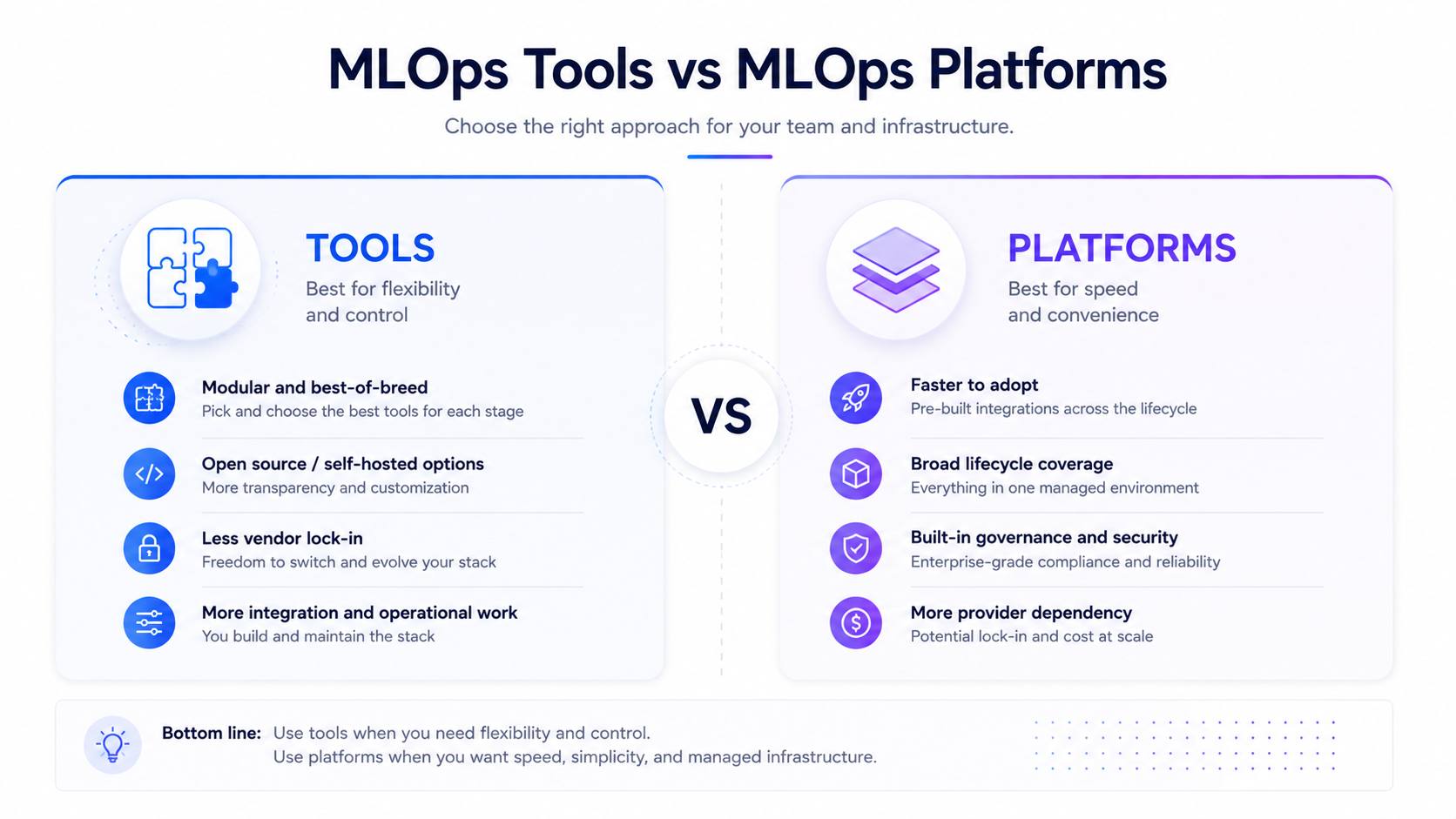
The first decision isn't which MLOps tool to buy. It's whether you need a tool or a platform, and that single choice drives most of your cost and flexibility.
A tool solves one slice of the lifecycle: MLflow for tracking, DVC for data versioning, Feast for features. You combine several into a stack; you own a platform that bundles many slices into one managed environment: SageMaker, Vertex AI, Databricks. Tools give you flexibility and no lock-in but require you to integrate and operate them.
Platforms cut integration work and hand you governance out of the box, at the price of provider dependency and, at scale, cost. Everything below is tagged as one or the other, because knowing which you're looking at is half the evaluation.
The seven stages of the MLOps lifecycle
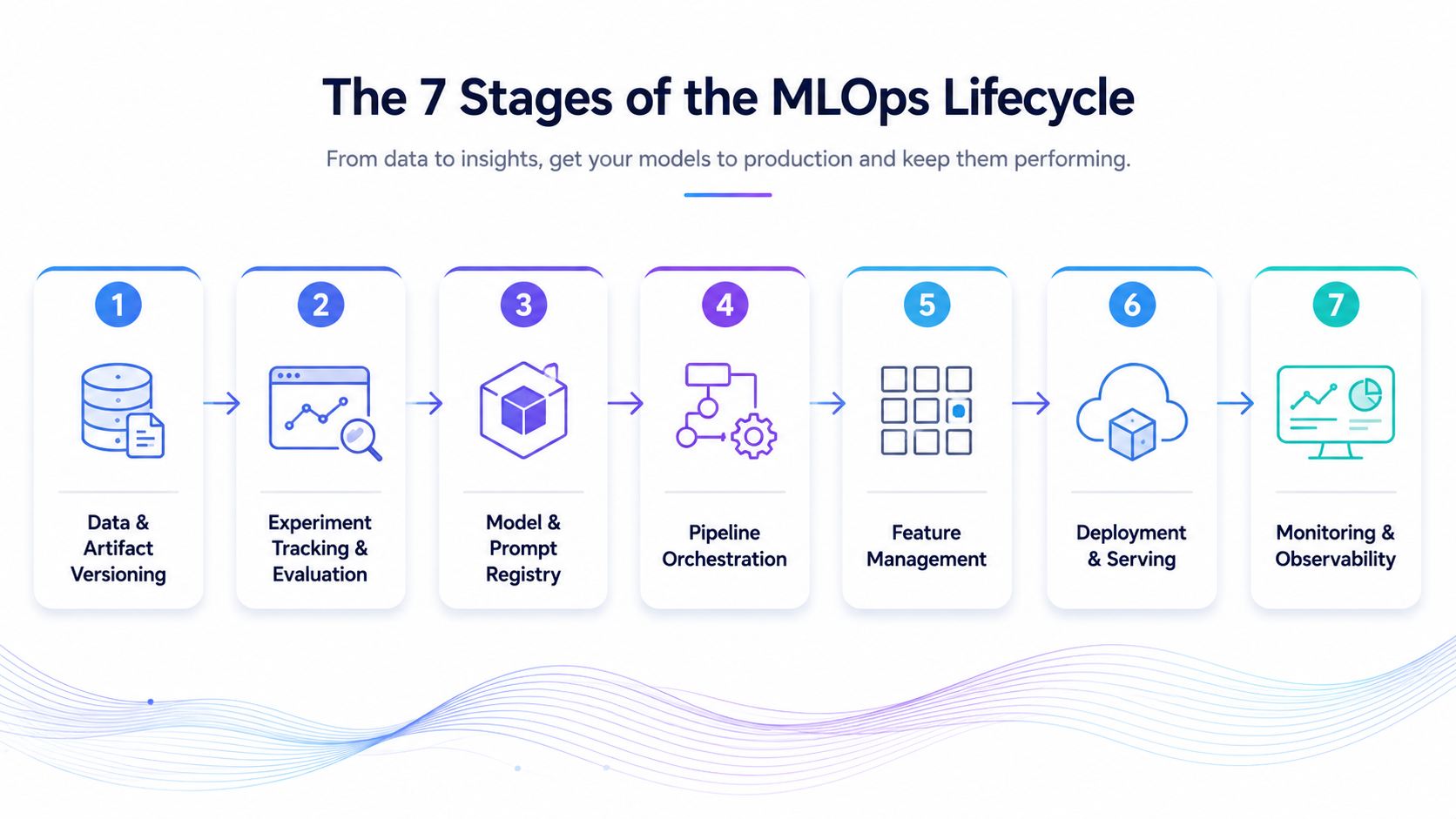
Every tool here earns its place by covering one or more of seven stages. Knowing the stages is what turns a list of names into a stack you can actually assemble.
- Data and artifact versioning tracks datasets and model files the way Git tracks code, so any result can be reproduced from the exact inputs that produced it.
- Experiment tracking and evaluation record the parameters, metrics, and code behind every run — and, increasingly, the evaluation scores for model and LLM output quality.
- Model and prompt registry is the central store where trained models (and now prompts) are versioned and promoted through staging to production, enabling minute-scale rollbacks.
- Pipeline orchestration automates the multi-step flow from ingestion through deployment training, handling dependencies and failures.
- Feature management keeps the features used in training identical to those served at inference, eliminating training-serving skew.
- Deployment and serving package a model and expose it as a low-latency or batch endpoint.
- Monitoring and observability track live performance, data drift, and for LLMs, output quality and cost after deployment.
A tool that nails one stage and ignores the rest isn't a weakness; it's the norm. Independent reviews of the category consistently find that most MLOps tools specialize, which is exactly why stack assembly beats platform worship.
How we evaluated these MLOps tools
These aren't ranked one-to-fifteen, because "best" depends on your stack. Instead, each tool is assessed on the same criteria:
lifecycle coverage (how many stages it handles well), deployment model (open-source self-hosted, managed, or cloud-tied), ecosystem and integrations, operational complexity (what it costs in engineering time to run), production maturity, and fit by team size and ML maturity.
The recommendations reflect technical capabilities, ecosystem maturity, and the real operational trade-offs of running each tool, not vendor positioning. Where a tool is genuinely the standard for a stage, that's noted; where a superlative isn't defensible, it isn't made.
The 15 best MLOps tools in 2026
Each profile follows the same shape like what it is, who it's best for, its strongest advantage, its main limitation, and pricing, so you can compare them on equal terms.
Open-source and composable
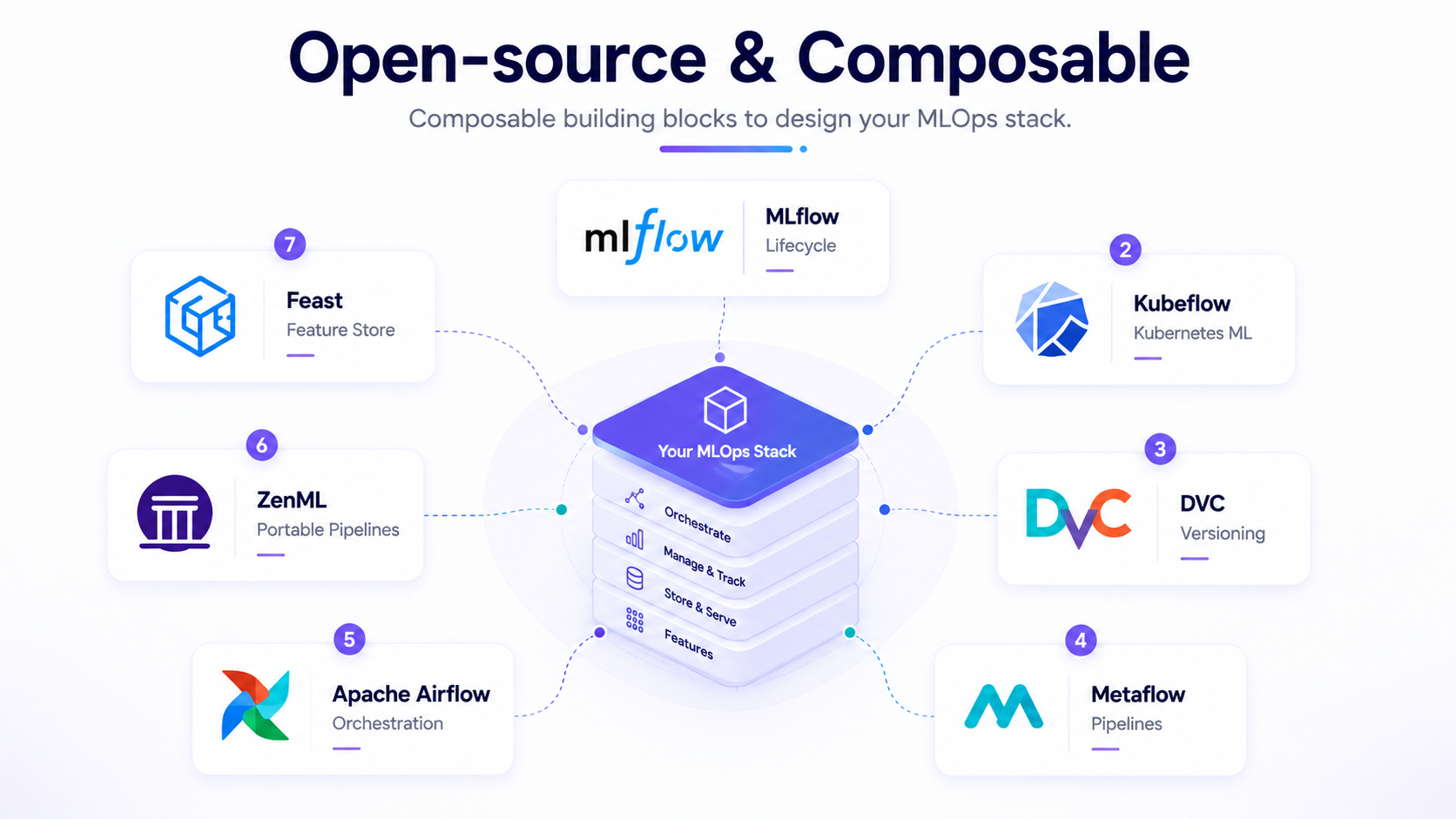
1. MLflow
MLflow is an open-source ML and AI lifecycle platform covering experiment tracking, model and prompt management, evaluation, a model registry, and deployment. Created at Databricks and donated to the Linux Foundation, it's framework-agnostic and instruments existing Python code in a few lines.
Its more recent releases have pushed well beyond classical ML into LLM and agent observability tracing, evaluation metrics, and prompt versioning, which keeps it relevant to both MLOps and LLMOps.
Best for: teams that want open, portable lifecycle management and a safe anchor for a self-managed stack.
Strongest advantage: near-universal integration; it plugs into almost any ML or AI code.
Limitation: it's a lifecycle layer, not a full serving-and-orchestration platform; you still bring infrastructure for those at scale.
Pricing: open source (Apache 2.0); managed versions available inside Databricks and other data platforms.
2. Kubeflow
Kubeflow runs ML workflows natively on Kubernetes, with Pipelines for DAG-based workflows, Notebooks for development, KServe for serving, and Katib for hyperparameter tuning.
Best for: teams for whom Kubernetes is already a strategic platform, running heavy deep-learning workloads on GPU clusters.
Strongest advantage: portability across any cloud or on-prem Kubernetes, with every pipeline step isolated in a container.
Limitation: operational complexity running it well often needs a dedicated platform-engineering team, the hidden cost most adopters underestimate.
Pricing: open source (Apache 2.0); free to use, expensive to operate.
3. DVC (Data Version Control)
DVC brings Git-style version control to datasets and models, storing lightweight pointers in Git while pushing large files to remote storage like S3 or GCS. It also supports pipeline definitions and basic experiment tracking.
Best for: research teams and smaller shops that want reproducibility with a minimal infrastructure footprint.
Strongest advantage: familiar Git workflows branches, commits, pull requests extended to data and models.
Limitation: it covers versioning; serving and monitoring live elsewhere.
Pricing: open source (Apache 2.0).
4. Metaflow
Metaflow, open-sourced by Netflix in 2019, lets data scientists write ordinary Python while it handles versioning, compute scaling, and cloud integration in the background. Steps are decorated to run on large instances or pull from S3 without infrastructure code.
Best for: data-science-forward teams that prioritize fast iteration over platform control.
Strongest advantage: the smallest gap between local experimentation and production runs of any tool here.
Limitation: no full model registry out of the box; teams pair it with MLflow.
Pricing: open source (Apache 2.0).
5. Apache Airflow
Apache Airflow is a widely deployed general-purpose workflow orchestrator, defining pipelines as Python DAGs with a deep catalog of connectors for AWS, Spark, Kubernetes, and hundreds of other systems.
Best for: teams with existing data pipelines who want to extend them into model training and deployment.
Strongest advantage: flexibility; it orchestrates almost anything, and most data teams already know it. If you're deciding where a dedicated orchestration layer belongs, Airflow is the default reference point.
Limitation: not ML-native; Prefect and Dagster are lighter modern alternatives to its operational overhead.
Pricing: open source (Apache 2.0); managed via Astronomer, AWS MWAA, and others.
6. ZenML
ZenML is a framework that sits above your other tools, letting you write pipelines once and run them across MLflow, Kubeflow, SageMaker, and more without rewriting code.
Best for: teams that want to avoid lock-in and keep their stack swappable as needs change.
Strongest advantage: it standardizes a multi-tool stack behind one interface, genuinely useful when you're assembling rather than buying.
Limitation: it's a layer, not a destination; you still choose and run the underlying tools.
Pricing: open source (Apache 2.0); paid managed cloud tier available.
7. Feast
Feast is an open-source feature store that centralizes feature computation and storage so offline training and online serving use identical transformations.
Best for: multi-team setups sharing features across models with online inference and governance needs.
Strongest advantage: it directly solves training-serving skew, the expensive bug that silently degrades production models.
Limitation: a feature store is a ceremony for a single team shipping a single model; adopt it only when feature reuse is a real problem.
Pricing: open source (Apache 2.0).
Managed and cloud-native platforms
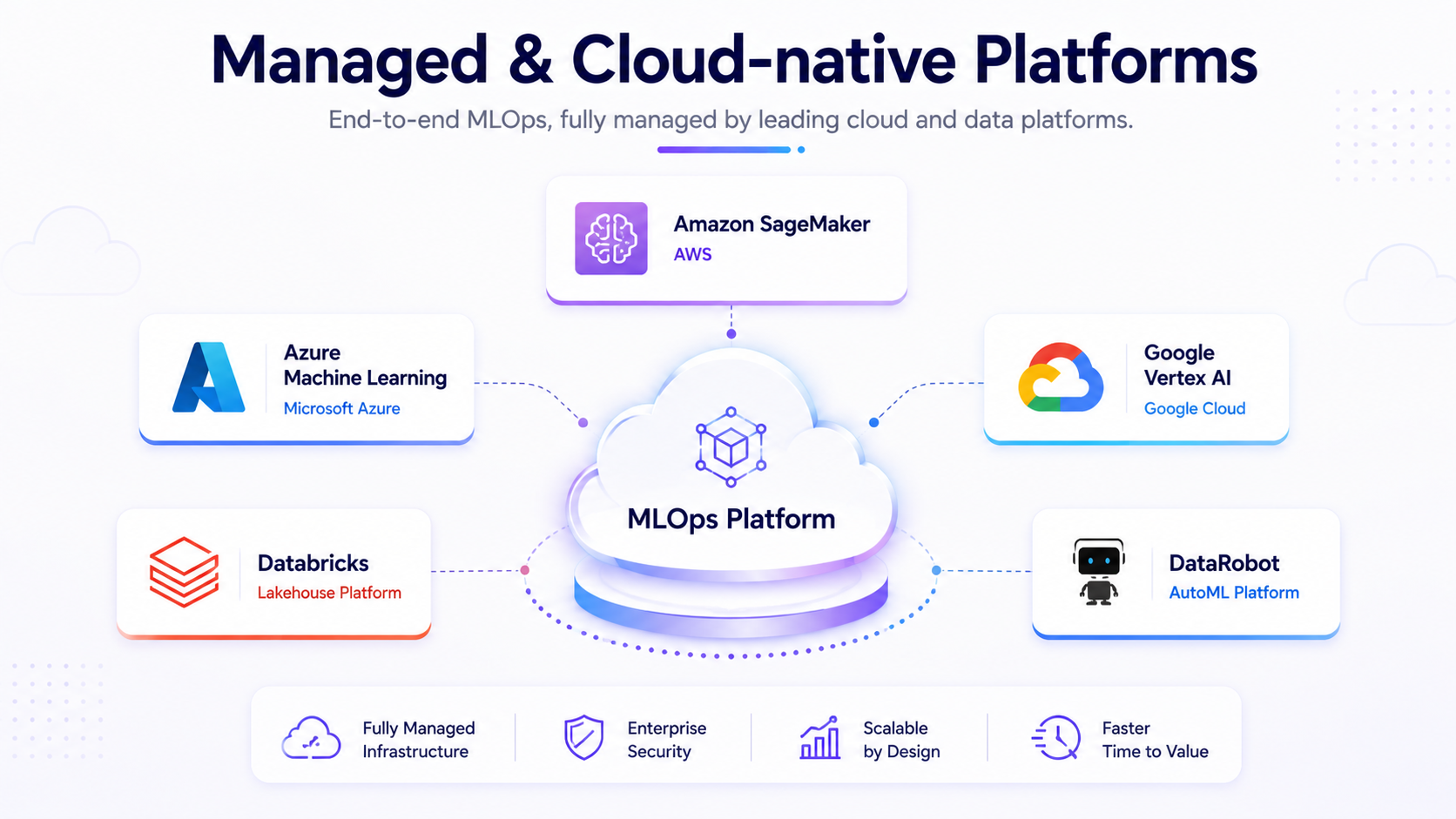
8. Amazon SageMaker
Amazon SageMaker is AWS's end-to-end platform, covering data prep, training, tracking, registry, deployment, and monitoring, with managed compute that provisions and tears down GPUs automatically.
Best for: teams deeply invested in AWS infrastructure.
Strongest advantage: tight integration across the AWS ecosystem; SageMaker Pipelines gives code-first orchestration, and it pairs naturally with the wider set of AWS DevOps tooling many teams already run.
Limitation: breadth brings a learning curve, and costs climb quickly without governance.
Pricing: proprietary, pay-as-you-go on AWS.
9. Azure Machine Learning
Azure Machine Learning offers comparable end-to-end capability on Azure, with a low-code designer and a code-first Python SDK, plus governance aligned to Microsoft's compliance frameworks.
Best for: enterprises on the Microsoft stack, especially in regulated sectors.
Strongest advantage: strong enterprise governance and data-environment integration.
Limitation: most valuable inside the Azure ecosystem; less compelling if your data lives elsewhere.
Pricing: proprietary, pay-as-you-go on Azure.
10. Google Vertex AI
Vertex AI unifies Google Cloud's ML workflows, AutoML and custom training, a registry, pipelines, plus GenAI tooling and model evaluation for LLMs.
Best for: GCP-based teams and those doing significant generative-AI work.
Strongest advantage: one of the strongest native LLM and evaluation toolsets among the cloud platforms.
Limitation: tied to Google Cloud; multi-cloud teams get less from it.
Pricing: proprietary, pay-as-you-go on GCP.
11. Databricks
Databricks unifies data engineering, data science, and ML on one lakehouse, embedding managed MLflow, a feature store, model serving, and monitoring in a single governed environment.
Best for: teams where data engineering and ML share the same platform and want to cut the number of systems they operate.
Strongest advantage: the data-and-ML unification genuinely reduces operational overhead and works across clouds.
Limitation: it's a commitment to the lakehouse model and its consumption pricing.
Pricing: proprietary; consumption-based across AWS, Azure, and GCP.
12. DataRobot
DataRobot is an enterprise AutoML-first platform that automates model building, deployment, and monitoring with heavy governance features.
Best for: enterprises that want automation and compliance over hands-on architectural control, including analysts who aren't ML engineers.
Strongest advantage: speed from data to a governed, deployed model with minimal code.
Limitation: less flexibility for teams that want to control architecture directly; premium pricing.
Pricing: proprietary, enterprise (quote-based).
Tracking, evaluation, and monitoring specialists
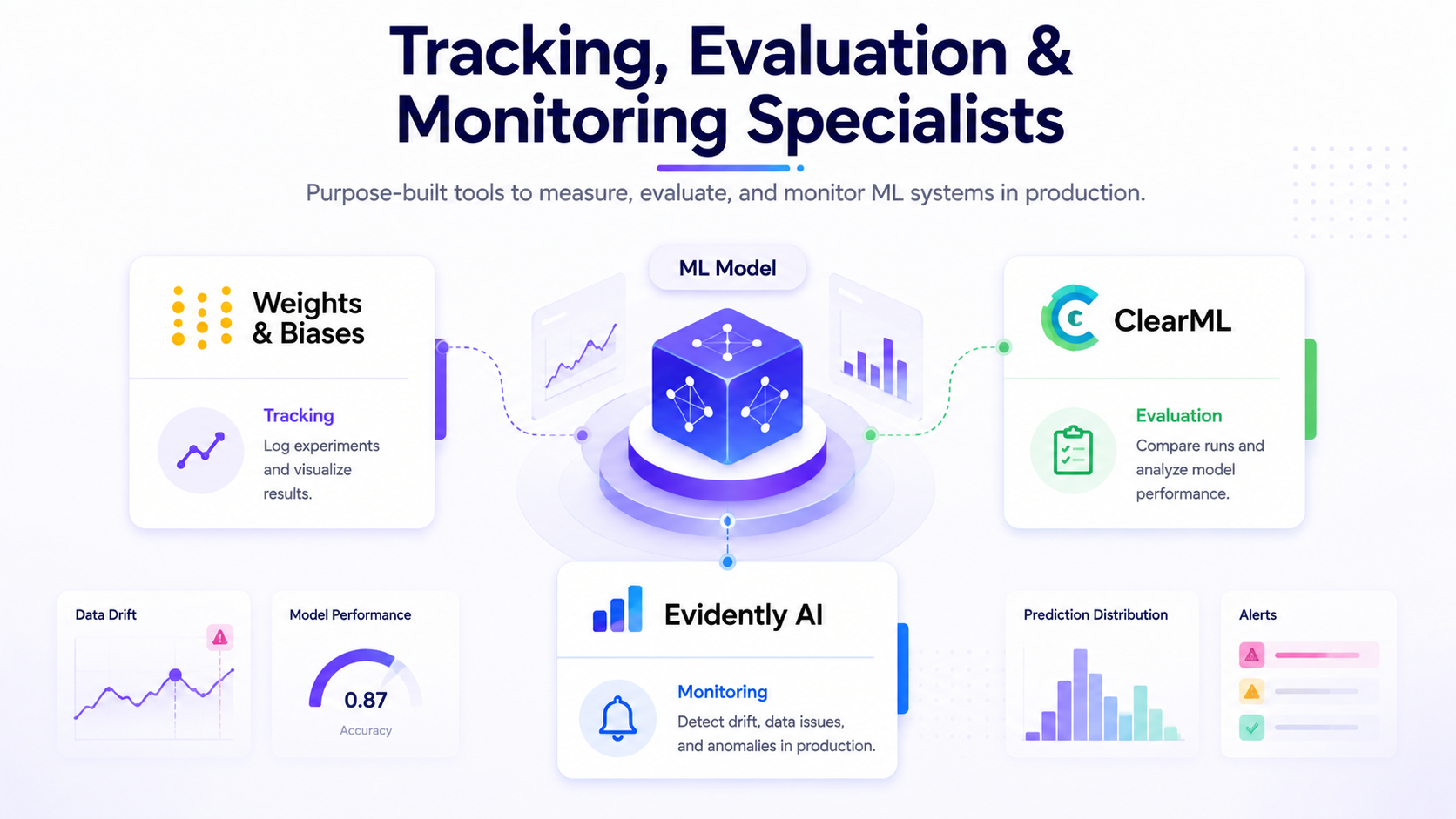
13. Weights & Biases
Weights & Biases is a developer-first platform centered on experiment tracking, visualization, and hyperparameter sweeps, extended with LLM evaluation and prompt tracking. Best for: research and applied-ML teams where experiment visualization and collaboration matter most.
Strongest advantage: the tracking and visualization experience developers actually enjoy using.
Limitation: focused on the experimentation end; you add orchestration and serving separately.
Pricing: free tier for individuals; paid team and enterprise plans.
14. ClearML
ClearML is an open-source, self-hostable suite spanning experiment tracking, orchestration, data management, and model management effectively a broad MLOps stack in a single tool.
Best for: teams that want an open-source, self-hosted alternative to managed tracking without wiring together five separate tools.
Strongest advantage: broad lifecycle coverage in one open-source package you control end to end.
Limitation: doing many things means it's not always the deepest at any single one; self-hosting carries operational overhead.
Pricing: open source; paid managed and enterprise tiers available.
15. Evidently AI
Evidently AI is an open-source AI evaluation and observability framework covering data drift and performance monitoring for classical ML, plus evaluation and testing for LLMs, RAG applications, and agents.
Best for: any team that needs drift, quality, and LLM-output evaluation bolted onto an existing stack.
Strongest advantage: focused, open-source observability that fills the stage most homegrown stacks neglect, and it now spans ML and LLM monitoring in one library.
Limitation: monitoring and evaluation only; it's a component, not a platform.
Pricing: open source; paid cloud platform available.
MLOps tools comparison
Grouped by what stage they own and how they deploy, all 15 tools line up like this:
The open-source tools each own one stage you combine yourself; the managed platforms cover the whole lifecycle but bind you to their cloud. Your stack is usually one anchor, MLflow or a cloud platform, plus specialists that fill the gaps.

The real cost trade-off between Open-source vs managed MLOps
The choice between open-source tools and managed platforms is the defining decision of the 2026 landscape, and it's usually framed wrong. The trap is confusing "free to download" with "free to operate."
Open-source tools like Kubeflow, MLflow, and DVC carry no licensing fees and no vendor lock-in. That's real value. But the operational cost is equally real: Kubeflow is powerful and notoriously complex, and keeping a self-managed stack running, upgrading, breaking dependency changes, and security patching often needs several dedicated platform engineers. For a team shipping a handful of models, that headcount can dwarf a platform subscription.
Managed platforms invert the equation. SageMaker, Vertex AI, and Databricks fold integration, security, and governance into the product, so a small team can operate what would otherwise need a platform group. You pay for that in subscription and consumption costs, and in reduced flexibility.
The honest rule: if you have dedicated ML platform-engineering capacity, curated open source usually wins on cost and control; if you don't, managed infrastructure can be cheaper once engineering time, maintenance, security, and upgrades are counted, though managed platforms can become very expensive at scale, so model your costs against real usage before committing. This is the same build-versus-buy calculus that runs through cloud architecture decisions generally; the license price is rarely the number that matters.
MLOps vs LLMOps in 2026
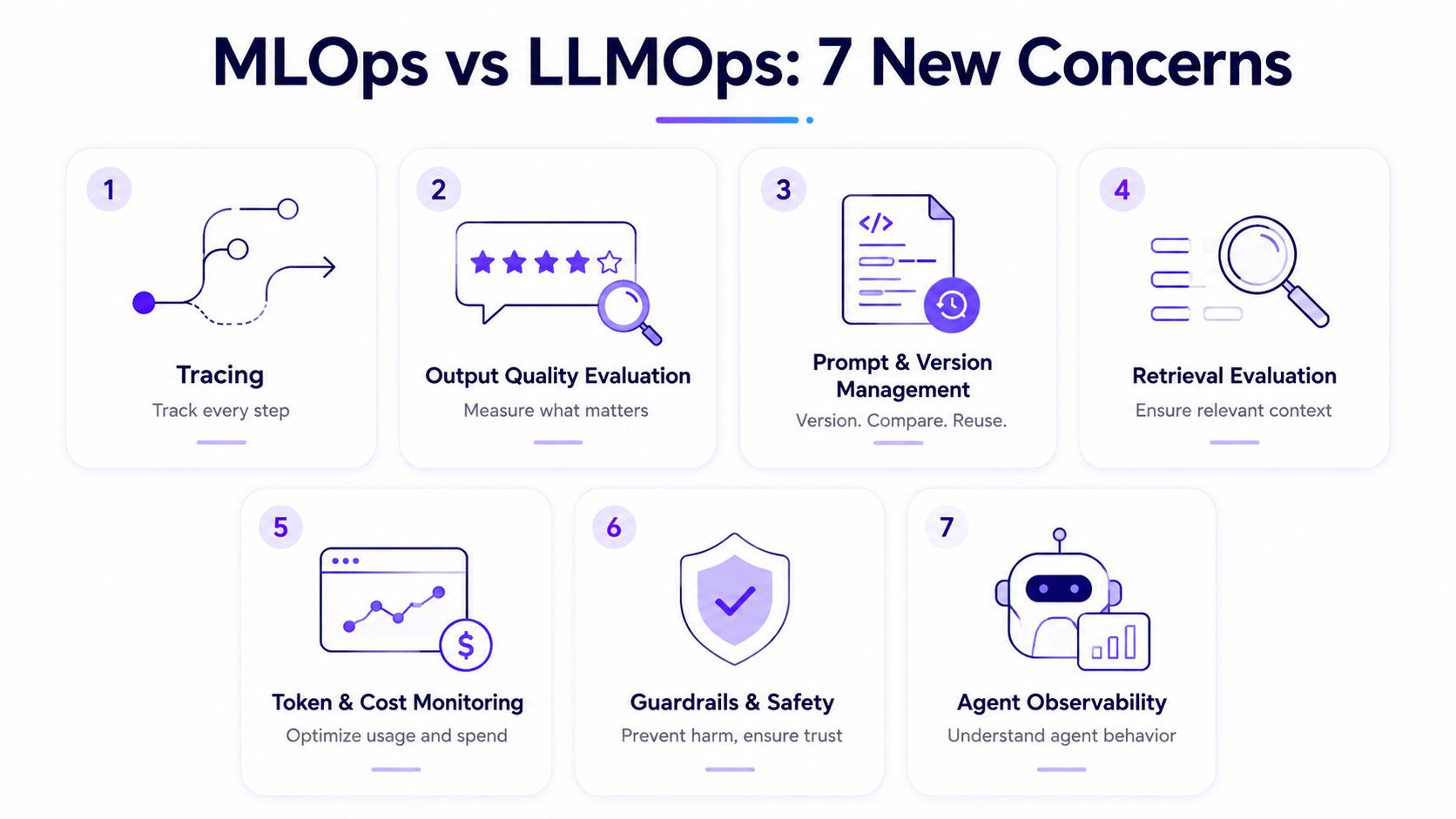
Large language models have broken the assumptions that traditional MLOps was built on. You're no longer just versioning a scikit-learn model behind an endpoint; you're managing prompts, fine-tuned adapters, retrieval pipelines, evaluation suites, and agents that chain multiple steps together. That's given rise to LLMOps as a discipline of its own, and it's where the tooling is moving fastest.
The operational surface is genuinely different. LLMOps adds concerns that classical monitoring never had to handle:
- Tracing the full execution of a request through an RAG or agent architecture: retrieve, rank, call tool, generate often via OpenTelemetry-based instrumentation.
- Evaluation of output quality, since there's no single accuracy number; teams score relevance, faithfulness, and safety across many inputs.
- Prompt and version management, treating prompts as versioned artifacts in a registry alongside models.
- Retrieval evaluation, measuring whether the right context was fetched before the model ever generated.
- Token and cost monitoring, because inference spend scales directly with usage and can surprise a finance team.
- Guardrails and safety checks on inputs and outputs, plus human feedback loops for continuous quality.
- Agent observability trace stores that visualize an agent's full chain of reasoning, which traditional dashboards simply can't show.
The established tools have adapted rather than been replaced. MLflow now positions its AI observability around traces, evaluations, prompt management, and governance for agent workflows. Weights & Biases and Vertex AI added prompt management and evaluation logging. Evidently expanded from ML drift monitoring into evaluation and testing for LLMs, RAG, and agents.
If your roadmap includes LLMs in production, weigh platforms by their prompt-management, evaluation, and fine-tuning support rather than classical model monitoring alone, and expect a stack that handles retrieval and embeddings as a baseline, not a future phase.
How to choose the right MLOps stack
There's no universal best tool; the right stack depends on your team size, existing infrastructure, and ML maturity. Work through it in this order:
- Start from your infrastructure: Already on AWS, Azure, or GCP? The native platform (SageMaker, Azure ML, or Vertex AI) gives the tightest integration and the least glue code. Running your own Kubernetes? Kubeflow fits the existing operational model.
- Match tooling to your ML maturity: Early teams get immediate value from MLflow for tracking and a registry, with no infrastructure change. Mature teams running distributed GPU training justify Kubeflow's complexity.
- Weigh your platform-engineering capacity honestly: No dedicated platform team? Lean managed. Have one? Curated open source pays off in control and cost.
- Fill your weakest stage deliberately: Teams often have tracking and training covered but neglect monitoring. Evidently, AI or a platform's built-in observability closes that gap.
- Keep the stack swappable: A layer like ZenML lets you change underlying tools later without rewriting pipelines, which matters in a landscape moving this fast.
The pattern that works is one anchor plus targeted specialists, not a single platform expected to be excellent at everything.
Conclusion
The best MLOps tool isn't a single product; it's the combination that covers your lifecycle without leaving seams your team can't maintain. MLflow anchors most self-managed stacks; the cloud platforms win when integration and low operational overhead matter more than flexibility; specialists like Feast, Weights & Biases, ClearML, and Evidently AI fill the stages a general platform underserves.
Start from your existing infrastructure, be honest about your platform-engineering capacity, and pick deliberately for the stage you're weakest on. If you're standing up MLOps from scratch or untangling a stack that's grown by accident, Code B's AI and ML engineering team can help you design one that fits your infrastructure and stays maintainable as the landscape keeps shifting.
 WhatsApp
 Call Us
 Mail Us