


Mobile App Development Cost Guide 2026: Pricing, Features & Timelines



Why App Budgets Overrun & How to Prevent It
A cost breakdown for every development phase, from discovery to launch.
Accurately estimating mobile app development costs is essential for budgeting, vendor selection, and product planning. Cost influences decisions around feature scope, platform strategy, development timelines, infrastructure requirements, and long-term maintenance.
Businesses evaluating the same application concept frequently receive estimates that vary by tens or even hundreds of thousands of dollars, making it difficult to determine what a realistic budget should look like.
The reason for this variation lies in the technical and operational requirements behind the product. Factors such as application complexity, backend architecture, third-party integrations, compliance obligations, team structure, and deployment approach all contribute to the final cost.
This guide breaks down each of these variables with current benchmarks, practical examples, and cost ranges to help business leaders, product owners, and decision-makers evaluate budgets more confidently and plan development investments with greater accuracy.
Mobile App Cost Overview
Mobile app development costs can vary significantly depending on the product's complexity, the features being built, the level of customisation required, and the development team's location and expertise. While every project is unique, most apps fall into a few common categories based on their scope and technical requirements.
The estimates below provide a realistic starting point for budgeting a mobile app project in 2026. They reflect typical development costs and timelines for businesses building custom applications, from simple MVPs to large-scale enterprise platforms.
These ranges should be viewed as benchmarks rather than fixed prices. The final cost depends on factors such as feature complexity, backend architecture, third-party integrations, security requirements, platform selection, and the amount of testing needed before launch.
Why do estimates vary so much?
Ask five agencies for a quote on the same app idea, and you will likely get five different numbers. That happens because early estimates are based on visible features, screens, flows, buttons, while the bulk of development effort lives in what users never directly see: data handling, access control, error states, authentication, and infrastructure setup.
Agencies that quote low often price the interface and exclude the backend. Agencies that quote high may be pricing for edge cases your product does not yet need. The most reliable estimates come after a scoping session where requirements are properly defined.
What Most Apps Cost to Build
In 2026, mobile app development costs typically range from $10,000 to $300,000+, depending on complexity, platform requirements, and development team location. Most business apps with user accounts, backend systems, and third-party integrations fall between $30,000 and $80,000, while enterprise applications with compliance requirements, complex workflows, and extensive integrations frequently exceed $150,000. Backend complexity, platform choice, integrations, and team structure are the primary factors influencing cost.
What Drives Mobile App Development Cost
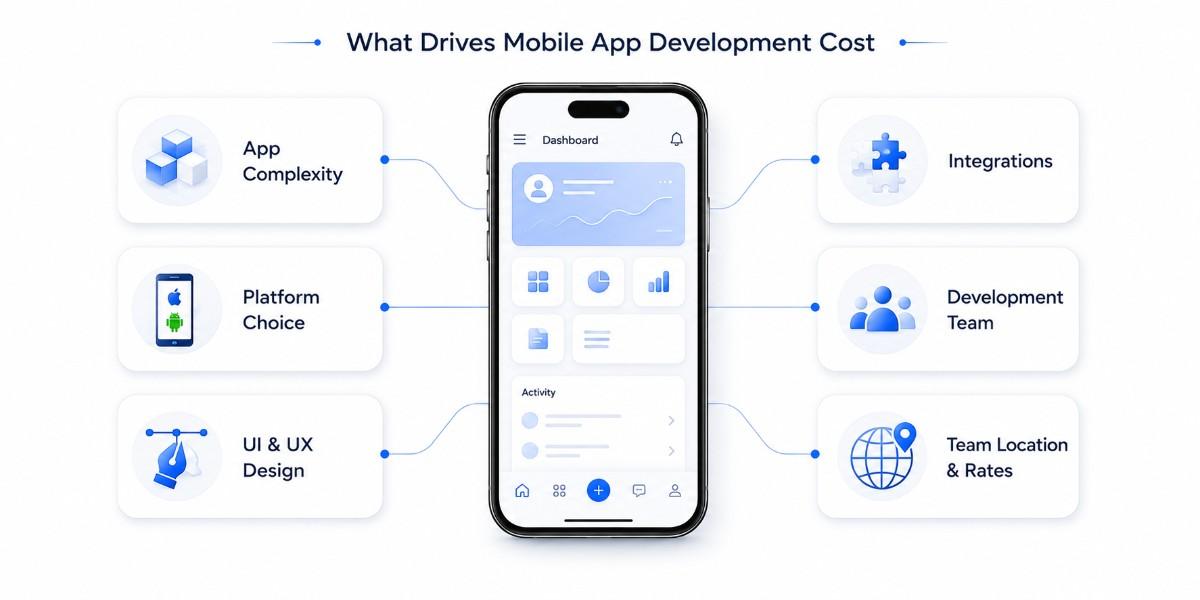
Cost does not come from any single decision. It accumulates across six areas, and when multiple high-complexity choices land in the same project, budgets compound quickly.
App complexity and feature scope
This is the primary driver. A simple app with four screens, no user login, and no backend data storage is fundamentally different from an app that manages user profiles, processes payments, syncs with external systems, and sends real-time notifications.
The second product is not just "more features"; it requires a backend architecture, a database design, security controls, and testing across far more user paths. Each layer of complexity extends development time across the entire team, not just one developer.
Features that seem straightforward during planning often create additional requirements around permissions, reporting, performance optimisation, and support for future updates. As applications grow, teams spend more time ensuring that new functionality works correctly without disrupting existing workflows, which further increases development effort.
Platform choice
Building for iOS only, Android only, or both materially changes the budget. A single-platform native build is the baseline. For businesses building a mobile app using Kotlin, adding iOS through native development roughly doubles testing and maintenance effort, even if frontend code overlaps.
Cross-platform frameworks like Flutter and React Native reduce duplication through shared code but introduce their own configuration and compatibility overhead. The right choice depends on where your users are, not on which option appears cheaper upfront.
Certain device capabilities, operating system updates, and performance requirements may require platform-specific development even when a cross-platform framework is used. Teams therefore need to consider not only the initial build cost but also how the chosen approach will support future features and product growth.
UI and UX design depth
Design is not decoration. Custom layouts, brand-specific interaction patterns, and non-standard navigation structures all take additional time to build and test. Standard component-based design (using platform default UI patterns) moves faster through implementation and reduces the chance of frontend bugs.
Custom design is often worth it, but it should be chosen deliberately, with a clear sense of what it adds to the user experience. The design process itself also contributes to cost. User research, wireframing, interactive prototypes, usability testing, and design revisions all require time before development begins.
Projects that invest in design validation early often avoid costly rework later, but that upfront effort must still be included in the overall budget.
Backend and third-party integrations
Every external service your app depends on, payment processors like Stripe or Razorpay, mapping services, analytics platforms, push notification tools, and authentication providers, adds integration work. Each integration requires configuration, error handling, testing, and ongoing monitoring.
A payment integration alone involves sandbox testing, webhook handling, failure states, and security review. As the number of integrations grows, so does the time required to validate that everything works together reliably.
Backend requirements often expand as products mature. Features such as user activity tracking, audit logs, reporting dashboards, role-based permissions, and automated workflows may not be visible to end users. Still, they consume a significant portion of development hours. In many business applications, backend systems account for more effort than the mobile interface itself.
Development team structure
Whether you build with an in-house team, a development agency, or freelancers changes the financial model significantly. In-house teams carry fixed costs through salaries and benefits. Freelancers lower the upfront number but transfer coordination responsibility to you.
Agencies bundle design, development, QA, and project management, which reduces your overhead but comes at higher day rates. The right model depends on your internal capacity and how much ongoing development the product will need after launch.
The efficiency of the team structure often matters as much as the hourly rate. Projects can become more expensive when responsibilities are unclear, communication breaks down, or technical decisions are delayed. Well-defined processes, experienced project management, and established delivery practices frequently reduce overall project costs by minimising rework and keeping development moving forward.
Team location and hourly rates
This is where the largest cost variance lives. A senior developer in the United States charges $120–$200 per hour. The equivalent skill in India charges $25–$60 per hour. On a 1,500-hour project, that difference represents $140,000–$210,000 in labour cost before any other factor is considered.
Location is not a proxy for quality, but it is the single biggest lever on total budget for most projects. Businesses evaluating offshore or distributed teams should also consider factors beyond hourly pricing. Communication practices, time zone overlap, technical expertise, industry experience, and project governance all influence delivery outcomes.
Mobile App Development Cost by Project Complexity
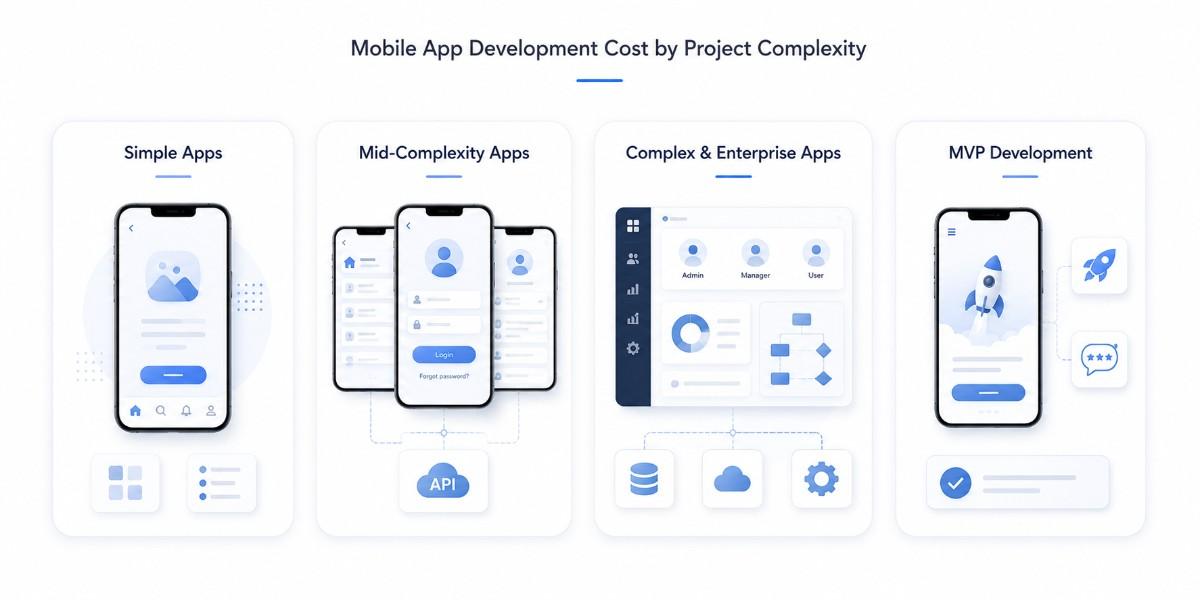
Simple apps
Simple apps are defined by what they do not include rather than what they do. There is no user login, no real-time data sync, no payment processing, and no complex backend logic. Examples include informational apps, basic calculators, content display apps, or simple scheduling tools with no multi-user functionality.
At this price point, you are typically building for a single platform, using standard UI components, and relying on lightweight backend infrastructure or none at all. Quality assurance is faster because there are fewer user paths to validate.
What you should not expect at this budget: anything that handles user data persistently, requires synchronisation across devices, or depends on third-party service integrations. The moment those requirements enter the scope, the cost moves into the next tier.
Mid-complexity apps
This is where most business applications live. A mid-complexity app typically includes user authentication, a relational database, one or more third-party integrations (payments, maps, notifications), an admin dashboard, and custom UI elements. The backend requires thoughtful architecture because data flows between multiple systems, and user roles often determine what different people can see and do.
Most startup products, internal tools, marketplace apps, and industry-specific B2B tools fall into this category. If you are building something for customers to use regularly, this tier is usually the honest starting point.
Complex and enterprise apps
Complex apps carry layered business logic, multiple user roles with distinct permissions, strict compliance requirements, and integration with financial, healthcare, or enterprise systems. The backend is substantial, often involving microservices, message queues, or data pipelines, and QA cycles are extended because the failure consequences are high.
Financial platforms, healthcare applications, logistics systems, and multi-tenant SaaS products regularly land here. The higher cost reflects not just more features, but a fundamentally different standard of engineering rigour.
MVP cost
An MVP development is not a cheap version of your full product. It is a focused build that tests whether your core value proposition works in the real world before you invest in the full build. A well-scoped MVP includes the minimum feature set needed to generate real user feedback, typically one user flow, one platform, and no administrative tooling beyond what is essential.
At $15,000–$50,000, an MVP gives you a working product, actual user data, and the information you need to decide whether to expand, pivot, or stop. Teams that skip the MVP stage and build everything at once often spend $150,000+ discovering the same information.
Mobile App Development Cost based on Project Stages
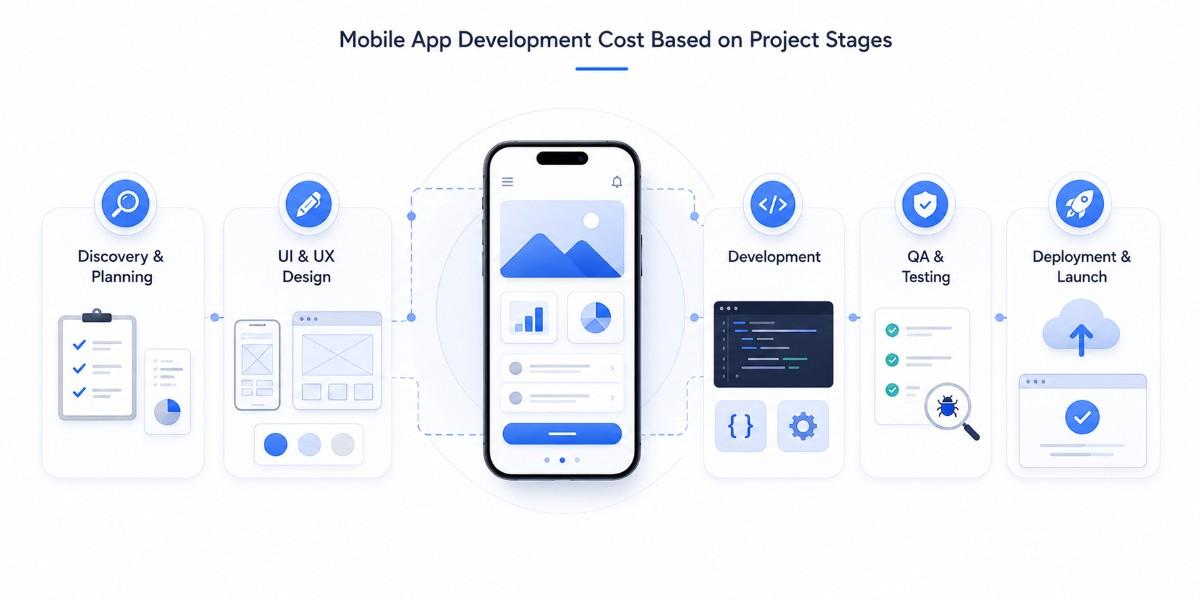
One reason early app estimates miss the mark is that many businesses focus only on development and overlook the activities required before, during, and after coding. Understanding how budgets are typically distributed across these stages helps create more accurate expectations and reduces the risk of unexpected costs later in the project.
Discovery and Planning
Before a line of code is written, someone needs to define what is being built, why, and how. Discovery covers user flow mapping, technical architecture decisions, database design, and the creation of a functional specification.
This phase is the most leveraged investment in the project because decisions made here shape every hour of development that follows. Skipping it is one of the most reliable ways to guarantee expensive rework later.
Depending on the complexity of the product, businesses typically invest between $3,000 and $10,000 in workshops, requirements gathering, technical planning, and project scoping before development begins.
UI and UX Design
Design covers wireframes, visual design, prototype creation, and design system definition. The range is wide because it depends on the number of screens, the degree of customisation, and how many revision cycles are involved.
Design budgets commonly range from $5,000 to $20,000. A simple app with standard UI patterns might need $5,000–$8,000 in design work. A product with custom interaction design, complex flows, and brand-specific visual language can require $15,000–$20,000.
Projects at the lower end often rely on proven interface patterns and limited screen counts, while more sophisticated products require extensive prototyping, usability testing, and highly customised visual systems. The goal is not simply to make the application look appealing but to ensure that users can complete tasks efficiently and intuitively.
Frontend and Backend Development
This is where the majority of the budget goes in every project. Frontend development covers what users see and interact with. Backend development covers the server, the database, the business logic, and the APIs that connect everything. On a $60,000 project, expect roughly $30,000–$36,000 to go to development across these two disciplines.
Backend complexity is the most variable part; a simple CRUD app has minimal backend cost, while a real-time, multi-user system with financial logic has substantial backend requirements. In most projects, development consumes roughly 50–60% of the overall budget. The exact amount depends largely on backend complexity.
A straightforward application with basic data management has relatively modest requirements, while products involving real-time communication, financial transactions, advanced workflows, or large-scale data processing require substantially more engineering effort.
QA and Testing
Quality assurance is not optional. On a $60,000 project, budget $9,000–$12,000 for testing. This covers functional testing, regression testing, device testing (particularly critical for Android), security testing, and performance testing under load. Teams that cut QA to save money typically spend more on post-launch emergency fixes, negative reviews, and reputation damage.
For most projects, QA and testing account for approximately 15–20% of the total budget. Teams that reduce testing to save money often face higher costs after launch through emergency fixes, customer support issues, poor user reviews, and lost trust. Thorough testing is generally far less expensive than correcting critical issues in production.
Deployment and App Store Launch
Deployment is the final step before users can access the application. This stage includes configuring hosting environments, setting up CI/CD pipelines, preparing production infrastructure, generating app store assets, and managing the submission process for app marketplaces.
While the Apple Developer Program currently costs $99 per year and the Google Play Console requires a one-time $25 registration fee, these charges represent only a small portion of launch-related expenses.
Businesses should also account for deployment setup, release management, environment configuration, and app store preparation, which often require an additional investment of approximately $2,000 to $5,000, depending on project complexity and release requirements.
How Features and Functionality Affect Costs
The question "how much does it cost to add X feature?" is one of the most practical things a product owner can ask. Here is a realistic reference for common app features, priced at standard agency rates.
Why do features cost more than their code
Every feature listed above involves more than writing the frontend interface. It requires backend API design, data modelling, error handling for every failure state, security controls, and QA validation across devices and edge cases. A payment feature is not done when the happy path works; it is done when failed cards, expired tokens, duplicate submissions, and webhook failures are all handled correctly.
On third-party services
Using established services like Stripe for payments or Twilio for SMS significantly reduces development cost compared to building equivalent functionality yourself. If you're evaluating which payment gateway fits your app, the choice of provider also affects how much integration work lands on your development team.
Stripe's payment library saves several weeks of development time. The trade-off is an ongoing fee (Stripe charges 1.4 - 2.9% per transaction in most markets). In almost every case, the development time saved is worth the transaction cost, at least at an early scale.
How Platform Choice Affects Mobile App Development Costs
Platform choice is one of the earliest and most consequential decisions in any mobile project. It affects development cost, testing overhead, and long-term maintenance.
iOS App Development Cost
iOS development benefits from a controlled ecosystem. Apple's hardware fragmentation is minimal compared to Android, which simplifies device testing. Platform guidelines are strict, but they are also consistent; once you understand them, implementation is predictable.
iOS users, as a group, spend significantly more within apps. Data from the App Store shows the App Store generated $85 billion in 2025 compared to Google Play's $47 billion, with iOS users spending approximately 2.5x more per person than Android users.
For products that depend on in-app purchases or subscriptions, this makes iOS the financially logical starting point. The cost of developing an iOS application typically ranges from $25,000 to $130,000, depending on the product's complexity, feature requirements, and backend infrastructure.
Applications with standard user flows and limited integrations sit toward the lower end of the range, while products requiring custom functionality, real-time features, advanced security, or extensive third-party integrations move toward the upper end.
Android App Development Cost
Android's wider global reach comes with higher testing overhead. The platform runs across thousands of device configurations, screen sizes, and OS versions, which means QA requires more time to achieve comparable coverage.
Android holds approximately 72% of the global mobile OS market share, making it the default choice when broad international reach matters more than monetisation per user. The device fragmentation challenge is manageable; it just needs to be costed correctly. Budget more for QA on Android builds than iOS builds of equivalent complexity.
The cost of Android app development generally falls between $20,000 and $120,000. Projects with relatively simple workflows and limited device-specific requirements can be delivered at the lower end, while applications that require extensive testing across multiple devices, complex integrations, offline functionality, or advanced user experiences require significantly higher investment.
Cross-Platform Development Cost
Flutter (Google) and React Native (Meta) are the two dominant frameworks for building apps that run on both iOS and Android from a shared codebase. Both are mature, well-supported, and used in production by large companies.
Cross-platform development typically reduces duplication in UI and business logic, which can lower initial build cost. It also means updates are deployed to both platforms simultaneously, which simplifies ongoing maintenance.
The caveats: framework setup adds time upfront, some platform-specific features still require native code, and performance on very complex animations or hardware-intensive features can differ from native builds.
For most business applications, where the primary requirements are reliable data handling, clean UI, and stable performance, cross-platform is a sensible choice that reduces cost without meaningful trade-offs. Most cross-platform projects fall within a budget range of $30,000 to $100,000, the Savings depend on app complexity and how much the design aligns with shared components.
Should you build for one platform first?
Generally, yes. Building for a single platform first lets you validate your product with real users before committing to the full cost of dual-platform support. The decision on which platform to start with should be based on where your target users are, not on assumptions about which is easier or cheaper to build.
If your users are primarily in the US, UK, or other high-income Western markets, start with iOS. If your market is India, Southeast Asia, Latin America, or Sub-Saharan Africa, start with Android. If you genuinely cannot identify a clear user geography, cross-platform avoids the forced choice entirely.
Mobile App Development Costs Across Industries
The category an app belongs to shapes its cost more than surface-level feature count suggests. Industry-specific requirements compliance, data sensitivity, real-time coordination, and transaction accuracy are what push apps into higher cost ranges.
E-Commerce Apps
E-commerce applications typically range from $25,000 to $80,000 depending on the size of the product catalogue, payment requirements, and integration complexity. The primary cost drivers are payment processing, inventory management, customer accounts, order tracking, and backend administration tools.
More advanced e-commerce platforms may also include personalised recommendations, loyalty programmes, multi-vendor functionality, subscription management, and integrations with ERP or inventory systems.
While the customer-facing experience appears relatively straightforward, much of the development effort is concentrated on order management, inventory synchronisation, payment workflows, and operational reporting behind the scenes.
Fintech and Banking Apps
Fintech and banking applications investments typically range between $50,000 and $300,000+, making them one of the most expensive categories to develop. The complexity comes from security requirements, regulatory compliance, transaction processing, fraud prevention, and integrations with financial institutions.
Features such as Know Your Customer (KYC) verification, Anti-Money Laundering (AML), compliance overhead, transaction monitoring, audit logging, encryption standards, and regulatory compliance (GDPR, PCI-DSS, RBI guidelines for India) all add sustained development and legal review costs.
Even an MVP in this space requires security architecture that most other app categories can defer. Integrating with banking APIs, open banking standards, or brokerage systems adds further complexity.
Healthcare Apps
Healthcare app development generally ranges from $40,000 to $250,000, depending on regulatory requirements and data management needs.
Applications in this sector frequently handle sensitive patient information, which introduces strict security and privacy obligations. Compliance frameworks such as HIPAA, GDPR, and local healthcare regulations often require additional development effort beyond standard mobile applications.
Projects that integrate with Electronic Health Record (EHR) systems, telemedicine platforms, wearable devices, or patient monitoring tools require specialised integrations and extensive testing to ensure data accuracy and system reliability.
Food Delivery & On-Demand Apps
Food delivery and on-demand service applications typically cost between $30,000 and $100,000. The coordination requirement, between customers, vendors, and delivery partners, updating in near-real-time, is what makes these apps technically demanding.
In food delivery apps, the real-time location tracking, order state management, payment processing, and notification systems across three user types (customer, restaurant, driver) all need to work reliably under load. Building one side of this system (customer-only) is cheaper; building all three sides is where costs approach the upper end of the range.
As the platform scales, infrastructure requirements increase significantly because multiple users must interact with the system concurrently without delays or service interruptions.
E-Learning Apps
Education platforms generally require budgets ranging from $20,000 to $120,000, depending on content complexity and learning features. The cost range here is wide because the requirements vary enormously. A content delivery app with video lessons and progress tracking is at the lower end.
A platform with live instruction, collaborative tools, assessments, certificates, and institutional management sits much higher. Video streaming infrastructure (or third-party services like Vimeo or Mux) is the single largest cost variable in e-learning apps.
Basic e-learning applications focus on content delivery, quizzes, progress tracking, and course management. More advanced platforms may include live classes, video streaming, certification systems, assessments, gamification features, and collaborative learning environments.
Video hosting, content management, learner analytics, and personalised learning paths often become major cost drivers as educational products expand.
Social Media Apps
Social networking and media-focused applications commonly range from $60,000 to $200,000+. User-generated content, feed algorithms, notification systems, and content moderation drive the cost of social apps. The infrastructure requirements are also different at scale, media storage, CDN delivery, and database performance under concurrent load become high ongoing operational costs.
Building a social app that looks simple but handles media reliably is substantially more expensive than it appears. Content moderation systems, media storage infrastructure, recommendation algorithms, messaging capabilities, and feed generation significantly increase development complexity and operational costs.
AI-Powered Apps
AI-powered applications introduce an additional cost layer on top of standard mobile development requirements. Large Language Model (LLM) integrations commonly add between $15,000 and $40,000 to a project, depending on the complexity of prompts, workflows, and user interactions.
Applications that require custom machine learning models, predictive systems, recommendation engines, or advanced automation can add $20,000 to $80,000 or more. Costs increase further when AI features require continuous training, vector databases, retrieval systems, agentic workflows, multi-step reasoning, or integration with multiple AI providers.
While AI can create significant business value, it should be budgeted as a dedicated capability rather than treated as a standard application feature.
How Team Selection Affects Development Cost
The team structure you choose has a direct impact on both project cost and delivery outcomes. While businesses often compare hourly rates first, the real consideration is how efficiently a team can plan, build, test, and maintain the product. Two teams charging different rates can produce very different total project costs depending on their processes, experience, and level of ownership.
Global Development Rates by Region
Development rates vary significantly by region, which is why geography remains one of the largest drivers of mobile app development cost.
These differences become substantial on larger projects. A mobile application requiring 1,500 development hours may cost between $225,000 and $450,000 when delivered by a US-based agency, while a comparable project completed by an experienced Indian agency often falls between $37,500 and $90,000.
The gap is primarily driven by differences in operating costs, salaries, and overhead rather than development capability.
Mobile App Development Cost in India
India remains one of the most cost-effective destinations for mobile app development in 2026. The country has a mature software ecosystem, a large engineering talent pool, and extensive experience delivering products for clients across North America, Europe, Australia, and the Middle East.
Most established Indian agencies operate within a blended rate range of $25–$60 per hour. For a mid-complexity application requiring approximately 1,500–2,500 development hours, this typically results in a project cost of $37,500–$150,000. The same scope often costs between $150,000 and $500,000 when delivered by agencies in the US or Western Europe.
When evaluating Indian development partners, businesses should focus on delivery maturity rather than price alone. Clear documentation, dedicated project management, technical leadership, and structured QA processes usually have a greater impact on project success than hourly rate differences.
In-House Development Teams
An in-house team provides maximum control, direct collaboration, and long-term product ownership. This model is often chosen by businesses that view software as a core strategic asset and expect continuous development over many years.
However, the true cost extends beyond salaries. Recruitment, employee benefits, payroll taxes, equipment, software licences, training, office infrastructure, and management overhead all contribute to the total investment.
In the United States, the fully loaded annual cost of an experienced developer commonly ranges from $150,000 to $300,000 per year. In India, the equivalent cost typically falls between $20,000 and $50,000 annually.
For businesses planning a defined project with a clear launch target, building an internal team from scratch is often the most expensive route. In-house teams generally make the most sense when ongoing development needs justify the long-term investment.
Freelancers
Freelancers are often the lowest-cost option for individual tasks, prototypes, proofs-of-concept, or projects with clearly defined requirements. Hourly rates vary widely, but experienced mobile freelancers typically charge less than agencies because they operate independently and have lower overhead costs.
The challenge is that responsibility for project coordination shifts to the client. Architecture decisions, quality assurance, documentation, testing, release management, and delivery oversight must either be handled internally or distributed across multiple contractors. As project complexity increases, this coordination burden can become significant.
For small projects, freelancers can provide excellent value. For larger applications involving multiple integrations, ongoing development, or strict deadlines, the cost of coordination and potential rework often reduces the apparent savings.
Development Agencies
Development agencies provide access to a complete delivery team rather than individual contributors. Their rates generally include project management, UI/UX design, frontend and backend development, quality assurance, architecture guidance, code reviews, deployment support, and ongoing maintenance planning.
Although agency rates are typically higher than freelancer rates on a per-hour basis, they frequently reduce overall project risk and management overhead; businesses that want to move quickly often find that working with a dedicated offshore developer gives them the delivery structure of an agency at a fraction of the cost.
A $50 per hour agency rate that includes planning, testing, design, and delivery management can result in a lower total project cost than coordinating multiple freelancers charging $30 per hour.
For businesses launching customer-facing applications, agencies often provide the most predictable balance between cost, expertise, accountability, and delivery speed. The value lies not only in the development work itself but in the processes and specialised roles required to deliver a reliable product.
Which Team Structure Is Right for Your Project?
The right choice depends on your budget, internal capabilities, and long-term product goals.
- Choose an in-house team if software development is a long-term strategic function and continuous product development is expected.
- Choose freelancers for smaller projects, prototypes, or narrowly defined work where internal stakeholders can manage delivery.
- Choose a development agency when you need a multidisciplinary team, structured delivery processes, and end-to-end project ownership.
The most economical option is not necessarily the one with the lowest hourly rate. It is the model that can deliver the required outcome with the least amount of risk, coordination overhead, and costly rework. Organizations planning long-term offshore engagement sometimes formalize this into a dedicated offshore development center, which changes the commercial and operational structure significantly.
Hidden Costs Most Budgets Miss
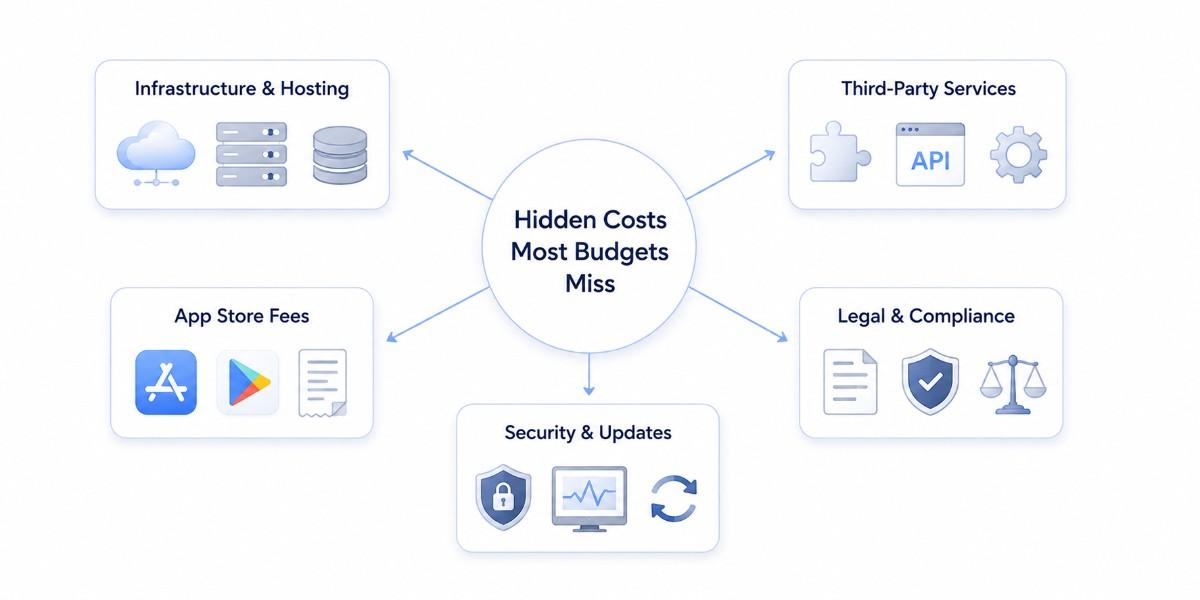
Development cost is the line item that gets quoted. These are the lines that get missed.
Infrastructure and Cloud Hosting
Every app in production needs infrastructure to store data, process requests, manage authentication, and support user activity. This typically includes servers, databases, file storage, content delivery networks (CDNs), and monitoring tools.
Firebase is a popular choice for early-stage applications because its free tier can support initial usage with minimal setup, while AWS and Google Cloud offer greater flexibility for applications with more complex scaling, security, or performance requirements.
Infrastructure costs rarely grow in a linear way. A new feature that increases file uploads, video usage, search activity, or API requests can shift hosting requirements significantly. The budget required to support 1,000 active users is often dramatically different from the budget required to support 100,000 users, even when the application itself remains unchanged.
Third-Party Service Fees
Most apps depend on external services: Stripe or Razorpay for payments (1.4–2.9% per transaction), Twilio for SMS (around $0.0075 per message in the US), Google Maps API (pricing based on API calls), or push notification services. Individually, these fees are small. Cumulatively, they can represent a meaningful operating cost by the time your app has real usage. Map these costs before launch, not after.
Many businesses model development costs carefully but fail to model usage costs. Features such as OTP verification, transaction processing, AI integrations, geolocation tracking, and communication services create recurring expenses that scale directly with customer activity. As user adoption grows, third-party fees frequently become one of the highest ongoing operational costs.
App Store Fees and Revenue Share
The Apple Developer Program costs $99/year. Google Play charges a one-time $25 registration fee. Both platforms take a 15–30% commission on in-app purchases and subscriptions: 15% for developers earning under $1 million annually through Apple's Small Business Program, rising to 30% above that threshold. Google applies 15% on the first $1 million in annual earnings, then 30% beyond.
For subscription-based products, platform commissions can have a significant impact on margins. Businesses should evaluate these fees early when defining pricing strategies, particularly for products where recurring revenue forms a major part of the business model. A successful app can generate substantial revenue, but platform fees scale alongside that success.
Legal and Compliance Costs
Privacy policy drafting, terms of service, and GDPR-compliant data handling documentation typically cost $500–$3,000 in legal review. Apps in regulated industries (health, finance) will need more extensive legal counsel. This is not optional; App Store submission requires a privacy policy, and operating without proper data handling documentation creates regulatory exposure.
Compliance requirements extend beyond launch documentation. Businesses collecting customer data, processing payments, storing medical information, or operating across multiple regions may need periodic policy updates, compliance reviews, and legal assessments as regulations evolve. These costs should be treated as part of the product lifecycle rather than a one-time launch expense.
Security and Compliance Updates
Security is not a one-time consideration. OS updates introduce new APIs and deprecate old ones. Third-party libraries need patching. Regulatory requirements evolve. Budget for recurring security maintenance separately from bug fixes. The cost of a post-launch security incident, in engineering time, user trust, and potential regulatory fines, far exceeds the cost of proactive maintenance.
Security-related work also includes access reviews, vulnerability assessments, dependency updates, authentication improvements, and infrastructure hardening. These activities rarely introduce visible new features, yet they are essential for maintaining application reliability and protecting user data as the product grows.
Marketing and User Acquisition
An app with no users has no value. This is consistently the most underbudgeted line item in app projects. Plan for at minimum $5,000–$20,000 in launch-phase marketing and ongoing user acquisition costs if your business model depends on scale. This sits outside the development budget but belongs in the same planning conversation.
The launch budget is only the starting point. Paid acquisition, content marketing, app store optimisation, referral programmes, influencer partnerships, and retention campaigns all require ongoing investment. Products with strong growth targets frequently spend more on acquiring users over time than they spent building the initial application itself.
Mobile App Maintenance Cost After Launch
Apps that stop being maintained stop being used. Operating system updates, library deprecations, user feedback, and performance issues require ongoing engineering investment.
Annual maintenance typically costs 15–25% of the original build cost. On a $60,000 app, budget $9,000–$15,000 per year for maintenance. On a $150,000 app, that is $22,500–$37,500 annually. Where you land in the range depends on how frequently the app is updated, how many third-party integrations require attention, and how rapidly your user base grows.
Monthly maintenance cost breakdown
For a typical mid-complexity app post-launch:
What maintenance actually includes
OS updates from Apple and Android happen annually, and each release can break existing functionality, particularly around permissions, notifications, and camera access. Third-party APIs change their contracts, deprecate features, and alter pricing structures. Performance degrades as usage patterns evolve. Each of these requires engineering attention, and none of them is discretionary.
What affects if you skip maintenance
Apps that miss iOS and Android major OS updates can be delisted from the App Store if they fall too far behind minimum SDK requirements. Security vulnerabilities in unmaintained apps are exploited more frequently than most non-technical stakeholders expect. Negative reviews citing crashes or outdated functionality compound over time and suppress organic downloads. The cost of neglect is not zero; it is paid later and at a higher rate.
How to Estimate Your App Development Cost
Estimating app development cost is ultimately an exercise in reducing uncertainty. The more clearly you understand the product, its users, its technical requirements, and its business goals, the more accurate the estimate becomes.
Reliable budgets are rarely created from broad industry averages alone. They come from understanding what needs to be built, how it will be built, and what level of quality is required.
Start with the Business Outcome
Before estimating features, define the outcome the application is intended to achieve. An app designed to validate a startup idea requires a different investment than one expected to support thousands of daily users from launch. The desired outcome influences every subsequent decision, including feature scope, platform strategy, infrastructure requirements, and launch timelines.
Projects with clearly defined objectives tend to produce more accurate estimates because technical decisions can be evaluated against specific business goals rather than assumptions.
Feature-Based Estimation
Feature-based estimation remains the most reliable forecasting method because it measures actual functionality rather than visual complexity.
A login screen may appear simple, but the underlying feature can involve authentication, password recovery, account verification, session management, permissions, and security controls. Estimating features individually exposes the true effort behind the product and helps identify the components that drive costs.
This approach also makes prioritisation easier because features can be categorised as essential, desirable, or future enhancements.
Time and Rate Estimation
The simplest estimation formula is:
Development Hours × Hourly Rate = Project Cost
For example, a project requiring 1,500 development hours at a blended agency rate of $50 per hour would result in an estimated cost of approximately $75,000.
This method works well when requirements are already defined and the development team has experience delivering similar projects. It becomes less reliable during the early planning stages because assumptions about complexity, integrations, user flows, and testing effort can significantly affect the final hour count.
The challenge is rarely the hourly rate. It is the accuracy of the time estimate behind it. Two agencies may quote similar rates but arrive at very different budgets because they interpret the scope differently.
MVP-First Estimation
For startups and new product initiatives, an MVP-first approach is often the most practical way to estimate costs. Rather than funding every planned feature upfront, businesses focus on building the minimum version required to validate demand, gather user feedback, and test market assumptions.
Most MVPs fall within a budget range of approximately $15,000 to $50,000, depending on functionality and technical requirements.
The advantage of this approach is that future investment decisions are based on real usage data rather than assumptions. Features that users value can be expanded in later phases, while lower-priority functionality can be delayed or removed entirely.
Account for Requirements Beyond Development
Many budget overruns occur because businesses estimate the application but overlook the surrounding requirements.
Infrastructure, quality assurance, security reviews, app store preparation, third-party services, compliance requirements, analytics, monitoring, and post-launch support all contribute to the total cost of ownership. A realistic estimate evaluates the complete delivery lifecycle rather than development alone.
Projects that ignore these costs often appear affordable during planning but become significantly more expensive after launch.
What to Include in Your RFP
The accuracy of a development quote depends heavily on the information provided to potential vendors. A strong Request for Proposal should explain the business goals, target users, core functionality, platform requirements, integration needs, expected timelines, compliance considerations, and long-term product objectives.
It should also identify any known technical constraints and clarify whether the project is an MVP, a replacement for an existing system, or a completely new product. Detailed requirements reduce assumptions, improve estimate accuracy, and make vendor comparisons more meaningful.
Comparing Multiple Estimates
Receiving multiple proposals often creates more confusion than clarity because no two agencies estimate projects in the same way.
Instead of comparing total price alone, evaluate how each estimate allocates effort across planning, design, development, testing, deployment, and support. Significant differences in scope assumptions frequently explain large pricing gaps.
The most useful proposal is not necessarily the cheapest one. It is the one that most clearly explains what is included, what is excluded, and how the estimate was constructed.
Evaluating Development Quotes
Certain warning signs appear repeatedly in projects that experience budget overruns or delivery issues. Quotes that seem dramatically cheaper than competing proposals, omit testing activities, provide vague scope descriptions, or promise unusually short timelines deserve additional scrutiny.
Similarly, proposals that do not explain assumptions, change management processes, or post-launch responsibilities often create misunderstandings later in the project.
A reliable estimate should provide enough detail that another experienced team could understand how the budget was calculated.
When Estimate Becomes Reliable
The most accurate estimates emerge after discovery and technical planning have been completed. At that stage, user flows, integrations, architecture decisions, and feature requirements are sufficiently defined to reduce uncertainty.
Early estimates are useful for budgeting discussions, but they should be treated as directional ranges rather than fixed commitments. Confidence increases as requirements become clearer and technical decisions move from assumptions to documented specifications.
How to Reduce Cost Without Cutting Quality
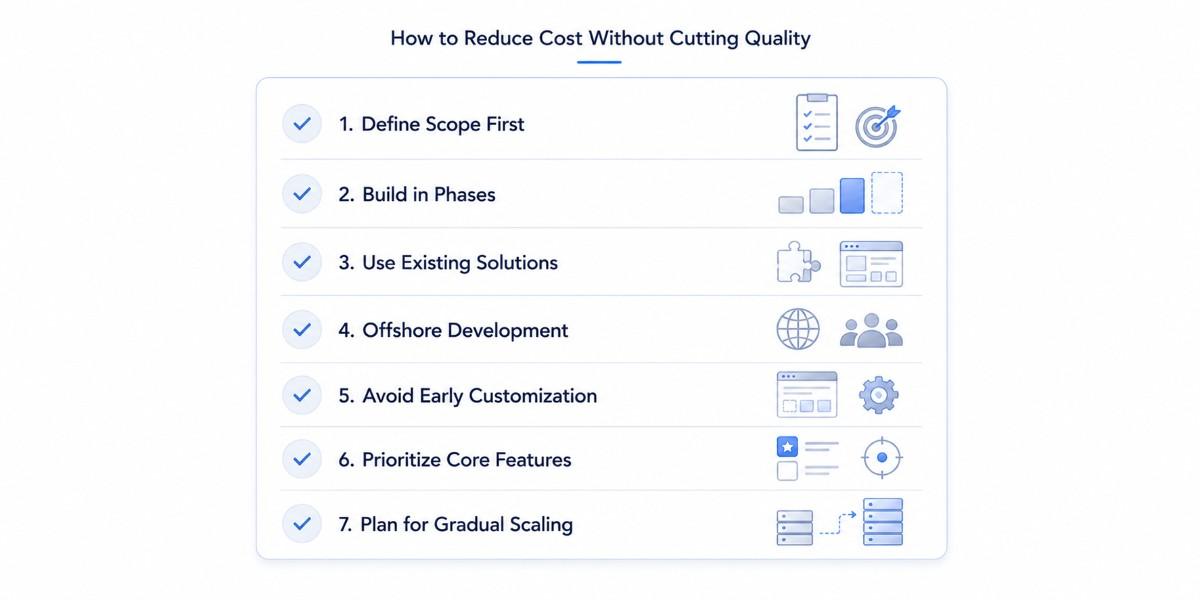
The goal is not to spend less, it is to spend correctly. The most successful projects are not necessarily the ones with the largest budgets, but the ones that allocate resources to the areas that create the greatest business value. These approaches consistently improve efficiency without compromising product quality, reliability, or user experience.
Define Scope Before Procurement
Undefined requirements are the single most reliable source of cost overruns. Every week spent refining a specification before development begins saves multiple weeks of rework inside the build. If a scope definition session costs $5,000, it routinely saves $20,000–$50,000 in downstream changes.
A well-defined scope also improves estimate accuracy and vendor comparisons. When requirements are documented clearly, agencies spend less time making assumptions and more time pricing actual work. This reduces the likelihood of change requests, budget revisions, and delivery delays once development is underway.
Build in Phases
Release a working v1, learn from real usage, then build v2 with better information. This approach is not just about reducing initial cost; it is about avoiding the very common outcome of building features nobody uses. A $40,000 first phase that teaches you what users actually want is worth more than a $150,000 big-bang launch that guesses.
Phased development also improves capital allocation. Instead of committing the entire budget upfront, investment decisions can be tied to measurable outcomes such as user adoption, retention, revenue generation, or operational improvements. Each phase becomes an opportunity to validate assumptions before additional resources are committed.
Use Existing Solutions
Stripe, Razorpay, Twilio, Firebase Auth, Google Maps, and similar services exist precisely because building equivalent functionality from scratch is expensive and rarely necessary. Using them reduces development time by weeks and transfers maintenance responsibility to organisations whose entire business is keeping those services reliable.
The cost savings extend beyond the initial launch. Established platforms receive ongoing updates, security improvements, compliance support, and infrastructure investments that would otherwise fall to you. Leveraging mature services allows development teams to focus on the parts of the product that create competitive advantage rather than rebuilding common functionality.
Offshore Development
Working with a development team in India or Eastern Europe reduces labour cost by 60–80% compared to equivalent Western agencies. The trade-off is coordination overhead: you need clear specifications, agreed communication cadences, and milestone-based payments with defined acceptance criteria. Teams that invest in the process side of an offshore engagement consistently get good outcomes. Teams that treat it as a way to get cheap work done quickly often fail to do so.
Success in offshore development depends less on geography and more on delivery maturity. Structured communication, transparent reporting, documented requirements, and clearly defined ownership create predictable outcomes regardless of location. The strongest partnerships are built around process quality rather than hourly rate comparisons.
Avoid Early Customisation
Custom UI is expensive to build and test. In v1, the goal is to validate whether users engage with the product, not to deliver a fully refined visual experience. Standard UI patterns that users already understand reduce development time and lower cognitive load for new users. Reserve custom design investment for the moments where it genuinely differentiates the product experience.
Every custom component increases design effort, frontend development complexity, testing requirements, and future maintenance obligations. By relying on established design patterns during the early stages, teams can launch faster, gather user feedback sooner, and identify which areas of the experience genuinely justify additional design investment.
Prioritise Core Features
Not every feature contributes equally to business outcomes. Some features directly support acquisition, retention, revenue generation, or operational efficiency, while others provide only marginal value despite requiring significant development effort.
Prioritising the features that deliver the greatest business impact helps control costs without reducing product effectiveness. Features that do not materially improve user outcomes can be scheduled for future releases once the core product has demonstrated traction and value.
Plan for Gradual Scaling
Many projects spend money preparing for traffic volumes they may never reach. Building infrastructure capable of supporting millions of users from day one increases complexity, development effort, and operational costs unnecessarily.
A more efficient approach is to design systems that can scale progressively as demand grows. This reduces upfront investment while preserving the flexibility needed to support future growth. The result is a product architecture that remains practical for current requirements without limiting long-term expansion.
How Code B can Help you with Cost Estimations
Getting an accurate cost estimate for your app is only useful if the person giving it has actually built what you are describing. At Code B, we have shipped mobile and web products across fintech, healthcare, logistics, and e-commerce, which means when we scope a project, we are drawing on real delivery experience, not a pricing template.
We work with you from the first conversation through to launch and beyond. That includes defining what to build and what to defer, choosing the right platform and technology stack for your specific situation, realistically scoping integrations, and structuring the build in phases that protect your budget.
We also advise on where off-the-shelf services save you significant development cost and where custom builds are genuinely worth it; that kind of guidance changes the final number more than most clients expect going in.
Our clients range from founders validating their first product on a defined MVP budget to product teams inside established businesses rebuilding systems that have outgrown their original architecture. What they have in common is that they needed a technical partner who could think through the problem with them, not just execute a brief.
If you are trying to understand what your app should cost, what a realistic timeline looks like, or how to structure the build, fill in the form below. One of our founders will get back to you directly within one business day.
FAQs

 WhatsApp
 Call Us
 Mail Us